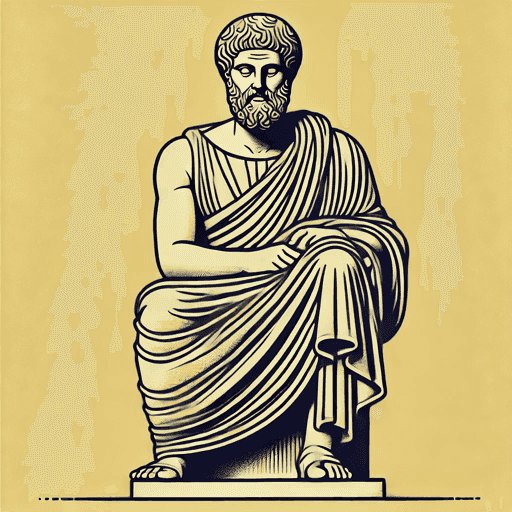
Discourses and Selected Writings
69 pages • 2-hour read
EpictetusDiscourses and Selected Writings
A modern alternative to SparkNotes and CliffsNotes, SuperSummary offers high-quality Study Guides with detailed chapter summaries and analysis of major themes, characters, and more.
Key Figures
Epictetus
Epictetus was born into enslavement sometime around 50 CE in the Greek city of Hierapolis in modern-day Turkey. At an early point in his life he was brought to Rome enslaved to Epaphroditus, an imperial secretary to Nero who was himself a freedman (a formerly enslaved person who had been freed). Drawn to philosophy, he took lessons under a Roman Stoic philosopher, Musonius Rufus (c. 25-101).
At some point, Epictetus was freed or was able to purchase his own freedom and began teaching Stoic philosophy in Rome. Epictetus was said to have walked with a limp, although sources vary as to the reason for his disability, claiming it was either due to an injury from abuse he suffered while enslaved or because of arthritis. He also adopted the child of a friend whom he raised with the help of a woman whose name has been lost, although it is unknown if the woman was simply an acquaintance or his wife or lover.
In 89, for reasons that are not entirely clear, the emperor Domitian banished all philosophers from Italy. Epictetus then relocated to the city of Nicopolis in northwest Greece. There, he established a successful school of philosophy where he would teach until his death around 135 CE. It was the lectures he gave at this school that would form the basis for the Discourses, which were written and compiled by Arrian, who was one of his students at Nicopolis. As far as is known, Epictetus never wrote anything himself. The only other work that might have been based on his words is the Enchiridion, which was also written by Arrian.
Arrian
The actual author and editor of the Discourses and the Enchiridion, Arrian was a student of Epictetus at Nicopolis. He was born to Greek parents in 86 or 89 CE in the city of Nicomedia (modern-day İzmit, Turkey). A prominent figure in the Roman imperial court, Arrian served as a magistrate, governor, and general under the Roman Empire and obtained the rank of Senator of Rome. It is unknown when he died, although it is speculated it was sometime between 146 and 160 CE.
A prolific writer, there are other surviving works by Arrian besides his writings involving Epictetus. He also wrote Periplus of the Euxine Sea, a guide to sites around the shore of the Black Sea, and Indica, a history of Alexander the Great’s military campaign in India. His most famous surviving work, however, is the Anabasis of Alexander, a history of the military campaigns of Alexander the Great.
Agrippinus
A philosopher praised by Epictetus, Agrippinus was a Stoic philosopher. None of his works survive and little is known about him outside the Discourses. However, he was allegedly part of a conspiracy by several prominent philosophers against Nero and was exiled from Rome.
Chrysippus
An early Greek Stoic philosopher who lived in Athens and died in 208 BCE, Chrysippus and his writings had a great influence on the development of Stoicism, although none survived into modern times except as fragments. Epictetus often praises Chrysippus, but he also criticizes his students and others for being too dependent on and concerned with Chrysippus’s writings.
Diogenes
Born to a prominent family in the city of Sinope in modern-day Turkey, Diogenes was exiled after he was caught in a scheme to debase the coinage. After that, he became a radical philosopher who founded the movement called Cynicism. Diogenes lived a life of self-sufficiency and begging, renouncing all property and material possessions as well as any legal ties to a specific place, declaring that he was a “citizen of the world.” Epictetus holds him up as a figure of admiration, although he also advises his students not to try to imitate Diogenes by becoming a Cynic.
Epicurus
Epicurus was a Greek philosopher who lived in Athens from 341 to 270 BCE. He founded the philosophical school named after him, Epicureanism, which taught that the gods existed but were not involved with human affairs and that happiness is best achieved through intellectual pursuits and the enjoyment of moderate pleasures. Epictetus denounced Epicureanism as a destructive philosophy.
Socrates
Held up by Epictetus as a moral model, Socrates was a philosopher in the Greek city of Athens who was born sometime around 470 BCE. He left behind no writings, but his student Plato is believed to have preserved his teachings in the form of dialogues presenting conversations and debates between Socrates and other prominent Athenians, the most well-known of which is the Republic.
Socrates was known for his focus on ethical issues and his style of rhetoric, today known as “the Socratic method,” in which topics are discussed by asking and answering a series of questions. In 399, the democratic government of Athens executed him by having him drink hemlock, a poison, on charges of impiety and corrupting the youth. Even though his students tried to free him before his execution, Socrates famously refused to escape and chose to accept his death.

Unlock analysis of every key figure
Get a detailed breakdown of each key figure’s role and motivations.
- Explore in-depth profiles for every key figure
- Trace key figures’ turning points and relationships
- Connect important figures to a book’s themes and key ideas