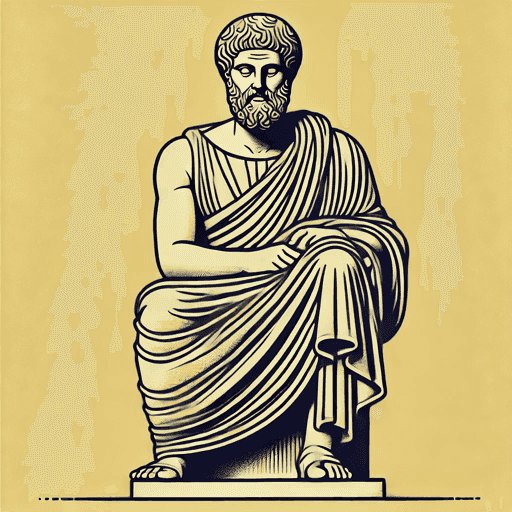
Discourses and Selected Writings
69 pages • 2-hour read
EpictetusDiscourses and Selected Writings
A modern alternative to SparkNotes and CliffsNotes, SuperSummary offers high-quality Study Guides with detailed chapter summaries and analysis of major themes, characters, and more.
Part 3Chapter Summaries & Analyses
Part 3: “Enchiridion”
Part 3, Chapter 1 Summary
People are “responsible” for their “impulse […] desire, aversion and […] mental faculties in general,” but they are not responsible for their “body, material possessions […] reputation, status—in a word, anything not in our power to control” (221). When people confuse what they are not responsible for with what they are responsible for, or what belongs to them and what does not, it leads to fear and despair. On the other hand, if there is no such confusion, then that person has freedom and “will never blame or criticize anyone” (221).
Epictetus recommends that, when one receives a strong impression, they should recognize that there is a difference between the impression and its cause. Next, they should consider if the impression is something they can control. If it is not, then they must not bother with it.
Part 3, Chapter 2 Summary
People should reserve their “aversion” (222) not to everything they would prefer to not experience, but only toward what is under people’s control and is not a part of the average human experience. Having “resentment” toward “illness, death or poverty” will only cause “disappointment” (222), as will having desire for anything outside their control or what is bad for them.
Part 3, Chapter 3 Summary
Epictetus advises the reader to start reminding themselves of the value of small objects that are important to them. Then they should move on to more significant things and people they love. For example, they should remind themselves that their wife or children will die.
Part 3, Chapter 4 Summary
Epictetus suggests that the reader always “mentally rehearse” (223) their actions before they do them, even if it is something as simple as going to bathe. This is a way to prepare oneself if something happens to ruin the plan of action.
Part 3, Chapter 5 Summary
Death itself is not “frightening,” only “the judgment that death is threatening” (223). It is similar to judgements based on anger or sadness, which should be held “accountable” (223) instead of the actions of other people.
Part 3, Chapter 6 Summary
There is nothing wrong with having pride, but Epictetus advises against pride in anything that does not belong to you. For example, there is taking pride in the beauty of a horse you own rather than your own attributes.
Part 3, Chapter 7 Summary
Epictetus compares death to being a sailor on a ship that stops on land. You are free to do what you like while the ship is stopped, but when the ship is ready to go and the ship’s captain summons you, then you must leave.
Part 3, Chapter 8 Summary
Epictetus describes the “path to peace” (224) as accepting what happens, instead of wishing for something to happen.
Part 3, Chapter 9 Summary
Illness and disability are a “problem for the body, not the mind” (224). Epictetus suggests that people remind themselves of this when their body fails them.
Part 3, Chapter 10 Summary
Each person has the ability within themselves to resist or endure impressions like temptation, suffering, or feeling insulted. If one continues to practice resisting impressions, then it becomes easier over time.
Part 3, Chapter 11 Summary
If a loved one dies, Epictetus advises that people say, “I returned it,” instead of “I have lost something” (225). This serves as a reminder that everything you have is on loan from God so you do not think things you lose are stolen from you.
Part 3, Chapter 12 Summary
Epictetus asserts that being poor and without fear is better than being rich and full of anxiety. He gives the example of a disobedient enslaved person. Even if the enslaved person ignores you, it is not worth being upset.
Part 3, Chapter 13 Summary
Epictetus advises that anyone who wants to be seen as wise or respectable, “don’t altogether believe it” (226). This is because it is difficult “to keep your will in agreement with nature, as well as externals” (226).
Part 3, Chapter 14 Summary
There is no point in desiring things that are outside your control, such as that your loved ones never die or that your enslaved persons are always honest. Avoid desiring or hating anything, since you surrender your freedom to the person who controls what you desire or hate.
Part 3, Chapter 15 Summary
Epictetus advises readers to always act “politely” (217) as if at a banquet. By practicing this, eventually they will be able to “decline these goods even when they are on offer” (217).
Part 3, Chapter 16 Summary
When seeing someone crying, you should realize that they are not upset by what happened to them, but the impression they have of what happened to them. Still, you should show them sympathy, but not to the point that you “commiserate with your whole heart and soul” (227).
Part 3, Chapter 17 Summary
Epictetus urges the reader to think of themselves as “an actor in a play” (227). God assigns you a role and determines the length of the play without any input from you.
Part 3, Chapter 18 Summary
Epictetus tells the reader to ignore bad omens like the cries of a raven. Omens are meaningless because it is possible to derive some good from any circumstance.
Part 3, Chapter 19 Summary
One can always avoid “defeat” (228) by not participating in competitions outside one’s control. At the same time, never assume that someone who seems to have more social or economic privilege than you is “happy” (228).
Part 3, Chapter 20 Summary
If someone hurts you, “you must believe that you are being harmed” (229). Epictetus advises one to try to respond thoughtfully to any impression, no matter the circumstance.
Part 3, Chapter 21 Summary
Epictetus advises the reader to always remember that bad circumstances can arise at any time. If so, it will help you resist irrational desires and thoughts.
Part 3, Chapter 22 Summary
Anyone who truly embraces philosophy will eventually become admired, but first they have to tolerate being mocked. Further, a philosopher should avoid being “pretentious” (229).
Part 3, Chapter 23 Summary
It is impossible to seek external approval without having “compromised your integrity” (229). The only approval a philosopher should seek is their own.
Part 3, Chapter 24 Summary
Epictetus assures people that they should not be troubled by the thought they might be “a nobody in complete obscurity” (230). It is not something to worry about because it is not entirely in your control and you “only have to be somebody in the areas you control—the areas, that is, where you have the ability to shine” (230).
Instead of worrying about how your lack of success means you will not be able to help your friends or community, you should realize that they can look to themselves. It would be enough to help others by developing a good and honest character and being prepared to fill any role your talents will allow.
Part 3, Chapter 25 Summary
If you do not receive an honor like being invited to a party, do not be upset. Epictetus compares such a situation to not paying for a head of lettuce. You do not have the lettuce, but you still have the money you would have spent. Similarly, by not going to the party, you did not pay the price of having to praise the party’s host.
Part 3, Chapter 26 Summary
Epictetus urges people to treat our own losses the same way we would someone else’s. If a friend’s loved one dies, people normally react by saying, “‘Well, that’s part of life’” (232). Epictetus believes that anyone should have the same reaction when faced with loss, even if it is their own possession or loved one.
Part 3, Chapter 27 Summary
Epictetus argues that evil “is no natural part of the world’s design” (232). Comparing the world to a target designed to be shot with arrows, he suggests instead that the world was clearly designed for the good.
Part 3, Chapter 28 Summary
Epictetus notes that anyone would be upset if someone else managed to take their body. Nevertheless, he says, people routinely let other people’s opinions upset their mind.
Part 3, Chapter 29 Summary
In regards to planning for a project, Epictetus advises readers to plan out every step before beginning. This is so that you do not give up easily when facing problems. He remarks that this often happens to people who decide to become philosophers, not knowing that they suffer social stigma and hardship.
Part 3, Chapter 30 Summary
“Duties are broadly defined by social roles,” Epictetus writes. For example, one has duties dictated by nature to one’s father, even if he is a bad one. The same holds true for anyone who is a “neighbor, citizen and general” (234).
Part 3, Chapter 31 Summary
The “chief duty” (234) humans owe to the gods is believing that they exist, intervene in the world, and created humanity to “obey them and welcome whatever happens” (235). If you accept this, you would never blame the gods for your misfortunes.
Naturally, living beings move toward what they consider good while moving away from what they consider bad. This even results in people turning against someone who has good intentions toward them, but their actions and motives are perceived as malicious. Epictetus sees this also in how people who experience misfortune “curse the gods” (235).
Epictetus adds by suggesting it is “never wrong” (235) to perform the traditional rites for the gods. It only becomes problematic when the rites are performed carelessly.
Part 3, Chapter 32 Summary
On the subject of divination, Epictetus warns readers to remember that “the future […] is indifferent, and nothing to you” (236). Epictetus does not oppose consulting fortune tellers, but he is against consulting them in order to solve a problem that could be fixed through reason.
Part 3, Chapter 33 Summary
Epictetus provides general advice. First, he encourages you to decide who you want to be and stay true to it, even when “alone” (236). Next, he says one should speak as little as possible, avoid small talk, and “do not laugh too often or too loud” (237). Never take an oath unless you must. Avoid the company of non-philosophers.
He also recommends avoiding all luxury, owning only what is necessary. Be celibate until marriage, but do not be boastful about your morality. Whenever someone spreads bad rumors about you, Epictetus recommends responding with, “Yes, and he doesn’t know the half of it, because he could have said more’” (237). If you attend a game, do not hope for one team or participant to win and never jeer or yell. If attending someone’s lecture, “remain serious and reserved” (237).
Finally, Epictetus provides advice on how to hold conversations. Think of how the philosophers Socrates or Zeno would act before meeting someone, especially someone with influence, and expect the worst before the meeting. During a conversation, do not focus on yourself and do not try “to be funny” (238) or use profanity.
Part 3, Chapter 34 Summary
Epictetus cautions the reader to be mindful even when receiving pleasure and to weigh whether or not the pleasure will outweigh the good that will come from abstaining.
Part 3, Chapter 35 Summary
Of course, Epictetus does not believe anyone should do anything wrong. However, if they want to do something good, but most people around them disapprove, they should do it without worrying about the opinions of the majority.
Part 3, Chapter 36 Summary
Epictetus tells the reader to avoid taking “the largest portion of a dish” (239) during a banquet. The reason is that a guest should think of themselves not as an individual, but as part of the community that is at the banquet.
Part 3, Chapter 37 Summary
Never take on “a role beyond your means” (239), Epictetus says. This is not only to avoid embarrassment, but also because you may miss an opportunity you are better suited for.
Part 3, Chapter 38 Summary
Epictetus recommends that the reader should be as careful with their character as they are when they try to avoid stepping on something sharp when walking.
Part 3, Chapter 39 Summary
Anyone’s “body defines the limit of his material needs” (239). Epictetus warns that exceeding this limit could lead to disaster.
Part 3, Chapter 40 Summary
Epictetus notes that typically girls are called “ladies” after the age of 14. While after that age girls focus on “their potential as sexual partners” (240) by concentrating on their appearance, Epictetus remarks that they have to understand they can only be called “ladies” if “they cultivate modesty and self-respect” (240).
Part 3, Chapter 41 Summary
Spending too much on the body, whether it is exercising or eating, “shows a lack of refinement” (240). Instead, people should focus more on the mind.
Part 3, Chapter 42 Summary
If you feel insulted by someone, “remember that they are only doing or saying what they think is right” (240). Further, if they are motivated by misguided thoughts, then that wrongness will harm them. For these reasons, even people who wrong you should be treated with “compassion” (240).
Part 3, Chapter 43 Summary
When you feel wronged by your brother, Epictetus advises that one should not focus on the wrong that was done. Instead, endure the wrong by reminding yourself of your relationship with your brother.
Part 3, Chapter 44 Summary
Part 3, Chapter 45 Summary
Instead of saying that someone does something badly, instead say they do something “in haste” (241). This should be done because one does not know anyone’s motives for doing anything the way they do.
Part 3, Chapter 46 Summary
If you are a philosopher, you should never explain your principles even if asked, but instead constantly act upon them.
Part 3, Chapter 47 Summary
According to Epictetus, never brag about “simple living” (242). You should try to live modestly “for yourself, not for outsiders” (242).
Part 3, Chapter 48 Summary
A philosopher should only expect true “help or harm” (242) from themselves, never from other people. Anyone who “never criticizes, praises, blames or points the finger” (242), never displays pride at compliments, and never answers insults shows that they have improved their character.
Part 3, Chapter 49 Summary
Epictetus claims that being able to “understand and comment on Chrysippus’ books” (243) is not worth being proud over. Instead, Epictetus only seeks to follow nature. Whenever anyone asks Epictetus to interpret Chrysippus, “I only feel shame that my actions don’t meet or measure up to what he says” (243).
Part 3, Chapter 50 Summary
Always stand by your goals, Epictetus advises, regardless of other people’s opinions.
Part 3, Chapter 51 Summary
Part 3, Chapter 52 Summary
Applied philosophy can be broken down into several stages. The first stage is applying basic moral principles to one’s own behavior, like always telling the truth. Then comes developing logical proofs to justify one’s actions, in this case explaining why lies are wrong. Next, one “supports and articulates the proof” (244) by, for example, examining the meaning of the words “truth” and “lie.” Epictetus considers the first stage the “most important” (245), yet it is also the one most people fumble.
Part 3, Chapter 53 Summary
Epictetus recommends several sayings one can repeat to oneself in any situation. The first is a prayer to Zeus and Destiny, quoted from a lost play by Euripides, to lead one to “the goal I was long ago assigned” (245), even if they resist. The second is a quote from Plato, where Socrates addresses a man named Crito and discusses relenting to the will of the gods. The final saying is another quote from Plato, with Socrates naming two prosecutors against him, Anytus and Meletus, and declaring they “can kill me, but they cannot harm me” (245).
Part 3 Analysis
The Enchiridion is intended as a guidebook and introduction to Epictetus’s philosophy. As such, it is a simplified presentation that lacks the actual arguments and use of applied reasoning that one finds in the Discourses. Instead, the focus of the Enchiridion is on Philosophy as Daily Practice Rather Than Theory. For example, there is the practical advice, “In the case of particular things that delight you, or benefit you, or to which you have grown attached, remind yourself of what they are. Start with things of little value” (222) and “Don’t hope that events will turn out the way you want, welcome events in whichever way they happen: this is the path to peace” (224).
The practical advice in the Enchiridion focuses especially on maintaining The Distinction Between What We Control and Do Not Control, through two ways. One is in memorizing basic statements of principle. In modern terms, this is much like keeping in mind a proverb like, “A watched pot never boils.” One example is, “Just as a target is not set up in order to be missed, so evil is no natural part of the world’s design” (232). This contains the deeper meaning that the world was not created for evil, but for good, which expresses the meaning of Epictetus’s concept of natural law.
The second way is by writing of general situations that could be applicable to different circumstances. One case of this is this passage from the Enchiridion: “If you are ever tempted to look for outside approval, realize that you have compromised your integrity” (229). This is the type of paradigm that could be applied to a variety of situations, including one’s educational career, work life, or creative pursuits.
The structure and approach of the Enchiridion supports its purpose as a practical introduction to Epictetus’s philosophy. Since Epictetus believes that “the first and most important field of philosophy is the application of principles such as ‘Do not lie’” (244), then the Enchiridion fulfills a crucial role is explaining basic principles as well as their application.

Unlock all 69 pages of this Study Guide
Get in-depth, chapter-by-chapter summaries and analysis from our literary experts.
- Grasp challenging concepts with clear, comprehensive explanations
- Revisit key plot points and ideas without rereading the book
- Share impressive insights in classes and book clubs