Do Not Disturb
63 pages • 2-hour read
Freida McFaddenDo Not Disturb
A modern alternative to SparkNotes and CliffsNotes, SuperSummary offers high-quality Study Guides with detailed chapter summaries and analysis of major themes, characters, and more.
Symbols & Motifs
Mirrors
Content Warning: This section of the guide includes discussion of physical and emotional domestic abuse, violence, and death.
Mirrors form an important motif in the text, reflecting the theme of Appearance Versus Reality. The nature of mirrors, which show a reflection of the self, are often used in literature and film to convey a duality within a character or some secret they are keeping hidden. In Do Not Disturb, mirrors are prevalent throughout, as are the secrets, lies, and hidden truths that the characters maintain.
A mirror first appears after Quinn kills her husband. She thinks, “When I get out of the shower, my skin is bright red. I wrap a towel around my body and stare at myself in the mirror over the sink” (17). Quinn is “bright red” because she spent so long in the shower scrubbing herself, trying to get the blood off her skin from killing Derek, but also trying desperately to get rid of the vivid memories of her abuse. For Quinn, she has been living two lives: One where she projects happiness in her marriage and another where she suffers from Derek’s abuse without telling anyone. Now that he is dead, she must keep the secret of killing him.
In Rosalie’s point of view section, she begins to wonder why Nick’s mood suddenly changes. She sees him “take an extra second to check out his appearance in the bathroom mirror before he leaves for the motel” (216). The reader knows that Nick has started a relationship with Christina. This moment in the mirror emphasizes the duality of his character, as he tries to hide his affair from his wife.
Mirrors serve this purpose throughout the novel, conveying the struggle that characters undergo as they try to hide their secrets from others. They are most prevalent in Greta’s room, where Quinn notes, “the wall is lined with mirrors, so I can see myself no matter where I look” (60). This fact conveys two elements of Greta’s character. First, it is in her room that characters are forced to grapple with the other version of themselves. She does not allow Greta or Claudia to lie—even about their names—as she immediately confronts them when they attempt to do so. Second, it symbolizes the truth about Greta that is only revealed at the end of the text: She is the one who killed Christina. The mirrors in her room thus reinforce the fact that Greta, too, has always been more than she first appeared to be.
“Do Not Disturb” Sign
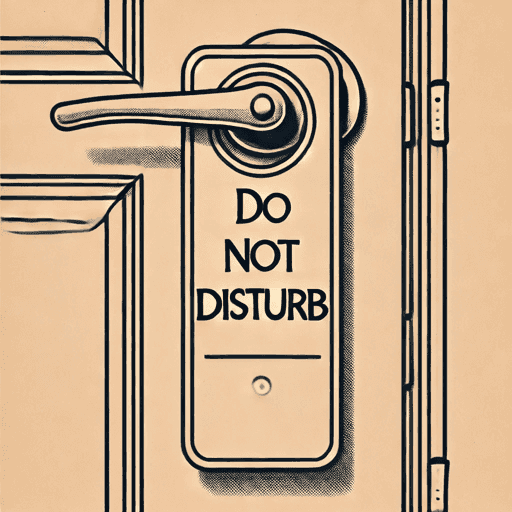
The titular “Do Not Disturb” sign symbolizes the hidden secrets that people have, emphasizing the theme of Appearance Versus Reality. The sign is present on room 201, which was where Christina was murdered. Additionally, when both Quinn and Claudia enter room 203 to stay, they turn over the “Do Not Disturb” sign on their own door. The sign indicates the need for privacy and the desire to be left alone. For Nick, that means hiding his past with Christina and keeping people out of room 201—which holds his secrets. For Quinn and Claudia, it represents their need to keep their truths about Derek to themselves.
Throughout Do Not Disturb, it is implied that Nick is guilty of killing Christina. The police suspected him, whoever went into her room had a key, and Rosalie sees Nick going to the dumpster with a garbage bag the night of her death. This implies to the reader that his “Do Not Disturb” sign—and his unwillingness to rent the room—hide the reality that he murdered her. However, in the final moments of the text, Greta reveals that she is the one who killed Christina. As she does so, she gives the “Do Not Disturb” sign from room 201 to Rosalie, telling her that “it’s time to open the room up again to guests. Let the past be the past” (321). This act not only absolves Nick of his crimes, but also physically and symbolically forces Rosalie and Nick to move past what happened with Christina. With the closure from Greta’s confession, the two can finally move on from the secrets they have been hiding surrounding Christina’s death.
Fortune and Destiny
The ideas of fortune and destiny are recurring motifs throughout Do Not Disturb. They first appear with the character of Greta, who insists that she has “the gift” of telling the future. When she discusses the idea with Quinn, she explains that “in some cases, people may alter their destinies […] But it is rare. Most people simply allow it to happen” (98-99). Greta emphasizes the inevitability of fate, conveying to Quinn the idea that destiny is powerful and can rarely be changed.
Similarly, Rosalie recounts her experiences with a fortune teller before she and Nick were married. The woman reads her fortune using tarot cards, then warns her to call off her engagement, telling her that she will have a “revelation” and that “Nick will bring the death of another” (193). This encounter impacts Rosalie for years afterward. When she gets diagnosed with multiple sclerosis, she assumes that it is what the psychic was referring to. Then, when Christina dies, Rosalie assumes that Nick killed her, thinking “That psychic at the carnival was right. My husband is a murderer. And it’s all because of me” (244).
These moments in the text emphasize the role that destiny plays in people’s lives. It gives the impression that the characters’ paths are inevitable, with the darkness, death, and danger that is projected for them becoming an inescapable part of their futures.
However, this idea is turned on its head in the final moments of the text. When Greta tells Rosalie that she is the one that killed Christina, she also informs her that she invented Quinn and Christina’s fortunes to scare them away. She explains that she “had to help it along” (319), wanting to protect Nick and Rosalie’s marriage. With this final revelation, McFadden emphasizes the importance of personal choice in the paths people take in life. Rather than the characters’ lives being predetermined—and able to be foretold by a psychic—much more important are the choices people make.

Unlock the meaning behind every key symbol & motif
See how recurring imagery, objects, and ideas shape the narrative.
- Explore how the author builds meaning through symbolism
- Understand what symbols & motifs represent in the text
- Connect recurring ideas to themes, characters, and events