Doughnut Economics: Seven Ways to Think Like a 21st-Century Economist
51 pages • 1-hour read
Kate RaworthDoughnut Economics: Seven Ways to Think Like a 21st-Century Economist
A modern alternative to SparkNotes and CliffsNotes, SuperSummary offers high-quality Study Guides with detailed chapter summaries and analysis of major themes, characters, and more.
Index of Terms
Gross Domestic Product (GDP)
A major theme in Doughnut Economics is Rethinking Progress Beyond GDP, an argument based in Raworth’s belief that economic models focused solely on GDP inherently fail to meet humanity’s and the environment’s needs. GDP describes the total monetary value of all goods and services produced within a country's borders over a specific period of time. It specifically refers to goods and services provided or made within a specific country, and it only considers finished products (a piece of furniture, but not the wood used to make it). It includes household spending, business spending on capital goods (or assets used to produce other, finished goods), government purchases, and the value of exports minus the imports accepted within that time period. For many governments, the GDP is a crucial signal of the health of the economy; however, Raworth argues that it is only one factor in a broader depiction of a nation’s or economy’s well-being.
Distributive by Design
“Distributive by design” is an economic approach that embeds the widespread sharing of income and opportunity into the core structure of the economy (25). This principle challenges the 20th-century belief that rising inequality is a necessary phase of development that will eventually be corrected by economic growth. As Kate Raworth argues, “Don’t wait for economic growth to reduce inequality—because it won’t. Instead, create an economy that is distributive by design” (148). Rather than relying solely on redistributing income after it has been earned, this approach focuses on pre-distributing wealth by transforming the ownership of its key sources. These sources include land, the power to create money, enterprise, technology, and knowledge. The structural ideal for this design is a distributed network, which balances efficiency with resilience by fostering a diverse ecosystem of small-, medium-, and large-scale enterprises. This prevents the concentration of economic power and promotes a more equitable circulation of value.
The Doughnut
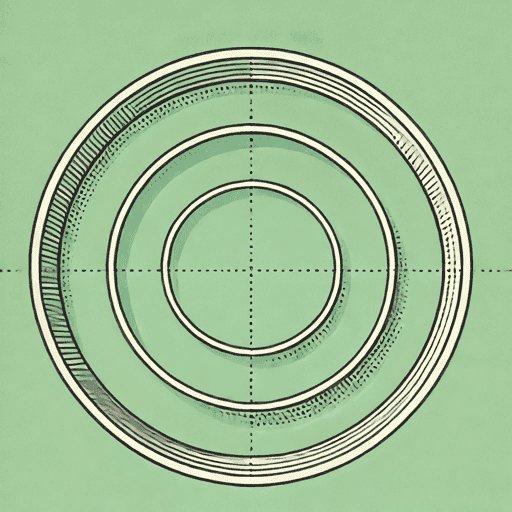
The Doughnut is the central framework of Doughnut Economics, offering a new goal for economic activity. It consists of two concentric rings that define a safe and just space for humanity, bounded by a social foundation of human rights and an ecological ceiling of planetary boundaries. Its fundamental purpose is to reorient economics away from the pursuit of GDP growth and toward the goal of meeting the needs of all people within the means of the living planet. As Raworth writes, “Between those two rings is the Doughnut itself, the space in which we can meet the needs of all within the means of the planet” (9). This visual model serves as a compass for 21st-century prosperity, reframing the idea of progress from one of endless upward growth to one of thriving in dynamic balance.
The framework’s influence extends beyond theory into policy and practice. The image was reportedly used by negotiators during the creation of the UN Sustainable Development Goals as a reminder of the interconnected social and ecological objectives they were aiming for. The concept has continued to gain traction through the Doughnut Economics Action Lab (DEAL), an organization co-founded by Raworth to support cities, communities, and businesses in applying the model to real-world challenges. This demonstrates its practical potential for guiding transformative action.
Embedded Economy
The Embedded Economy is a redrawn map of the macroeconomy that corrects what Raworth presents as the narrow and misleading focus of the traditional Circular Flow diagram. This new picture illustrates how the economy is not a self-contained market system. Instead, Raworth’s diagram “nests the economy within society and within the living world” (62), making visible the essential roles played by four key realms of provisioning: the household, the market, the commons, and the state. By including often-overlooked actors, the model highlights households’ unpaid domestic labor and the collaborative value creation of the commons. Furthermore, it explicitly shows the economy’s reliance on a continual flow of energy and materials from the Earth and its generation of waste and pollution, realities that are absent from conventional models. This holistic perspective underscores the necessity of wisely embedding markets within social rules, cultural norms, and non-negotiable planetary boundaries.
Planetary Boundaries (Ecological Ceiling)
The ecological ceiling forms the outer ring of the Doughnut and is defined by nine planetary boundaries. These boundaries represent critical Earth-system processes, such as climate stability and freshwater cycles, which together maintain the temperate and stable conditions that have allowed human civilization to flourish. They act as non-negotiable environmental limits, or guardrails, to prevent human activity from pushing the planet into a dangerous and unpredictable state. As Raworth describes it, “the nine planetary boundaries create the best picture we have yet seen of what it will take to hang on to the home-sweet-home of the Holocene” (42). Humanity has already overshot several of these boundaries; for example, the atmospheric concentration of carbon dioxide is over 400 parts per million, far exceeding the 350-ppm boundary. Transgressing these limits increases the risk of triggering abrupt and potentially irreversible tipping points, which reinforces the urgency of creating economies that are regenerative by design.
Regenerative by Design
“Regenerative by design” is a core principle for creating an economy that works with, rather than against, the cyclical processes of the living world (25). This approach aims to replace the linear and degenerative industrial model of “take, make, use, lose” with one that is fundamentally restorative (181). Raworth explains its goal is to unleash “regenerative design in order to create a circular—not linear—economy” that runs on renewable energy and eliminates waste by turning outputs from one process into inputs for another (23). A key application of this principle is the circular economy, often depicted as a butterfly diagram with two “wings” representing biological and technical material cycles. This framework ensures that resources are continuously reused, repaired, and recycled, restoring Earth’s life-supporting systems. When applied to urbanism, it inspires the creation of “generous cities” that actively contribute to the health of the biosphere by, for example, sequestering carbon, purifying air, and restoring soil fertility.
Social Foundation
The social foundation constitutes the inner boundary of the Doughnut, establishing a baseline of human rights and well-being below which no person should fall. It “sets out the basics of life on which no one should be left falling short” and is composed of twelve dimensions (39), including food, clean water, housing, healthcare, education, energy, and political voice. These dimensions are directly aligned with the UN’s Sustainable Development Goals, which were adopted by all member states with a target date of 2030, lending the framework global legitimacy. Despite significant progress in human development, Raworth highlights that considerable shortfalls persist worldwide, with billions of people still lacking access to life’s essentials. The existence of this deprivation provides a clear moral and practical impetus for creating an economy that is distributive by design, ensuring that value and opportunity reach everyone.

Unlock all 51 pages of this Study Guide
Get in-depth, chapter-by-chapter summaries and analysis from our literary experts.
- Grasp challenging concepts with clear, comprehensive explanations
- Revisit key plot points and ideas without rereading the book
- Share impressive insights in classes and book clubs