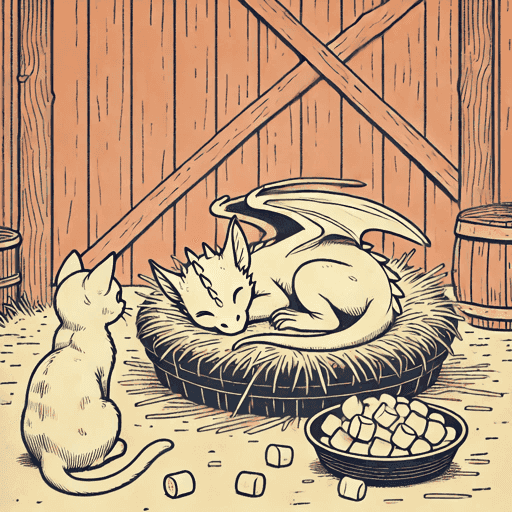
Dragons and Marshmallows
34 pages • 1-hour read
Asia Citro, Illustr. Marion LindsayDragons and Marshmallows
A modern alternative to SparkNotes and CliffsNotes, SuperSummary offers high-quality Study Guides with detailed chapter summaries and analysis of major themes, characters, and more.
Important Quotes
“Sassafras gave me a stinky look, but he gave in and followed me. As we got close to the house, I spotted my mom in the window. But she wasn’t looking at us. She was looking at our old barn. And holding a photo.”
(Chapter 1, Page 10)
This passage concludes the first chapter. The description of Zoey’s mom looking at the old barn while holding a photo foreshadows that Zoey will discover the photo of her mom with the magical frog and learn about the existence of magical creatures. Citro uses vague detail to build suspense, because the reader doesn’t yet know what the photo shows or why Zoey’s mom is looking at the barn.
“I was also curious about that photo she’d stashed away so quickly. As she packed, I poked at her papers and scootched them around. Whoa. What was that? A purple glow came from under a pile of papers. I pushed the top papers aside and gasped. In the photo was my mom when she was around my age. She was grinning with two missing teeth. With a purple frog on her head. That was glowing. I almost dropped the photo.”
(Chapter 2, Page 12)
This passage builds intrigue, as both Zoey and the reader are unsure where the purple glow is coming from. The passage introduces the importance of magical animal photos as a motif throughout the novel. Citro builds suspense as Zoey observes her mother’s age and appearance in the photo first, before adding that it also includes a glowing purple frog.
“The poor thing was crumpled on the ground, barely breathing. I knew it must be very sick or hurt. I had to help it. I carefully scooped it up and held it close. I found an old empty fish tank in our barn and got to work figuring out what was wrong. Books helped a little, but I needed to run some simple experiments, too.”
(Chapter 3, Pages 15-16)
The novel frequently engages in Comparing Science to Magic; scientific inquiry is integral to how both Zoey and her mom see and interpret the world. Although she was amazed to find such a unique frog, Zoey’s mom conducted research to find out how to help it. As well as characterizing her as empathetic and caring, the passage positions science as the best way to learn about unknown subjects.
“A big smile spread across my face. This was incredible. The only thing I might love more than science is magic. And my mom was telling me there was magic right here in our own backyard.”
(Chapter 3, Pages 19-20)
Citro shows Zoey’s amazement through her thoughts and gestures, as she “smiles,” and then describes the situation as “incredible.” The passage explicitly highlights Comparing Science to Magic. It also emphasizes the novel’s everyday setting as a potential site of magic, which the novel depicts as often being found close to home.
“Every once in a while the most beautiful tinkling sound would come from my mom’s office. She always told me it was an alarm on her phone reminding her to do something. I guess I never thought to ask what.”
(Chapter 4, Page 25)
Citro uses the auditory detail of the “beautiful tinkling” to make the description more vivid as the reader imagines what the doorbell might sound like. At the same time, the uncanny ringing is paired with the quotidian detail of a phone alarm. Again, Citro emphasizes the interconnection between the magical and the everyday.
“‘You’re going to be gone for a week. That’s a long time. If an animal rings the bell while you’re gone, do you think maybe I could help them?’ I looked down at my feet and poked the ground with my toe. ‘I mean, I know I’m just a kid. But I could try.’”
(Chapter 4, Pages 25-26)
Citro uses Zoey’s body language to show Zoey’s uncertainty in herself and the situation. She “looked down” and shuffles her foot on the ground, self-deprecatingly. Her speech pattern also shows her nervousness. She builds to her question slowly, beginning by emphasizing how long her mom will be away. The inclusion of “maybe” in the third sentence shows Zoey’s hesitation about whether her mom will allow her to care for the magical creatures.
“I set my Thinking Goggles on the barn desk and grabbed the pile of science notebooks. I spent the next few hours with Sassafras curled up in my lap as I flipped through all of them. The photos were so incredible. I flipped to a page with a creature that looked like a flower. I leaned in for a closer look, and the scent of roses filled my nose.”
(Chapter 5, Page 33)
Citro includes visual and auditory sensory detail in this image of a creature that looks “like a flower” and somehow generates “the scent of roses” from the page. Like the close connection between science and magic, this passage emphasizes a similar connection between reading and magic.
“‘Hmmm. I need to find a place to keep you that won’t catch on fire.’ I looked around the barn. ‘Let’s see…wood, fabric, and hay all burn easily. Bingo! Let’s put you in this pen with a dirt floor. If you cough again, the dirt won’t catch fire.’ Phew. Tucking the baby dragon under my arm, I quickly moved him to the pen. Sassafras hung back and watched us from outside the pen. My kitty was no longer so sure he wanted to cozy up to our new friend.”
(Chapter 6, Page 38)
Citro represents Zoey’s thought process in detail as Zoey narrates how she is setting up a space for the baby dragon. She displays caution and forward thinking when she notes materials that are flammable; resourcefully, she puts Marshmallow in the dirt-floored pen. Citro thus represents the power of working through a problem by observation and critical thinking.
“I flipped through my mom’s science journals. There weren’t any entries on dragons. I was stumped. I set the journals on the desk, which knocked my Thinking Goggles to the ground. Perfect! I dusted them off and popped them onto my head. I could feel a memory tickling my brain right away. Something that had happened last summer? Something with the forest? That was it!”
(Chapter 7, Pages 39-40)
Zoey accords her Thinking Goggles power throughout the novel. They are a symbol of the magic of science, as well as Zoey’s burgeoning trust in her abilities. Because she feels more confident when wearing them, she feels more able to draw on her previous experience to determine her next course of action. Citro uses a physical description of thought—a memory “tickling” Zoey’s brain.
“‘When animals have a lot of babies at once, sometimes there a few that aren’t as big or as strong as the rest. Some people call them runts. I’m sorry to say it, but they usually don’t survive.’ A tear rolled down my cheek. Staring down at the tiny little snake and thinking of him dying was just too sad. Mom gave my shoulder a squeeze. ‘Why don’t we give this snake a little help? We could make his first meal nice and easy. It might give him a boost. Many baby snakes like to eat worms…’”
(Chapter 7, Page 43)
This passage offers direct explanation of science concepts. It conveys STEM subject expertise as Zoey remembers her mom telling her about runts. It also characterizes Zoey as empathetic and sensitive, as she is immediately distraught at the thought of the snake dying.
“Now to make a guess. I would eat the marshmallows, but that baby snake ate the worm as if it tasted like a marshmallow. I shrugged. Maybe worms were like the reptile version of marshmallows?”
(Chapter 8, Page 47)
Zoey uses her own experience to develop her experiment. The scene thus emphasizes the Importance of the Scientific Method. Zoey exhibits her empathy by thinking about something she likes, and wondering whether other creatures experience taste differently.
“Now I needed to set up my experiment. Every time I’m experimenting, my mom always tells me the same thing. ‘Remember to only change one thing, and keep everything else in your experiment the same.’ And by every time, I really mean she says it every time.”
(Chapter 8, Page 49)
This is an example of scientific content being represented without jargon, in an understandable way for young readers. Citro explains independent variable (the one thing that is changed in an experiment) and controlled variables (the elements that remain the same) without using these potentially off-putting terms. The novel thus relates knowledge about experimental design without becoming overly technical or sacrificing characterization in Zoey’s first-person narration.
“Once he wiped off all the cereal pieces, he calmed down. Then his nostrils got really wide. He sniffed and took a few steps, then sniffed some more. He skipped all the other plates and went straight to the marshmallows. His little blue tongue shot out for a lick, and his eyes lit up. He was so excited, he let out a little hiccup. A spark landed on the marshmallow and smoked a bit before going out. The dragon immediately gobbled up the toasted marshmallow.”
(Chapter 8, Page 52)
Details of Marshmallow’s appearance and movements as he inspects the marshmallows, including the widening of his nostrils and his “little blue tongue” shooting out, allow readers to picture the unfamiliar creature. The passage also includes humor, as a dragon’s traditional fire breathing is used not to destroy but to toast a marshmallow.
“Marshmallow took a few more steps, then stumbled and fell to the ground. He didn’t get up. I fixed the temperature. I fed him the night before. What could be going on? He let out a heartbreaking whimper and half closed his eyes. On no! Was he dying? I didn’t know what to do. My heart pounded. I walked one way, then another. I needed something…I needed my mom!”
(Chapter 9, Page 64)
Short, declarative statements and questions represent Zoey’s thought process. She is distraught and confused about what went wrong. This moment is key for Zoey’s learning to balance Trusting Yourself and Asking for Help. Zoey quickly realizes that since the dragon might die, the situation is too dangerous and complex for her to handle without adult assistance.
“I ran into the house. At first I went to get my dad, but then I remembered he couldn’t help. I took a shaky breath. Then I grabbed the phone and called my mom. I tried not to cry while the phone rang. The call went to voicemail. I couldn’t hold it in anymore. Tears ran down my face. The dragon was going to die, and it was all my fault.”
(Chapter 10, Page 65)
This passage shows Zoey deciding to ask for help, but not immediately being able to obtain it. Her mom is unavailable and her dad can’t see magical creatures. Zoey’s response shows Zoey’s experience of guilt and her emotional investment in the dragon. While she initially tries to be strong, crying and the self-accusatory statement “it was all my fault” shows how much she cares.
“S’mores. Marshmallows. Too many marshmallows. Maybe that was it! My science experiment showed me what the baby dragon liked to eat, but maybe not what he should eat”
(Chapter 10, Pages 68-69)
The syntax shows Zoey’s thought process. When her dad reminds her about her stomach ache, she quickly makes inferential connections. The one word sentences and fragments echo the speed at which her brain is thinking. The passage also shows that Zoey is able to admit and learn from her mistakes, as she acknowledges that she determined what Marshmallow liked to eat, but failed to find out what he should eat.
“Your pet reptile is either a carnivore, an omnivore, or an herbivore and should be fed accordingly. If your reptile is a carnivore, offer a source of meat. Some carnivorous reptiles prefer animal meat, such as mice or fish. Other carnivorous reptiles prefer smaller sources of meat, such as earthworms or crickets.”
(Chapter 11, Pages 71-72)
This excerpt from the Care and Feeding of Reptiles book Zoey reads emphasizes the difference in word choice between this formal and academic text and the narration that reflects Zoey’s thoughts and speech. Nevertheless, even this textbook is made more approachable through the use of second person, instructing its reader to take action rather than only explaining the concept.
“I tried the same thing with each of the other foods. He gave them all one lick, but he didn’t eat any of them. I sat on the ground and put my head in my hands. I couldn’t even watch anymore.”
(Chapter 12, Page 76)
Citro uses two creatures’ body language to show, rather than tell, their responses to a confusing situation. First, Zoey observes Marshmallow’s response to the foods she’s offered; his physical behavior is the only way she can understand his preferences. He gives each a tentative lick, “but he didn’t eat any of them”— leading Zoey to conclude that he is not feeling well. In turn, Zoey reacts to the disappointment worry about Marshmallow’s worsening state by taking on a pose that shows how exhausted she feels—so emotionally low that she is literally “on the ground” unable to “watch anymore.” The illustration underscores Zoey’s despondency by portraying her in the pose described.
“My eyes flew open and I looked around. The reptile book had fallen out of my hands. Sassafras quietly snored on my chest. I must’ve fallen asleep while I was reading.”
(Chapter 13, Page 79)
Significantly, this passage occurs in the chapter following the one that features an illustration of Zoey asleep with the book. This is an example of dramatic irony through illustration because the reader finds out that Zoey has fallen asleep before she does. The image of Zoey waking up disoriented, and realizing that she “must’ve fallen asleep” thus becomes amusing for readers who have already learned what she doesn’t yet know.
“I messed everything up! There was a baby dragon and I wasn’t sure what was wrong. I fed him marshmallows, and at first he got better, but then he got so much worse. I tried to fix it by feeding him fish. But I don’t know if it worked. I don’t want him to die!”
(Chapter 13, Page 80)
Zoey is obviously upset here, as her emphatic statement—“I don’t want him to die!”—shows. However, she also methodically recounts what happened and what she observed throughout the process for her mom, demonstrating that her scientific acumen persists even through emotional crises.
“I had hoped I could handle all of this on my own. I wanted to impress my mom with a healthy dragon. Instead she was going to see a sick dragon that I hadn’t been able to help.”
(Chapter 14, Page 81)
Zoey’s pessimism ironically foreshadows the next scene’s happiness; Zoey is wrong, and Marshmallow is twice the size he was. Zoey’s focus on her mom’s potential disappointment suggests the importance of their relationship. Even though she is worried about Marshmallow for his own sake, she also doesn’t want to let her mom down, showing how important her mom’s opinion is to her.
“Just like that, the day went from awful to wonderful. I did it! Even though I made some mistakes along the way, I helped Marshmallow.”
(Chapter 14, Page 83)
Zoey acknowledges that she made mistakes, which is important both for her personal development and to the novel’s demonstration of scientific process. The scientific research requires iterating one’s work, especially after making mistakes and learning from them. She is proud of her accomplishments, and acknowledges how quickly the day changed from bad to good, which shows her resilience.
“‘Marshmallow’s getting awfully big, Zoey.’ I sucked in a big breath. I knew what she was going to say next and I didn’t want to hear it. ‘I know this part is hard. But a dragon isn’t meant to live in a barn. He’s meant to be free!’ I nodded and kept looking down. If I looked up at Marshmallow, I was sure I’d start crying. ‘I guess he’d have more fun flying around and exploring the forest,’ I mumbled. ‘And he might not even fit in the barn much longer.’ Saying good-bye was going to stink.”
(Chapter 15, Page 86)
In a bit of foreshadowing, Zoey realizes what her mom is going to say before her mom says it. She intuits that Marshmallow cannot be a pet; her upset response is reflected physiologically as she “suck[s] in a big breath” and looks down. She regulates her emotions by being aware of them. The passage shows Zoey’s maturity, since she accepts the need to say goodbye to the dragon despite her sadness.
“Marshmallow let out the most beautiful sound. It sounded like a cat’s purr, only louder and more like a song. Maybe dragons purr when they’re really happy?”
(Chapter 15, Page 89)
Citro uses a simile to describe what Marshmallow sounds like: a loud “cat’s purr.” This sensory detail grounds the fantastical element of the story in a real-life reference, connecting Marshmallow and Sassafras by linking the noises both make. Despite the emotional intensity of the scene, Zoey immediately asks a scientific question and again Comparing Science and Magic: She wonders if “dragons purr when they’re really happy” just as cats do.
“We cuddled up by the fire telling stories about the little guy and laughing. I ate five or six marshmallows, and went to grab another one. But then I remembered how Marshmallow felt after eating the plate of marshmallows. I set my roasting stick down and just enjoyed the fire. I’d skip the stomachache.”
(Chapter 16, Pages 93-94)
Zoey ends the book by making a choice informed by her experience with Marshmallow. As well as learning about scientific concepts, caregiving and letting go, and magical creatures, she has also absorbed more banal but important lessons about eating habits.

Unlock every key quote and its meaning
Get 25 quotes with page numbers and clear analysis to help you reference, write, and discuss with confidence.
- Cite quotes accurately with exact page numbers
- Understand what each quote really means
- Strengthen your analysis in essays or discussions