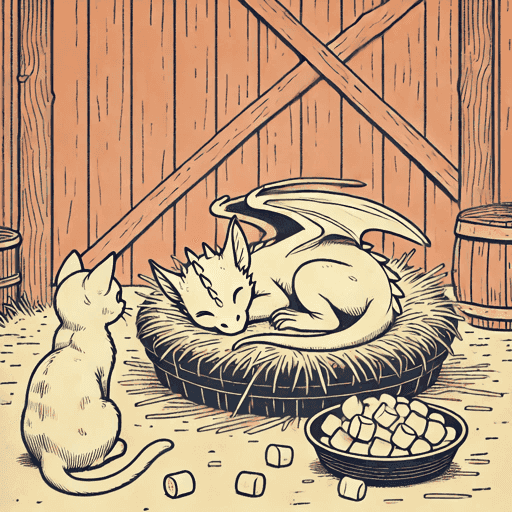
Dragons and Marshmallows
34 pages • 1-hour read
Asia Citro, Illustr. Marion LindsayDragons and Marshmallows
A modern alternative to SparkNotes and CliffsNotes, SuperSummary offers high-quality Study Guides with detailed chapter summaries and analysis of major themes, characters, and more.
Symbols & Motifs
Thinking Goggles
Zoey’s Thinking Goggles—really, a pair of lab goggles—relate to Zoey’s self-confidence and belief in her own abilities. She makes it clear that she both understands their real-world use and also finds them a powerful symbol of her intellectual capacity: “Most scientists wear goggles over their eyes, and I do too when I need to keep my eyes safe. But when I need to think of brilliant ideas, I wear my Thinking Goggles on top of my head. That way they’re closer to my brain” (6). The goggles thus symbolize Zoey’s reliance on her intellect when approaching problems. As an object that Zoey’s scientist mom also uses at work, they reinforce the Importance of the Scientific Method.
At the same time, the goggles bridge the gap between magic and reality. Because the physical sensation of having them “on top of her head” helps her focus, she assigns to the goggles a magical ability to help her come up with “brilliant ideas.” The goggles therefore also symbolize the connection between the novel’s fantastical and real elements.
The Barn
The barn initially appears to be a normal unused outbuilding, but turns out to be the site of the novel’s fantastical elements. The barn is equipped with the magical doorbell from Pip, and is the place where magical animals come when they are in need of help. It is also where Zoey houses Marshmallow, and conducts all her experiments. The barn thus symbolizes the link between the magical and the everyday, and is the setting for the novel Comparing Science to Magic.
When Zoey and her mom walk to the barn, Zoey considers the revelation that a building she’d always dismissed is actually amazing: “I laughed to myself. I never played there because I thought it was super boring. Boy, was I wrong” (22). In the illustration, the barn appears as antiquated and typical, complete with a stereotypical weathervane on the roof. However, the novel explores the idea that looks can be deceiving, as even the explicitly magical doorbell seems mundane at first: It “looked like a regular doorbell, except this one shimmered in a wave of rainbow colors. I moved my head up a bit and it disappeared” (24). The barn thus symbolizes that seemingly everyday things can be magical in spite of appearances.
Photographs
The photographs of magical animals are a motif that underscores the relationship Zoey and her mom have with the magical creatures they encounter. The first photograph in the story shows Zoey’s mom as a young girl holding a glowing Pip. This photo captures her mom’s first encounter with the magical animals, registering her excitement and sense of responsibility. Zoey will soon experience the same emotions.
Zoey is also excited about taking pictures of any magical animals she meets: “[O]ne of the best parts of this whole thing was going to be collecting magic photos” (30-31). The illustration emphasizes Zoey’s enthusiasm. In it, Zoey’s mom is handing her a camera, which Zoey accepts carefully with both hands. She is looking down at it with wide eyes and arched eyebrows that connote being thrilled. Photos are also represented as special because of scarcity. The camera uses instant film, so it will be expensive to take more than one shot.
Zoey forgets to take a photo of Marshmallow when she becomes preoccupied with taking care of him, not thinking about it until after her mom is back, Marshmallow is healthy, and he and Sassafras are playing together. This suggests that her initial idea that photos would be “the best part” of caring for magical animals is wrong. She underestimated the power and complexity of the experience. The photo she finally takes—of Sassafras riding on a horse-sized Marshmallow’s back—symbolizes the new, deeper relationship she has with the dragon. Looking at it makes Zoey realize it is time to release Marshmallow back into the wild.

Unlock the meaning behind every key symbol & motif
See how recurring imagery, objects, and ideas shape the narrative.
- Explore how the author builds meaning through symbolism
- Understand what symbols & motifs represent in the text
- Connect recurring ideas to themes, characters, and events