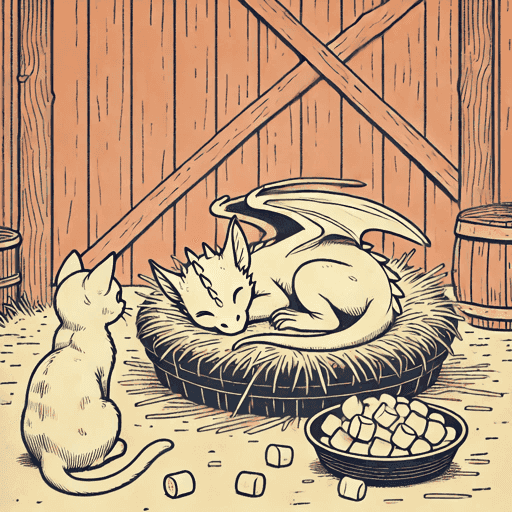
Dragons and Marshmallows
34 pages • 1-hour read
Asia Citro, Illustr. Marion LindsayDragons and Marshmallows
A modern alternative to SparkNotes and CliffsNotes, SuperSummary offers high-quality Study Guides with detailed chapter summaries and analysis of major themes, characters, and more.
Themes
Comparing Science to Magic
Science and magic happily coexist in the novel as Citro emphasizes STEM subjects alongside fantastical elements, portraying both as mysterious and fascinating, and as deeply interrelated since characters can make scientific inferences about the magic they encounter by relying on experience with the everyday. Citro thus emphasizes the possibility of finding strange and wonderful things through scientific inquiry.
Zoey has equivalent relationships with science and magic in the novel. Rather than prioritizing one over the other, she prizes both. Further, scientific or everyday phenomena are portrayed as mysterious and magical, while magical events are treated as being an understandable part of life. For example, Zoey’s Thinking Goggles are regular lab safety goggles. However Zoey accords them magical properties by believing they help her come up with good ideas. Conversely, Marshmallow is a magical creature and is fascinating to Zoey. However, he is also a reptile whose diet and physiological characteristics Zoey can learn about in books and experiments about mundane animals. In spite of being a magical creature, he is also subject to the scientific method.
Reading and research are characterized as excitingly magical throughout the novel. When Zoey’s mom explains how to help the magical animals, she suggests reading about mundane animals and running experiments to gather information. Zoey immediately becomes excited at the prospect: “[M]y heart beat faster […] I was heading straight for those journals. My breath caught. There’d be more magical photos in there! I could hardly wait to see them” (29). Zoey feels tangible excitement about reading and research that translates into physiological responses like a “faster” heartbeat and “caught” breath. Scientific research is characterized as thrilling because it will allow Zoey to discover amazing things. When Zoey reads the journals, she sees a page with a “creature that looked like a flower” and when she gets closer to the book “the scent of roses filled my nose” (33). Citro thus directly connects learning through reading with magic.
By including both fantastical elements and scientific facts in the novel, Citro suggests that science can be a form of magic. Each offers a way to interact with mystery, and learning is essential to mastering both.
Trusting Yourself and Asking for Help
Citro emphasizes that balancing trusting oneself and knowing when to ask for help is a key feature of maturing. Scenes like Zoey’s interactions with her mom, Zoey’s self-talk, and her decision making about when to involve an adult emphasize developing the ability to take on responsibility and the understanding of when to involve outside support. The idea is to present children as capable, while also modeling the importance of adult intervention when situations are dangerous or complex.
Zoey’s mom uses her trip to guide Zoey into this kind of age-appropriate independence. She shows that she knows that Zoey is capable when she allows her daughter to look after the magical animals. By placing trust in Zoey, she is implying that she believes in her daughter and encourages Zoey to believe in herself as well. However, Zoey’s mom also points out that Zoey can call if she needs any help. Zoey’s mom isn’t simply abandoning Zoey to figure out every challenge for herself; instead, she is letting her daughter see the difference between a problem that she can solve and one that requires adult assistance.
Zoey’s self-talk mirrors the way her mother talks to her. When she doubts herself, she reminds herself that her mother also cared for magical creatures at the same age. When Zoey needs inspiration, she uses her Thinking Goggles to boost her confidence and reminds herself of past successes. Zoey’s self-talk thus underscores the way parental influence manifests in the way children think about themselves.
Zoey learns when to persevere on her own and when a situation requires adult intervention. For example, when Marshmallow first arrives, he is weak but not in dire health. She therefore conducts her experiment about what dragons like to eat. When she finds him cold in the morning, she first tries to fix things herself, realizing that reptiles don’t produce their own body heat and finding a space heater. However, when he collapses, she immediately decides to involve an adult. When her mom isn’t available, she asks her father for help. Zoey’s newfound maturity is about balancing self-reliance with asking for help when needed.
Importance of the Scientific Method
Citro weaves the scientific approach to observation and conclusions throughout the book, mixing the plot and fantastical elements with science learning. Zoey’s reading and memories about things her mom taught her often feature scientific knowledge. The basics of the scientific method and experimental design are also modeled in Zoey’s experiments and her inferential understanding of the dragon based on what she already knows about reptiles. Citro transmits scientific knowledge to her readers organically through the story, which aligns with the book’s message about trusting one’s own capabilities and the value of mistakes for learning.
While Zoey works independently, she uses previous experiences to inform her decisions, demonstrating inferential learning. When she is first deciding how to help the baby dragon, she remembers seeing baby snakes hatching on a hike with her mom. They had a conversation about runts, and helped the smallest snake by feeding him worms. Based on this, Zoey concludes that Marshmallow is a runt and that she must feed him. This newfound understanding leads to her first research question—“What do baby dragons like to eat?” (46). When she finds Marshmallow cold in the morning, she remembers learning that her friend Sophie’s pet lizard, like all reptiles, is cold-blooded. Based on this previous experience, she finds a space heater to warm the dragon up. Books also allow Zoey to make inferences about a related situation. For example, after reading about carnivores, omnivores, and herbivores in the reptile book, Zoey chooses Marshmallow’s food more deliberately. The fact that Zoey uses multiple sources to gather information—her memories, books, and experiments—models the fact that scientific knowledge can be gained in many different ways.
The phrase “scientific method” is not used in the novel. However, Zoey employs established steps from it when creating her experiments about what baby dragons like to eat and what they should eat. Successful interpretations of previous experience build Zoey’s belief in her own capability. Mistakes, such as the first experiment, which tests Marshmallow’s food preferences rather than his ideal diet, allow Zoey to regroup and iterate, just as a real scientist would.

Unlock every key theme and why it matters
Get in-depth breakdowns of the book’s main ideas and how they connect and evolve.
- Explore how themes develop throughout the text
- Connect themes to characters, events, and symbols
- Support essays and discussions with thematic evidence