Dragonslayer
70 pages • 2-hour read
Tui T. SutherlandDragonslayer
A modern alternative to SparkNotes and CliffsNotes, SuperSummary offers high-quality Study Guides with detailed chapter summaries and analysis of major themes, characters, and more.
Character Analysis
Content Warning: This section of the guide includes discussion of animal death, death, and graphic violence.
Ivy
Ivy is the protagonist one of the novel’s overlapping storylines. Her character arc is one of intellectual and moral awakening. A round and dynamic character, she begins the narrative as the sheltered and devoted daughter of the revered Dragonslayer of Valor. Her defining traits are her deep-seated inquisitiveness and empathy, which compel her to look beyond the simplistic, heroic stories she has been told. Her arc illustrates the theme of Deception as a Tool of Power, as she systematically dismantles the public myth surrounding her father and, by extension, the foundation of Valor itself. Her initial, gentle questions to her teacher about fairness evolve into a formal investigation with her friends Violet and Daffodil, who form the “Truth Seekers” club. This alliance empowers her to trust her own observations over the accepted truth.
Ivy’s development is marked by key moments of disillusionment. When she secretly follows her father outside the tunnels, she witnesses not a hero preparing for battle but a coward who runs in panic at the mere sound of a dragon (90-91). This observation shatters her perception of him and validates her suspicions. Her subsequent discovery of the treasure cabinet, hidden beneath the very symbol of her father’s supposed heroism, confirms his corruption. The combination to the lock, “MINE” (271), acts as a definitive symbol of his all-consuming selfishness, a stark contrast to the selfless hero he pretends to be. This discovery galvanizes her to move from passive questioning to active rebellion, culminating in her plan to return the treasure to the dragons.
Ultimately, Ivy’s empathy extends beyond the human realm. Unlike the other citizens of Valor, she studies dragons not as monstrous enemies but as fascinating, intelligent creatures. This curiosity positions her as a bridge between the two species, a role she fully embraces by the novel’s end. Her decision to use a dragon to unseat her father is the culmination of her journey. She rejects the violent “dragonslayer” model of heroism and instead pioneers a new path based on communication and a desire for peaceful coexistence, demonstrating a maturity and courage her father never possessed.
Wren
Wren is a protagonist whose character is forged by betrayal and defined by a fierce, self-reliant independence. A round and dynamic character, she is introduced as a spirited, defiant seven-year-old who is sacrificed by her family and village to appease the dragons. This formative trauma instills in her a profound distrust of human society and its structures. Instead of succumbing to despair, Wren channels her anger into a powerful will to survive on her own terms. Her core traits are her resilience, resourcefulness, and a deep-seated cynicism toward people, which she contrasts with an equally deep capacity for empathy, a quality she reserves for animals and, most significantly, for her dragon, Sky.
Wren’s journey highlights the theme of Empathy as a Bridge Across Cultural Divides. After escaping her fate, she discovers and saves a seemingly abandoned baby dragon, Sky. Her decision to care for him, despite her ingrained fear of dragons, is a pivotal moment. She recognizes a kindred spirit in the small, fireless dragon, another outcast rejected by its own kind. Their bond becomes the central relationship of her life, a partnership built on mutual care and understanding that transcends species. She declares, “People are awful and untrustworthy and mean, so I’m going to make friends with a dragon instead” (14), a statement that becomes her guiding principle. This relationship allows her to heal and form a new, more authentic identity outside the human world that cast her out.
While Wren swears off humanity, her narrative shows a slow, reluctant re-engagement with people on her own terms. Her encounters with the spoiled but kind prince Undauntable and the long-lost Rose challenge her hardened worldview. She interacts with them not out of need but from a position of strength, trading her knowledge and resources while maintaining her independence. Her eventual reunion with her brother Leaf forces her to confront her past directly. By returning to Talisman to expose the corruption of the dragonmancers, she achieves a form of justice for herself. Her arc concludes not with a return to human society, but with the creation of a new path forward with Leaf and Ivy, one where her bond with Sky remains central to her identity and purpose.
Leaf
Leaf’s narrative follows the trajectory of a would-be hero who must dismantle his own heroic ideal. As a protagonist, he is both round and dynamic, beginning his journey as a grief-stricken boy consumed by vengeance. After being told that dragons killed his younger sister, Wren, he dedicates his life to becoming a dragonslayer, a figure of violent retribution. His initial traits are fierce determination and a profound loyalty to his sister’s memory. He swears, “one day every little sister in the world will be safe. Because I shall be the next and greatest dragonslayer of them all!” (25). This vow shapes his entire adolescence, driving him to train relentlessly and forsake all other paths. He fully embraces the “Dragonslayer” motif, seeing it as the only noble response to the brutal world he inhabits.
Leaf’s development hinges on the gradual and painful unraveling of the lies that have defined him. His apprenticeship with the dragonmancers, which he undertakes reluctantly, gives him a firsthand look at the corrupt power structure he once implicitly trusted. His capture and imprisonment in the mountain palace force him to confront the reality of dragons not as mindless monsters but as members of a society as complex as any human society. The most significant turning point, however, is Rowan’s confession that Wren was not killed randomly by dragons but sacrificed by the dragonmancers (282-84). This revelation shatters his entire worldview. The anger he has directed at dragons for seven years is suddenly rendered meaningless, forcing him to confront the fact that the true villains were human all along.
This disillusionment prompts a fundamental shift in his character. He rejects the simplistic path of vengeance and treasure hunting that his former companions, Rowan and Thyme, still advocate. Instead, he embarks on a new quest, not to learn how to kill dragons, but to find the original Dragonslayer and understand the truth. This journey leads him to Ivy and a more nuanced understanding of the conflict between humans and dragons. By the end of the novel, Leaf has abandoned the flawed ideal of the dragonslayer and instead embraces a new role as a peacemaker, seeking to build a future that honors Wren’s memory through understanding rather than violence.
Heath (The Dragonslayer)
Heath is the novel’s primary antagonist, embodying the theme of Greed as a Source of Corruption. He is a dynamic character whose arc is a study in moral decay, transforming from a treasure-obsessed youth into a paranoid and despotic ruler. From the outset, Heath’s motivation is pure avarice. During the initial heist, his desire for wealth is so all-consuming that it eclipses any concern for his siblings’ safety, culminating in his flight from the battle, as he abandons Stone and leaves their sister Rose for dead (xxv). This act of self-preservation and greed sets the foundation for his entire future.
After the theft, Heath constructs a new identity based on a lie, falsely claiming the title of “Dragonslayer” and framing his botched robbery as an act of heroism. This lie becomes the cornerstone of his power in the underground city of Valor. As lord, he demonstrates the tyrannical nature of his rule by creating laws that benefit himself, surrounding himself with sycophants, and banishing any dissenters, such as the Wingwatcher Pine, who might threaten his authority or uncover his secrets. His cowardice is a defining trait, starkly revealed when he flees in terror at the sound of a dragon, belying the heroic image he so carefully cultivates (90). His obsession with the dragon treasure remains central to his character, symbolized by the password to his secret cabinet: “MINE” (271). His final, public confession, in which he reveals his cowardice and betrays his brother to save himself, marks the complete collapse of his manufactured persona and his ultimate downfall as a leader.
Stone
Stone serves as a direct foil to his brother, Heath. He is a round and dynamic character whose journey is defined by guilt and an eventual search for atonement. From the beginning of the heist, Stone is characterized by his reluctance and fear, his primary motivation being the protection of his younger siblings rather than the pursuit of treasure. While Heath embraces the lie of the “Dragonslayer” to build a life of power, Stone is haunted by the truth of that night, particularly the apparent death of his sister, Rose.
Haunted by his part in the tragedy, Stone rejects the wealth they stole and lives an ascetic, isolated life in Valor. His perpetual gloom and occasional angry outbursts at Heath reveal his unresolved trauma and his inability to reconcile his actions with his conscience. He carries the secret that it was his spear, not Heath’s sword, that delivered the killing blow to the SandWing queen (348), yet he allows his brother to carry the title. This choice signifies his rejection of the glory and power Heath craves. Stone’s arc shifts from passive suffering to active participation when he helps Leaf and Ivy escape Valor. In guiding them and finally confessing the full truth, he begins to atone for his past, choosing to support a new generation’s quest for truth rather than remaining complicit in his brother’s lies.
Sky
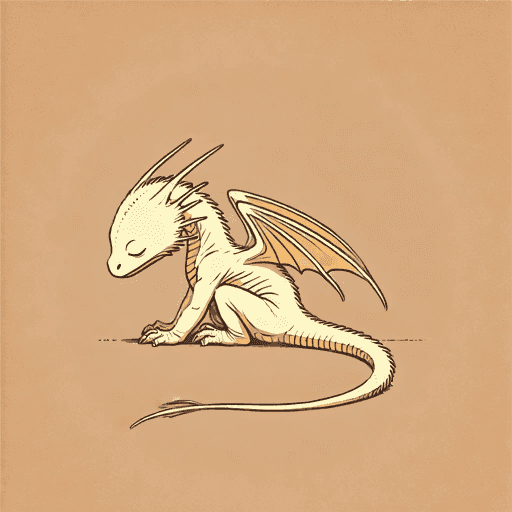
Sky is a symbolic character who represents innocence, empathy, and the possibility of connection across cultural and linguistic divides. As a mountain dragon born without the ability to breathe fire, he is an outcast from his own tribe, a status that mirrors Wren’s rejection by her human village. This shared experience of being an outsider forms the foundation of their deep, familial bond. Sky is a round character whose gentle and compassionate nature directly challenges the human perception of dragons as mindless, violent monsters. His vegetarianism, his love for small creatures like snails, and his unwavering loyalty to Wren demonstrate a capacity for emotion and kindness that the narrative posits is not exclusive to humans. He is a static character in that his core goodness never wavers, serving as a constant moral compass for Wren and as the living embodiment of the novel’s central argument for intercultural empathy.
Rose
Rose functions primarily as the catalyst for the novel’s central conflicts. Her death during the treasure heist is the pivotal event that fractures her family and ignites the long-standing war between humans and dragons. She is a flat character in memory, representing the lost innocence and the ultimate price of Heath’s ambition. Her death drives Heath’s greed, as he uses the stolen treasure to build a new life, and Stone’s guilt, which consumes him for two decades. For the dragons, her death at the hands of treasure thieves, alongside the murder of their queen, justifies their generations-long campaign of vengeance against humans. Her perceived reappearance in visions and, ultimately, her actual survival, serve to drive the plot’s final act, forcing a confrontation with the past and offering a chance for a different future. Her choice to remain with the dragons rather than return to human society serves as a final commentary on the novel’s themes of belonging and interspecies relationships.
Rowan
Rowan is a complex supporting character who acts as both a mentor and a source of deception in her brother Leaf’s life. Initially, she introduces him to the myth of the Dragonslayer and trains him in secret to become a warrior, seemingly in support of his quest for vengeance. However, her motivations are complicated by her relationship with Grove and their shared desire for treasure. For years, she allows Leaf to believe a lie about his sister’s death, channeling his grief to shape him into a tool for her own plans. Her eventual confession that Wren was sacrificed by the dragonmancers is a crucial turning point for Leaf, shattering his worldview and setting him on a new path toward the truth. This act shows her to be a dynamic character, ultimately choosing honesty at the expense of her own ambitions. By making this choice of her own volition and at a relatively young age, she is a foil for Heath, who clings to his deceptions throughout his life and doesn’t relinquish them until he is forced to do so.
The Dragonmancers
The Dragonmancers, led by the cruel Master Trout, are collective antagonists in the village of Talisman. They are flat, static characters who represent the corruption of spiritual and intellectual authority. Much like Heath in Valor, they maintain control through fear and manipulation, using fabricated “visions” from the dragons to enforce their will and enrich themselves. Their willingness to sacrifice a seven-year-old child, Wren, to eliminate a perceived threat and maintain their secrecy demonstrates their utter moral depravity. They function as a microcosm of the novel’s broader theme of corrupt power, showing how lies and fear can be used to dominate a community on a local level.
Violet and Daffodil
Violet and Daffodil are Ivy’s best friends and fellow members of the “Truth Seekers” club. As a pair, they function as foils to each other and as crucial supporting characters in Ivy’s development. Violet is logical, inquisitive, and cynical, often providing the analytical reasoning behind their investigations. In contrast, Daffodil is impulsive, dramatic, and emotionally driven, providing energy and unpredictable insights. Despite their constant bickering, their loyalty to Ivy is unwavering. They are the first to believe her suspicions about her father and empower her to seek the truth, playing an instrumental role in her journey from a passive observer to an active agent of change.
Grove
Grove acts as an external influence who expands Leaf’s understanding of the world beyond the confines of Talisman. Having lost his own village to dragons, he is skeptical of the dragonmancers’ passive, appeasement-based approach to survival. He introduces Leaf and Rowan to stories of the Indestructible City and reinforces the myth of the Dragonslayer, presenting an alternative model of active resistance. His worldly experience and desire for a different future help fuel Rowan’s and Leaf’s ambitions, setting them on the path that eventually leads to the mountain palace.
Undauntable
Prince Undauntable of the Indestructible City is a minor character and a foil for Wren. A curious and naturally empathetic youth, he feels lonely in his privileged, sheltered existence. His obsession with collecting rare objects reflects his eagerness to learn about the world beyond the Indestructible City. Though he often behaves in an entitled manner—initially viewing Wren as another unique object to collect, like her dragon scales—he shows his trustworthiness when he helps her sell her dragon scale in the ad hoc marketplace outside the city walls. Wren has never encountered money before, and Undauntable could easily take advantage of her inexperience, but instead he goes to great lengths to ensure that she gets a fair price. He cements this trustworthy character in the epilogue when he lies to his father to protect Wren. His interactions with Wren highlight Wren’s fierce independence and her rejection of the wealth and societal status that Undauntable embodies: Undauntable cannot comprehend why anyone would pass up the chance to marry the prince of the Indestructible City. His fascination with Wren provides her with a necessary link to human society, allowing her to acquire supplies and information without having to compromise her principles.

Unlock analysis of every major character
Get a detailed breakdown of each character’s role, motivations, and development.
- Explore in-depth profiles for every important character
- Trace character arcs, turning points, and relationships
- Connect characters to key themes and plot points