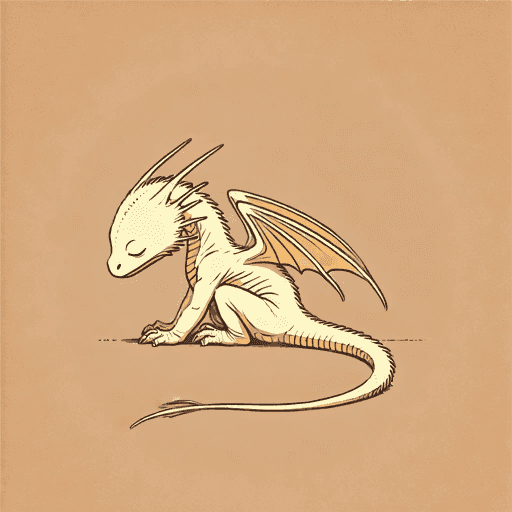
Dragonslayer
70 pages • 2-hour read
Tui T. SutherlandDragonslayer
A modern alternative to SparkNotes and CliffsNotes, SuperSummary offers high-quality Study Guides with detailed chapter summaries and analysis of major themes, characters, and more.
Part 2, Chapters 17-22Chapter Summaries & Analyses
Content Warning: This section of the guide includes discussion of death, animal death, and graphic violence.
Part 2, Chapter 17 Summary: “Leaf”
Leaf wakes in a large pit beneath the dragon palace, surrounded by animals and other human prisoners. A bearded man named Cardinal explains that they are being saved for a feast and that the dragon queen enjoys watching arena fights. Cardinal reveals that he has been imprisoned for five days and is the only survivor from a group sent to the arena; he survived by playing dead.
Leaf tells Rowan that his sword bounced harmlessly off the dragon’s scales. Rowan confirms that the Dragonslayer used a sword but cannot explain how he made it effective. Cranberry speculates it might have been magical or dragon-made. Leaf realizes how unprepared he is and how far from his goal of protecting his village, Talisman.
The pit is enormous, with a grated trapdoor ceiling far overhead. Leaf, Rowan, and Cranberry unsuccessfully attempt to reach it by stacking themselves and using cows as platforms. Over the next five days, dragons periodically add or remove prey and drop food into the pit. Cardinal explains that dragons capture humans from distant places, including wanderers and those foolish enough to come to the dragon palace in search of treasure. Rowan and Cranberry exchange guilty looks, tacitly admitting that they belong to this latter category. Another prisoner, Arbutus, is also a failed treasure seeker.
Leaf observes that the dragons’ complex society contradicts the notion that they are mindless monsters. On the fourth day, the whimpering man is taken away.
On the fifth night, after a day of commotion overhead, three dragons enter the pit. Rowan mentions having seen a pale-yellow sand dragon fly past a window earlier, speculating that the queen has guests for the feast. The dragons remove most of the animals for the feast, then seize Thyme. Before Leaf can react, the one-eyed crimson dragon selects him next.
Part 2, Chapter 18 Summary: “Ivy”
In their underground city of Valor, Ivy, Violet, and Daffodil investigate the whereabouts of the Dragonslayer’s stolen treasure. Violet discovers that Heath operates on credit and influence, never actual paying anyone for the services they render him, suggesting that the treasure remains hidden. Daffodil’s grandmother recalls Heath’s triumphant return but offers no useful information. Ivy searches every corner of her family’s cave but finds only human-made valuables, no dragon treasure.
Ivy deduces that the treasure must be hidden in the ruins of the old village, explaining why her father forbade entry and banished Pine. Though Ivy fears they will all be banished if caught, Violet convinces her that Foxglove and Squirrel will help them. Three days later, under the pretense of a skygazing mission, the group travels west toward the burned village. Ivy notices other Wingwatchers positioned as lookouts along the route, part of a secret signaling system.
At the ruins, Foxglove reveals a secret: Pine and Azalea, both banished Wingwatchers, have been living there and searching for the treasure with covert support from Valor. Azalea is angry that Foxglove brought the Dragonslayer’s daughter, but Ivy explains that they want to return the treasure to the dragons. Pine admits that they have found nothing despite extensive searching.
Ivy identifies her father’s likely childhood home near a blacksmith’s forge. As they search the adjacent smithy, a dragon’s shriek forces them into hiding. Ivy is pushed partway up the chimney, where she discovers a loose stone in the wall. Foxglove investigates and finds a hidden compartment that has been emptied—except for one item: a large, star-shaped blue sapphire.
Part 2, Chapter 19 Summary: “Wren”
After nightfall, Wren sneaks into the mountain dragons’ city, trying to retrace Sky’s path. She crosses a bridge and overhears two dragons arguing about someone named Burn, then navigates the dangerous streets, hiding from patrolling dragons. She discovers a courtyard filled with animal cages—a pet shop—and finds three empty cages that have been broken open. Worried that Sky freed the animals and got into trouble, she follows a faint blood trail to a quiet residential street.
Hiding atop a house, Wren overhears two dragons discussing the troublemaker responsible for freeing the pets. One reveals that someone offered to buy the culprit, and they speculate about why anyone would want such a weird, scrawny dragon. They mention that tomorrow, when the visitors fly back to the sand queen’s palace, they will see if he has been released. The dragons complain about the visiting sand dragon soldiers, who have been bossy and disruptive.
Wren deduces that sand dragon soldiers have captured Sky and will take him to their queen’s palace. She climbs a tall watchtower and spots tents near an oasis outside the city. Racing to the location at dawn, she finds the soldiers already preparing to depart. She sees Sky chained to a large guard dragon. A sand dragon general emerges, and Wren recognizes him as the one who attacked the Indestructible City. In a booming voice, he orders the army to move out, and within moments, the entire force takes flight in a whirlwind of sand. Wren is left standing alone in the empty camp as they fly away with Sky.
Part 2, Chapter 20 Summary: “Leaf”
As a dragon carries Leaf away, Rowan grabs his legs to stop him. The dragon seizes her in its other claw and throws her back down into the pit, and they shout defiant farewells before being separated. The dragon flies Leaf through a kitchen where dragons frantically prepare a feast, then up through the palace’s central hall, then drops him in the middle of an outdoor party on a high plateau. The gathering includes mountain dragons and visiting pale yellow sand dragons, with opulent decorations and a small golden dragon imprisoned in a suspended cage. The orange dragon queen sits on a massive throne.
Leaf dodges between guests, searching for Thyme. Strange, beautiful dragon song emanates from the mountains, silencing the party. The queen hisses in apparent annoyance and leaves with a large sand dragon and her guards. Leaf finds Thyme at the cliff’s edge. When Leaf suggests they climb to escape, Thyme insists it is impossible for him. Leaf hides Thyme under one of the food tables, then begins climbing the cliff behind the throne to reenter the palace and rescue his friends.
He climbs through the night, exhausted and in pain, his imaginary Wren offering encouragement. Near midnight, he watches the party end but cannot spot Thyme among the remaining animals taken inside. He collapses on a narrow ledge to rest.
In the midmorning, hundreds of screaming dragons wake him, fleeing from the arena in terror. He resumes climbing in daylight, fearing discovery. Two dragons—one copper, one blue—rush past him. A third, a warm brown dragon with kind, human-like eyes, circles back and plucks Leaf off the cliff.
Part 2, Chapter 21 Summary: “Ivy”
Ivy’s uncle, Stone, identifies the sapphire as part of the dragon treasure. He explains that Heath disliked the gem because holding it gave him nightmares of the dragons that destroyed their village. Heath arrives unexpectedly. Violet quickly throws the blankets containing the sapphire to Ivy, who clutches them to her chest. Heath questions their presence, barely concealing his anger. Foxglove claims they sought shelter from the rain. Heath orders Foxglove to confine the young Wingwatchers to the tunnels, ostensibly for more training.
Outside, Violet theorizes that Heath is threatened by the Wingwatchers’ association with Stone and concludes that he must have moved the treasure somewhere nearby in Valor after Pine’s banishment.
Over the following days, Heath becomes increasingly paranoid, expanding his personal guard and, on one occasion, suspending Wingwatcher training. He orders Lark, Ivy’s mother, to stay home with Ivy, though Lark has an important meeting. As Heath leaves, Ivy notices that her mother no longer looks at him with adoration. Lark explains that the lord of the Indestructible City has been persistently trying to recruit Heath as a dragonslayer, and Heath fears that they might kidnap someone for leverage. Ivy suspects he fears a ransom demand for the treasure more than he fears for his family’s safety. She encourages her mother to defy Heath and attend the meeting.
As soon as Lark leaves, Violet and Daffodil arrive. They begin a new search of the cave. Daffodil remarks on the “gross” severed dragon tail on its pedestal, and Ivy admits that she instinctively avoids it as she moves through the house. Daffodil realizes what this means: When Ivy recently searched the house for the dragon treasure, she didn’t search the area beneath the pedestal, which is covered by a tapestry. They lift the tapestry and discover a wooden cabinet with a four-letter combination lock. After trying numerous passwords—LARK, SLAY, GOLD, ROSE—Ivy suggests MINE, reflecting her father’s possessiveness. The lock opens, revealing a cache of gold, gems, and dragon artifacts.
Part 2, Chapter 22 Summary: “Leaf”
The brown dragon carries Leaf gently in cupped claws, unlike the careless grip of previous captors. It lands at the top of the cliff, carefully sets him down, speaks to him in the dragon language, and gestures toward the mountains before flying back into the palace. Leaf is stunned and confused. The dragon had every opportunity to eat him but instead helped him escape. He tries to rationalize that the dragon must be unwell, insisting to himself that dragons cannot be kind or sympathetic.
Leaf navigates the deserted upper levels of the palace, recognizing the layout from the stolen blueprint. Hearing groans from the throne room, he sees the dragon queen, badly injured and alone, collapse unconscious. His imaginary Wren urges him to kill her, but lacking a sword and feeling it would be dishonorable, he refrains. Five sand dragons fly in, lift the unconscious queen, and carry her away. Leaf concludes that the sand dragons have betrayed the mountain dragons.
He makes his way to the kitchen, which is in disarray. At the pit’s trapdoor, he lowers a makeshift rope but finds the door secured with a padlock. A tiny baby dragon appears and attracts attention with loud yelps. An adult dragon, instead of harming Leaf, retrieves a key and gives it to the baby, who delivers it to Leaf. He unlocks the trapdoor, and Rowan, Cranberry, and Thyme climb out. They reveal that they were sent to the arena that morning, where Cardinal and Arbutus were killed.
As they prepare to escape, Rowan insists she must tell Leaf the truth. She confesses that Wren was not accidentally eaten but was purposefully sacrificed by the dragonmancers as punishment for stealing their secret books—and that Rowan had blamed Wren to avoid punishment herself. The dragonmancers killed Wren to protect whatever secret she had discovered. Leaf is shattered, realizing his family has lied to him for seven years. He accuses Rowan of manipulating his grief to enlist him in her treasure-hunting scheme. She claims she wanted to empower him, but Leaf retorts she misled him into directing his anger at the wrong enemy.
Thyme suggests they steal treasure to save their brother, Grove, whom the dragonmancers are threatening to sacrifice, but Leaf insists the plan is futile—the dragonmancers will kill them all to protect their secrets. He announces he is not returning to Talisman and will not help them steal treasure. Instead, he declares a new goal: to find the real Dragonslayer and learn the truth.
Part 2, Chapters 17-22 Analysis
In this section, both Leaf and Ivy become fully aware of the degree to which their worldviews have been shaped by Deception as a Tool of Power. Leaf’s entire identity and sense of purpose has been predicated on the story of Wren’s death, a narrative weaponized by Rowan to fuel his hatred of dragons and recruit him for her treasure hunt. When Rowan confesses that the dragonmancers sacrificed Wren to protect their secrets, Leaf’s purpose collapses. His rage is redirected from a monstrous “other” to the human corruption within his own family and community. Similarly, Ivy’s investigation dismantles the heroic persona of her father, the “Dragonslayer.” The discovery that the combination to his treasure cabinet is the possessive word “MINE” (271) is a moment of stark revelation. This single word reframes his legend not as an act of communal protection but as one of profound selfishness, exposing the moral void at the heart of Valor’s origin story. For both characters, the disintegration of these personal narratives forces a pivot from quests for vengeance or restitution to a more complex search for objective truth.
The pervasiveness of Greed as a Source of Corruption ties together the separate worlds of Talisman and Valor. In Talisman, the dragonmancers murdered a child to conceal what she had discovered in their books, establishing an authority built on lethal secrecy. Heath’s rule in Valor increasingly operates on a similar principle. His paranoia, manifested in his banishment of Pine and his attempts to confine the younger Wingwatchers, stems directly from his need to protect his hidden Dragon Treasure. The treasure itself becomes a symbol of his moral decay; the blue sapphire, for instance, gives him “strange waking nightmares” (258), a tangible representation of the guilt he actively suppresses. Heath’s power is not derived from heroic deeds but from the lie that conceals his greed, a parallel to the dragonmancers’ power, which depends on concealing their history of theft and murder. In both societies, the hoarding of secrets and wealth leads to oppressive control and erodes communal trust.
In discovering the corruption that defines their political lives, Ivy and Leaf are catching up to Wren, who has understood this ever since she was sacrificed to the dragons at age seven. Similarly, they catch up to her in their evolving understanding of dragons. Leaf’s imprisonment serves as a catalyst for this shift. He enters the palace believing dragons are mindless killing machines, a view articulated by the cynical prisoner Cardinal, who calls them “giant mindless hungry monsters” (210). However, Leaf’s own observations contradict this; he witnesses a complex society with organized feasts, social structures, and even music. This cognitive dissonance is compounded by direct experience when a brown dragon actively helps him escape and a baby dragon assists in freeing his friends, evidence of Empathy as a Bridge Across Cultural Divides. These moments of unexpected kindness are inexplicable within his established framework of good versus evil, forcing him to confront the possibility of individuality and morality among the creatures he has sworn to destroy. Wren’s journey complements this by offering an immersive glimpse into dragon society, where she overhears mundane arguments and complaints, further humanizing them beyond the monstrous stereotype.
A parallel narrative structure converges the protagonists’ separate journeys around a shared pursuit of truth. Although Wren, Ivy, and Leaf operate in different geographical and social spheres, their quests are thematically identical: to uncover a foundational secret. Wren uses stealth and observation to track Sky’s captors. Ivy employs logic and collaboration with other dissident Wingwatchers to locate the treasure. Leaf, whose initial reliance on brute force proves futile, is forced onto a path of intellectual discovery after Rowan’s confession. The proximity of their crucial discoveries—Ivy finding the treasure, Leaf learning the truth about Wren, and Wren identifying Sky’s captors—creates a narrative convergence, bringing the three separate storylines together. This structural choice reinforces the interconnectedness of their stories, suggesting that the individual truths they seek are merely facets of a larger, shared reality that can only be fully understood when they unite.
The protagonists’ ideological conflicts are sharpened through their interactions with secondary characters who represent a spectrum of responses to systemic oppression. In the dragon palace, the pragmatic despair of Cardinal, who survives by feigning death, acts as a foil to Leaf’s desperate, if misguided, heroism. In Valor, the banished Wingwatcher Azalea embodies a bitter, righteous anger born of injustice, contrasting with Foxglove’s more strategic, covert resistance from within the system. These characters represent alternative paths and philosophies of survival and rebellion. Thyme’s unwavering focus on treasure, even in the face of Leaf’s emotional devastation, highlights Leaf’s significant character shift. He transitions from a materialistic goal (slaying a dragon) to an existential one: finding the truth by seeking out the real Dragonslayer. This array of foils illuminates the complexity of the world and the difficult moral choices the protagonists must make.

Unlock all 70 pages of this Study Guide
Get in-depth, chapter-by-chapter summaries and analysis from our literary experts.
- Grasp challenging concepts with clear, comprehensive explanations
- Revisit key plot points and ideas without rereading the book
- Share impressive insights in classes and book clubs