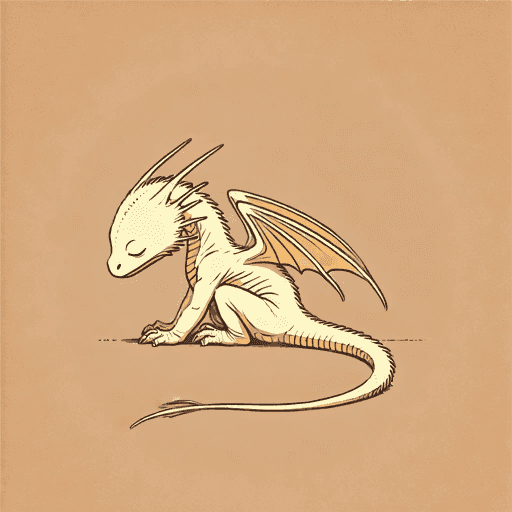
Dragonslayer
70 pages • 2-hour read
Tui T. SutherlandDragonslayer
A modern alternative to SparkNotes and CliffsNotes, SuperSummary offers high-quality Study Guides with detailed chapter summaries and analysis of major themes, characters, and more.
Part 3, Chapters 23-30Chapter Summaries & Analyses
Content Warning: This section of the guide includes discussion of death, animal death, and graphic violence.
Part 3, Chapter 23 Summary: “Wren”
After days of walking through the desert following Sky and the SandWing army west, Wren sees the entire battalion flying back south. She briefly glimpses Sky among them and recognizes the arrogant general leading them. She chases until they bank east and disappear. Guessing they are returning to the dragon city, she follows, reasoning that Sky will be easier to rescue there than from the unknown palace location.
When Wren reaches the city, she discovers that the army has already departed for the palace. She survives by stealing small portions of dragon food but cannot find a map to the palace. Anguished about Sky and wishing she had wings, she formulates a new plan: kidnap a dragon to fly her there.
After stealing a dragonet’s practice sword and rigging it to her back, Wren stalks solitary dragons on the city’s outskirts. She finds her target: a black dragon with silver scales, reading under a lemon tree. When a SandWing messenger arrives to give him an assignment scroll, Wren observes from a tree. The black dragon is clearly disappointed by the serious assignment. After the messenger leaves, Wren climbs down and approaches him.
Speaking in Dragon, Wren tells the startled dragon she needs his help rescuing her friend—a dragon—from the palace. The dragon guesses that she is another dragon’s pet, which she denies. She asks his name but cannot understand his reply. She mishears the name as “Murderbasket” and continues to call him that even after he corrects her. He refuses to help her, citing his assignment and insisting that she’s probably a hallucination. Wren argues that he does not want to do the assignment anyway. When she accidentally stabs his claw while threatening him with her sword, he realizes she is real and agrees to take her. Wren climbs onto his shoulder, and Murderbasket flies toward the palace.
Part 3, Chapter 24 Summary: “Ivy”
Ivy, Daffodil, and Violet skygaze from a tree in the forest after Ivy’s father, the Dragonslayer, relaxes his safety rules. They debate plans to return the stolen dragon treasure. Ivy daydreams about communicating with dragons despite Violet’s exasperation.
Three mountain dragons appear. One dives into the trees, roars in frustration, and rips a tree from the ground. Ivy spots a boy with tangled dark hair and torn clothes running below. As the dragon stalks closer to where the boy hides, Ivy decides she cannot let him die. Despite Violet’s warning and orders to stay put, Ivy throws her apple to distract the dragon. The girls scramble down, and Ivy beckons to the boy. They run to the nearest entrance, where Foxglove pulls them inside.
After Foxglove scolds them, the boy introduces himself as Leaf from Talisman. He has come seeking the Dragonslayer to learn how to kill dragons. Disappointed by his goal but trusting his sad eyes, Ivy agrees to take him to her father.
Part 3, Chapter 25 Summary: “Leaf”
Leaf is amazed to find Valor but surprised it is underground. As Ivy leads him through the calm tunnels, she explains that Wingwatchers study dragons and guard entrances. When Leaf asks if they are like the deceitful dragonmancers from his village, Ivy assures him they are not.
Leaf explains that his sister Wren was sacrificed to dragons by dragonmancers seven years ago. He expresses uncertainty about whether he should seek justice against them or continue his plan to protect other children by killing dragons. Ivy suggests that killing dragons might only make the survivors more vengeful.
They arrive at the Dragonslayer’s lavish caves. Heath appears, looking less heroic than Leaf imagined. He dismisses Leaf, telling him to wait for the next monthly audience. Attempting to gain attention, Leaf mentions a message from the Invincible Lord of the Indestructible City. Heath becomes enraged, grabbing Leaf and accusing him of being a threat. Leaf escapes using a self-defense move. Heath orders everyone out.
Ivy takes Leaf to stay with her Uncle Stone. After Ivy leaves, Stone reveals that he was present when the dragon was killed and that Heath only got lucky. When Leaf asks for the story, Stone assumes that Leaf wants the usual worshipful tale and refuses to tell it. Leaf insists he wants the truth, but Stone does not believe him and leaves.
Part 3, Chapter 26 Summary: “Wren”
Murderbasket lands Wren in a deserted palace courtyard. After the two agree never to tell anyone about each other, he departs. Wren scouts the palace, confirming that Sky is not among the dragon heads on spikes atop the outer wall. She notices that dragons who spot her seem to ignore her. Following furious roaring, she finds a windowless tower with a single violent prisoner but determines that Sky is elsewhere.
Wren establishes a watch post overlooking the soldiers’ courtyard. Two days later, the general arrives and bellows for Prince Smolder. Wren observes the contempt between them as the general, now identified as Sandstorm, asks for news of Queen Burn. Smolder confirms that Sandstorm’s gift is still alive. Wren realizes they are discussing Sky.
Following Sandstorm through the palace, Wren peeks into his room and sees Sky chained in a corner. After Sandstorm leaves, Wren reunites with Sky. He explains that the chains are locked with a key Sandstorm keeps around his neck. They conclude that stealing it while he sleeps is too dangerous. Realizing that Sky might be moved to the prison tower, Wren decides she must kill Sandstorm to get the key.
Part 3, Chapter 27 Summary: “Ivy”
Daffodil wakes Ivy with news that Heath is arresting Wingwatchers, including Foxglove, Squirrel, and Violet. When Daffodil mentions that guards will search the caves, Ivy and Daffodil realize the stolen sapphire—a piece of the Dragonslayer’s treasure—in Foxglove’s cave will be discovered.
They find Ivy’s mother awake and worried. She gives Ivy tacit permission to flee. The girls sneak through tunnels, avoiding patrols. At Foxglove’s cave, Ivy bluffs past the two guards posted outside by claiming a fugitive might be destroying evidence. One guard accompanies her to search. She tells him that she’ll search the cave adjacent to Foxglove’s and directs him to search Foxglove’s cave. This ploy works as planned: The guard, not fully trusting her, sends her into Foxglove’s cave while he searches the adjacent cave. Once in Foxglove’s room, Ivy quickly retrieves the sapphire from under the mattress and conceals it. After the guard finds nothing, they leave undetected.
Realizing they must get the sapphire out of Valor immediately, Ivy secures it in her belt, and they run for the nearest exit.
Part 3, Chapter 28 Summary: “Leaf”
Leaf wakes by instinct as Heath’s guards arrive to arrest him for conspiracy to murder the Dragonslayer. Stone hides Leaf, then lies to the guards. After the guards take up posts outside, Stone reveals a secret tunnel. He and Leaf crawl through and dig themselves out onto a hillside.
Stone explains that he built the tunnel fearing Heath’s paranoia. He reveals he, not Heath, actually killed the SandWing queen. He also mentions their sister Rose, whom Heath wrote out of the story. Stone explains that Heath’s original motivation was treasure, not heroism. Leaf’s heroic image of the Dragonslayer shatters.
Ivy and Daffodil appear. After exchanging stories, Ivy explains that the village was destroyed by dragons in retaliation for the treasure theft. Leaf realizes the story fails to mention that the humans provoked the dragons. Ivy suggests returning the treasure to make peace. Leaf tells her about a prior adventure inside the mountain palace where a kind brown dragon helped him, then reveals Stone’s confession. Ivy is shocked but realizes this story aligns with the cowardly, deceitful version of her father she has seen lately.
They see a small golden dragon exploring the ruins before it flies away. Leaf privately fears that Ivy’s hope of reasoning with her father is futile.
Part 3, Chapter 29 Summary: “Wren”
Wren decides to use poison to kill Sandstorm. In the palace kitchens, another human named Rose confronts her. Rose reveals that she lives in the palace and her dragon protects her. Starved for conversation, Rose helps Wren gather nine poison pellets. She explains that she came for treasure with her two brothers, one brother accidentally killed the queen, and she was left behind. Rose realizes that Wren understands Dragon, but a bell summons her away before she can press the issue.
Wren hides in a drawer in Sandstorm’s room overnight. The next morning, when a servant brings cinnamon milk, Wren drops all nine pellets into the drink and hides again. Sandstorm enters, taunts Sky about presenting him to Queen Burn, and drinks the poisoned beverage.
As the poison takes effect, another dragon bursts in shouting about an attack by unrecognized SandWings. Though clearly unwell, Sandstorm staggers out to join the battle. Wren climbs to the roof and watches him attack another dragon, then collapse dead.
She realizes with horror that while she succeeded in killing him, the key she needs is on his body, outside the palace’s human-proof walls, in the middle of a battle.
Part 3, Chapter 30 Summary: “Ivy”
Heath’s guards search the old village, but the group remains hidden in a nearby ruined temple. The next day, their fellow Wingwatcher, Forest, reports that Heath accused the Wingwatchers of plotting with the Invincible Lord to assassinate him, though Ivy knows the lord wants to hire her father. Under pressure, Daffodil confesses the Wingwatchers’ real plan: to organize a vote for a new leader. Forest reveals that Heath plans to capture Leaf—the accused assassin—and execute all prisoners together. Forest warns that Heath might execute Leaf on sight.
After a day and a half of rain, they brainstorm solutions but find none. When the rain stops, Ivy walks to the ruins alone. She holds the sapphire, closes her eyes, and asks it for help while picturing the little gold dragon.
She suddenly has a vivid vision of being in a desert facing the gold dragon. On its shoulder sits a woman who looks like an older version of her Aunt Rose. The dragon gestures toward the sapphire. Realizing the gem might be magically revealing the woman’s location, Ivy clutches it in alarm, and the vision ends.
Convinced the vision was real, Ivy runs back and wakes Stone, telling him she thinks Aunt Rose is still alive.
Part 3, Chapters 23-30 Analysis
The narrative structure in these chapters uses parallel plotlines to build suspense and create thematic resonance. The three protagonists—Wren, Ivy, and Leaf—converge on distinct but thematically linked settings: the SandWing palace, the ruins of Valor, and the underground city of Valor itself. Each character arrives at a physical and psychological turning point. Wren’s journey into the palace is a descent into a world of direct, violent action, culminating in her decision to assassinate a dragon general. In contrast, Ivy’s flight to the ruins represents a move toward idealism and the hope of reconciliation, as she plans to return the stolen treasure. Leaf’s arrival in Valor precipitates the collapse of his entire worldview, shifting his quest from violent revenge to a search for truth. By juxtaposing these journeys, the text explores divergent human responses to the cycles of violence initiated by Heath’s original crime. Wren’s pragmatic, aggressive problem-solving stands in stark opposition to Ivy’s collaborative, diplomatic approach, while Leaf’s arc of disillusionment serves as a bridge between these extremes. This parallel structure forces a comparison of their motivations and methods, questioning what constitutes effective action in a world defined by historical grievances.
These chapters are pivotal in dismantling the myth of the Dragonslayer and exposing Deception as a Tool of Power. Leaf’s quest to meet his hero ends in profound disappointment; Heath is not a mighty warrior but a paranoid, physically unimposing man whose power relies on repression and fear. The narrative strips away the heroic facade when Heath reacts to Leaf’s message with rage rather than courage, revealing a man ruled by insecurity. Stone’s subsequent confession that he, not Heath, delivered the fatal blow to the SandWing queen—and that their motive was treasure, not heroism—completes the symbol’s deconstruction. The story that has defined Valor’s identity and Leaf’s personal ambitions is exposed as a self-serving lie. When Leaf insists that he wants the truth about what happened, Stone’s cynical reply, “No, you don’t,” (324), underscores the seductive power of the heroic myth and the painful, disorienting nature of its unraveling. The Dragonslayer myth is thus reframed not as a tale of bravery, but as a cautionary example of how greed and deceit can poison an entire community.
The pervasive motif of hiding and secrets physically manifests the psychological state of the characters and the societies they inhabit. Stone hides Leaf before escaping through a secret tunnel, Ivy and her friends hide in trees and storerooms, and Wren conceals herself in a drawer to carry out her assassination plot. These literal acts of concealment mirror the deeper secrets being kept. The underground city of Valor is the ultimate expression of this motif—a community hiding from a threat it helped create. Stone’s secret escape tunnel, which he explains by saying, “I’ve been digging that tunnel since I got back to Valor a year ago” (347), is a tangible symbol of his long-held secrets and his deep-seated fear of his brother’s paranoia. His foresight reveals that the true threat to Valor’s citizens comes not from dragons, but from the instability of a leader whose power is built on a lie. The physical act of digging the tunnel parallels the psychological burden of secrets, showing how secrets necessitate the creation of escape routes, both literal and figurative.
Several encounters in this section challenge the novel’s prevailing human-dragon antagonism, showing the power of Empathy as a Bridge Across Cultural Divides. While Wren’s primary method is intimidation, her interaction with the black dragon she mockingly calls “Murderbasket” (300) is more complex. She successfully manipulates him not just with threats, but by astutely perceiving his character—his intelligence, loneliness, and reluctance to complete his own mission. Their transactional relationship, built on a mix of coercion and grudging respect, demonstrates a form of cross-cultural communication, however unorthodox. This contrasts with Ivy’s more idealistic yearning to understand dragons, which manifests in a vision of her Aunt Rose living peacefully on the shoulder of a golden dragon. This vision, along with Leaf’s memory of the kind brown dragon who aided his escape, reinforces the idea that coexistence is possible. The introduction of Rose, a human who has lived safely in the dragon palace for years, provides concrete evidence for this alternative, positioning her as a figure who has successfully bridged the divide that the protagonists are only beginning to navigate.
The use of character foils explores the complex moral landscape shaped by trauma and guilt. Heath and his brother Stone represent two divergent paths following the same catastrophic event. Consumed by the need to maintain his heroic lie, Heath devolves into paranoia and tyranny, arresting his own people to protect his fragile authority. Stone, conversely, is crippled by the truth, living in morose isolation, his actions defined by regret and a desire for atonement. Wren and Ivy also function as foils to each other. Wren embodies a pragmatic, survivalist morality, willing to use violence and manipulation to protect Sky. Her decision to assassinate Sandstorm is presented as a logical, if ruthless, solution. Ivy represents a more idealistic, community-focused ethic; her response to danger is to seek help, build consensus, and pursue peace, even at great personal risk. These contrasting pairs highlight the absence of a single, correct moral path, suggesting that responses to violence and injustice are deeply personal and shaped by individual psychology as much as by external circumstances.

Unlock all 70 pages of this Study Guide
Get in-depth, chapter-by-chapter summaries and analysis from our literary experts.
- Grasp challenging concepts with clear, comprehensive explanations
- Revisit key plot points and ideas without rereading the book
- Share impressive insights in classes and book clubs