Dragonslayer
70 pages • 2-hour read
Tui T. SutherlandDragonslayer
A modern alternative to SparkNotes and CliffsNotes, SuperSummary offers high-quality Study Guides with detailed chapter summaries and analysis of major themes, characters, and more.
Prologue-Part 1, Chapter 4Chapter Summaries & Analyses
Content Warning: This section of the guide includes discussion of death, child death, animal death, and graphic violence.
Prologue Summary: “Twenty Years Ago…”
Three human siblings—Heath, Stone, and Rose—attempt to steal treasure from the sand dragons’ palace in the desert. Heath, the visionary, dreams of legendary wealth. Stone, the oldest at 20, has come only to protect his younger siblings.
As they crouch in the shadows beneath the palace walls under three crescent moons, Rose, their 16-year-old sister, climbs down from a narrow window slit with sacks of treasure. Stone believes they have enough, but Heath is obsessed with the vast rooms of gold inside.
Suddenly, a massive sand dragon—the queen herself, identifiable by her onyx and diamond crown—looms behind them, her venomous tail poised to strike. Heath lunges for a sword in one of the bags as the queen attacks. Rose throws a sack of treasure at the dragon’s head, momentarily stunning her. The enraged dragon retaliates with a burst of flames. Stone blindly stabs upward with his spear, causing the dragon to collapse.
Heath, burned and bloodied, holds the dragon’s severed tail and flees. Stone asks about Rose, but Heath tells him she’s gone. As more sand dragons pour from the palace, Stone’s courage fails. Still clutching treasure, he runs.
Part 1, Chapter 1 Summary: “Wren”
In the present, seven-year-old Wren is dressed by her parents and taken up a mountain, believing she’s attending another lecture from the village dragonmancers. She doesn’t realize she’s being taken to be sacrificed to a dragon. The three dragonmancers of Talisman seize her and begin the Gift for the Dragons ceremony. Recognizing the ritual from a book she’d stolen from them, Wren fights furiously, injuring the dragonmancers before they tie her up. Her parents and the villagers abandon her on a stone slab overlooking a river without looking back.
Wren realizes the dragonmancers chose her because they dislike her rebellious nature, and her parents allowed it. Her brother Leaf was deliberately taken hunting by their uncle to keep him away. Feeling utterly betrayed, she unties herself and decides she no longer needs anyone.
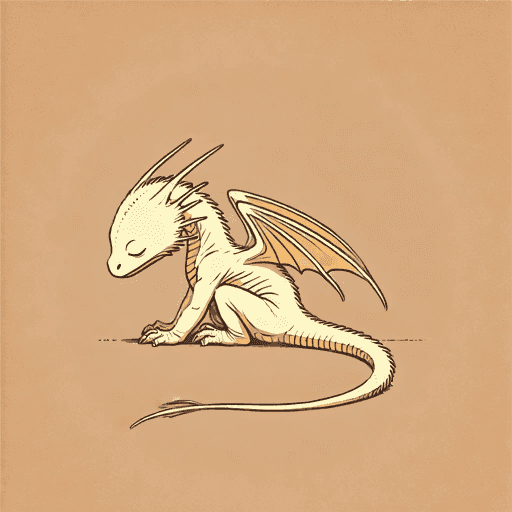
Crossing the river, she discovers a tiny, pale orange baby dragon tangled in branches. The dragonet is shivering and cold, which puzzles Wren since sky dragons are supposed to have fire. She frees it, and it immediately clings to her for warmth. A large rust-colored dragon with a burn scar on its cheek flies overhead, hunting. The baby dragon trembles in terror. Wren hides them both, speculating that the adult dragon abandoned the baby.
Wren names the dragonet Sky and decides that people are untrustworthy, but she and her dragon will be amazing together.
Part 1, Chapter 2 Summary: “Leaf”
Eight-year-old Leaf, Wren’s brother, hates dragons and the restrictive rules they impose on life in Talisman. His parents constantly preach obedience and fear. Returning from a hunting trip with his uncle, Leaf is told that Wren wandered off and was eaten by dragons. His parents blame Wren’s disobedience for her death.
Leaf feels angry rather than afraid, questioning why his parents aren’t mad at the dragons. He argues that the dragonmancers failed to protect Wren. His parents defend the dragonmancers, warning him never to speak ill of them. When Leaf declares that he wants to kill dragons, his mother insists that no human has ever killed a dragon.
His oldest sister Rowan, listening from the loft, interjects that Leaf should know about the Dragonslayer. Despite their parents’ attempts to dismiss it as myth, Rowan recounts the legend: A young man killed the sand dragon queen, cut off her venomous tail as proof, and escaped with her treasure, becoming the wealthiest and most powerful man in the world. Their father’s mention of a partner the Dragonslayer abandoned convinces Leaf the story is true.
Inspired, Leaf grabs a piece of firewood as a pretend sword and vows to become the next and greatest Dragonslayer, swearing that one day every little sister will be safe.
Part 1, Chapter 3 Summary: “Ivy”
Ivy is the daughter of Heath, the Dragonslayer and lord of Valor, an underground city built by survivors of a dragon attack. She grows up hearing her father’s heroic tales of killing the sand dragon queen, with the preserved venomous tail displayed in their home. The treasure her father claims to have stolen is supposedly hidden in a secret place, though Ivy suspects her mother has never seen it either.
At age six, Ivy begins noticing inconsistencies in her father’s claims. He takes credit for a tunnel to the underground lake that her mother and other women actually dug. At seven, she questions her teacher Miss Laurel about the recent banishment of Pine, a Wingwatcher who visited the ruins of the old village. Ivy points out that her father visits the ruins regularly, but Miss Laurel deflects, insisting that the Dragonslayer cannot break his own laws. Ivy suspects that her father created the law specifically to punish Pine.
Her friends Daffodil and Violet, having overheard, invite Ivy to join their secret club, the Truth Seekers. They vow to uncover the truth about Pine and everything else. The experience prompts Ivy to wonder what else her father has lied about. That night, studying illustrations of dragons, she has the forbidden thought that perhaps her father didn’t have to kill the dragon queen and wonders what the dragons’ version of the story would be.
Part 1, Chapter 4 Summary: “Wren”
During their first year together, Wren discovers that Sky is unusual for a dragon. He adores animals, especially snails, and refuses to eat meat, preferring nuts and berries. When Wren kills a rabbit for him, he cries. She also notices that he shows no signs of breathing fire, which she initially attributes to his age.
Now about eight years old, Wren travels south and west with Sky, avoiding the swamp’s hostile mud dragons. They cross the mountains toward the vast, terrifying desert. Wren misses reading and wishes for a map. She begins learning dragon language from Sky, teaching him human words in return.
One night, they discover a cave where five young dragonets of different colors play together peacefully. One appears to be reading a scroll, surprising Wren. She’s shocked to see different dragon types coexisting, which supports her belief that dragons are morally superior to people. Sky watches the dragonets with deep sadness, particularly as two breathe small flames to stoke their fire.
As clearly as she can, given the language barrier, Wren offers to help Sky join them. She worries that he’s lonely without any dragon friends, but he tearfully insists he’s happiest with her. When a full-grown red dragon with a burn scar—the same one from the river—enters the cave, Sky trembles in terror. They flee.
Reflecting on the younger dragonets breathing fire despite being smaller than Sky, Wren finally realizes Sky has no fire at all. She concludes that this is why he was abandoned and comforts him, telling him he’s perfect the way he is.
Prologue-Part 1, Chapter 4 Analysis
The opening chapters establish the narrative structure, with three overlapping storylines, each with its own setting and central characters. This structure creates dramatic irony by positioning the reader as the sole possessor of the complete truth. The Prologue offers an objective account of the inciting incident, detailing Heath’s greed, Stone’s actions, and Rose’s death. In contrast, Chapters 2 and 3 present the mythologized versions of this event that have become foundational stories for protagonists Leaf and Ivy. These false narratives reflect the theme of Deception as a Tool of Power. Leaf receives a heroic legend from his sister Rowan about a valiant “Dragonslayer” who defeated the sand dragon queen. Ivy, Heath’s daughter grows up with her father’s self-aggrandizing account, a tale of heroism substantiated by the trophy of the queen’s severed tail, which becomes a symbol of deception in the service of power as the extent of Heath’s lies comes to light. Because the reader has already seen the truth, Heath’s persona as “the Dragonslayer” illustrates how power is built upon the curation of history.
Wren, Leaf, and Ivy, the three protagonists of the three separate but overlapping storylines, demonstrate divergent responses to societal corruption and trauma, with the symbolic figure of the “Dragonslayer” acting as a nexus for their developing worldviews. Each character is a product of a flawed society: Wren is betrayed by Talisman’s manipulative dragonmancers, Leaf is indoctrinated by their fear-based rules, and Ivy is raised within the authoritarian city of Valor, which is built on her father’s false image of himself as the Dragonslayer. Their reactions create a triptych of youthful rebellion. Wren rejects human society entirely, choosing a solitary life with her dragon, Sky. Fueled by grief, Leaf internalizes the violent myth of the Dragonslayer, aspiring to embody this figure’s heroic power. Ivy, in contrast, approaches the same myth with skepticism, her curiosity leading her to question the inconsistencies in her father’s rule. This dynamic demonstrates how the same cultural narrative can inspire quests for vengeance, justice, or truth, depending on an individual’s motivations and experiences.
The Prologue and subsequent chapters ground the narrative in an exploration of Greed as a Source of Corruption. The disastrous dragon heist is initiated by Heath’s desire for legendary wealth, a greed that directly causes Rose’s death, fractures his family, and sets off 20 years of conflict between dragons and humans. This initial act of greed fuels Heath’s insatiable greed for political power in Valor: Because Heath’s power is built on a false narrative, he must exert even more authoritarian control to prevent his lies from coming to light. The dragonmancers of Talisman represent a parallel form of corruption: Like Heath’s, their power is based on lies that must be protected. Their decision to sacrifice Wren is not a genuine religious act but a political one, intended to eliminate a disobedient child who has accessed their books and thus threatens their secrets. Both Heath and the dragonmancers leverage fear of dragons to maintain control, illustrating how power gained through immoral means must be protected by systems of secrecy and violence.
The motif of hiding and secrets permeates the foundational chapters, defining the physical and psychological landscapes. Valor is a city built on the principle of hiding, its underground tunnels a physical manifestation of a society retreating from an external threat. This concealment mirrors the city’s psychological state, as its existence is predicated on hiding the truth of its founder’s past. In Talisman, the dragonmancers’ power relies on their exclusive knowledge and the villagers’ ignorance. Wren and Sky’s survival in the wilderness is a continuous act of hiding from both dragons and humans, embodying a state of vulnerability. For Ivy and her friends, the formation of the secret club, the Truth Seekers, transforms secrecy from a tool of oppression into one of liberation: They form a secret club to uncover the secrets of their oppressors. Their investigation represents a direct challenge to the manufactured reality of Valor, suggesting that confronting hidden truths is the first step toward dismantling corrupt power structures.
In a parallel storyline, the developing bond between Wren and Sky challenges the central human-versus-dragon conflict and introduces the theme of Empathy as a Bridge Across Cultural Divides. Sky subverts the human view of dragons as mindless killing machines: He is fireless, vegetarian, and emotionally sensitive. Wren’s decision to protect a creature she is meant to fear is an act of empathy born from a shared experience of abandonment. She recognizes in his vulnerability a mirror of her own, forging a bond that transcends species. The scene in the dragonet cave further complicates the human understanding of dragons, showing them to have social structures and the capacity for literacy. Sky’s sadness upon seeing other dragonets breathe fire reveals his own sense of otherness, positioning him as an outcast. Their relationship proposes that connection is not based on shared identity but on mutual care and the recognition of another’s suffering.

Unlock all 70 pages of this Study Guide
Get in-depth, chapter-by-chapter summaries and analysis from our literary experts.
- Grasp challenging concepts with clear, comprehensive explanations
- Revisit key plot points and ideas without rereading the book
- Share impressive insights in classes and book clubs