Driving to Town Late to Mail a Letter
17 pages • 34-minute read
Robert BlyDriving to Town Late to Mail a Letter
A modern alternative to SparkNotes and CliffsNotes, SuperSummary offers high-quality Study Guides with detailed chapter summaries and analysis of major themes, characters, and more.
Summaries & Analyses
Quizzes
NEWReading Tools
Symbols & Motifs
Driving
Driving can imply a physical journey or a controlling force within a person’s mind. The poem clearly denotes the first definition as the speaker drives the car to the town. This is a literal, concrete journey with a particular task: to mail a letter. However, when “driving” (Line 5) is again mentioned, the purpose has radically shifted, and the speaker aimlessly “[drives] around” (Line 5) rather driving to a destination. After they state that they “love” the “privacy of this snowy night” (Line 4), the “driving” (Line 5) stops being task related. The goal for the speaker becomes to “waste time” (Line 5) rather than to complete an errand. This suggests a shift from goal-oriented thought to meditative thought. The point of “driving around” (Line 5) is to extend the enjoyment of feeling and thought, to be contemplative, without a intended outcome.
Swirls of Snow
In the speaker’s observations of the town, they note that the “only things moving are swirls of snow” (Line 2). To swirl is, by definition, to move in a twist or spiral. For the snow to swirl it must be moved by wind—a force that can only be felt not seen. This correlates to the journey of the speaker’s thoughts, which eddy like the “swirls” (Line 2). The speaker’s thoughts move from the goal of mailing the letter, to observations of the evening to the emotional declaration of their “love” (Line 4) of the “privacy” (Line 4), By the end of the poem, the speaker is also literally moving “around” (Line 5) the town. They are driven by the love of “privacy” (Line 4), much like the snow is driven by the wind. In this way, Bly’s description of the snow in Line 2 foreshadows the epiphany in Line 4—their ultimate embrace of thoughts which allow them to circle to deeper internal engagement.
Iron Mailbox Door
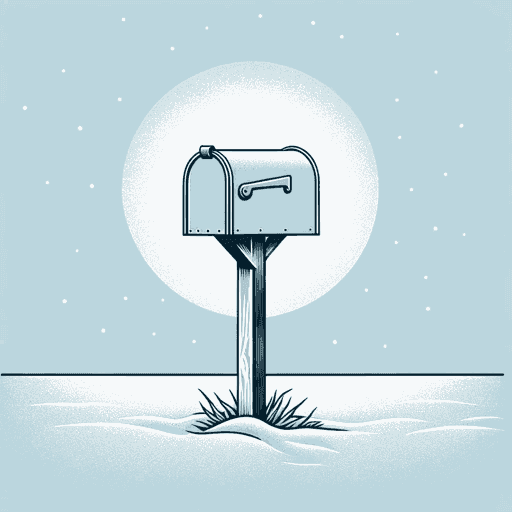
Bly’s imagery suggests the mailbox door is symbolic of the speaker’s feelings about mailing the letter. Other than the mention of intention in the title, Line 3 is the only place the action of mailing the letter is described. That the speaker feels the letter’s contents are weighty is symbolically shown by how they must “lift” (Line 3) the mailbox door made of “cold iron” (Line 3). Lifting the door suggests a weight to the door and an ownership of the activity by the speaker. The door does not pop or swing open; rather, its weight must be lifted by the speaker to achieve the goal of sticking the letter inside the box. They must make a deliberate effort to open the door. The “cold iron” (Line 3) of the door suggests its heaviness as well as its temperature, which further hints at the importance of the action. For the speaker, mailing this letter may not be an easy task: It has a cold, or ominous, weight.

Unlock the meaning behind every key symbol & motif
See how recurring imagery, objects, and ideas shape the narrative.
- Explore how the author builds meaning through symbolism
- Understand what symbols & motifs represent in the text
- Connect recurring ideas to themes, characters, and events