El Filibusterismo
51 pages • 1-hour read
José RizalEl Filibusterismo
A modern alternative to SparkNotes and CliffsNotes, SuperSummary offers high-quality Study Guides with detailed chapter summaries and analysis of major themes, characters, and more.
Chapters 16-20 Chapter Summaries & Analyses
Chapter 16 Summary: “The Tribulations of a Chinaman”
Quiroga, a Chinese man, is throwing a party. He hopes to open a consulate for China and become consul. He meets with Simoun from whom he purchased three expensive bracelets for a woman. This woman took all three bracelets when Quiroga only meant to give her one; thus, he owes Simoun money and claims he’s ruined because of it. Simoun says he’ll lower Quiroga’s debt if he helps smuggle rifles, and Quiroga agrees.
A group of people discusses an attraction at the Kiapo Fair, a large head referred to as a sphinx. Some try to explain it with science, while many churchmen think it’s sorcery. Simoun recommends that they simply see the attraction and decide for themselves, rather than rely on student Juanito’s description. Journalist Ben Zayd seconds the motion, and 12 of them head to the fair.
Chapter 17 Summary: “The Kiapo Fair”
At the Kiapo Fair, people from all walks of life have gathered—including the group from Chapter 16. Father Camorra is overcome by the beauty of the women at the fair, especially Paulita Gómez. Isagani accompanies her and her aunt, Doña Victorina. The group stops to look at some statues: The friars look saintly, an ironing woman is designed to mock the press and get a laugh, and one features a man tied up with two guards standing over him. The group is about to go see the sphinx when they realize Simoun is no longer with them; they go without him. Ben Zayb insists that the sphinx’s allure has to do with mirrors.
Chapter 18 Summary: “Sleights”
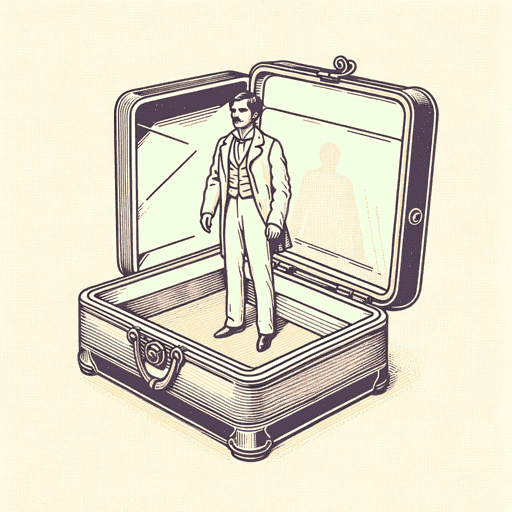
The group meets the man behind the sphinx exhibit—Mr. Leeds, an American fluent in Spanish. Ben Zayb is allowed to inspect the sphinx’s table but can’t find any mirrors. Leeds begins to tell a story about how he found a sarcophagus in Egypt. Inside was a worm-eaten box, which he passes around the room. The wood smells old and musty, and inside are ashes. Leeds says he learned two Egyptian words that brought the ashes to life, revealing a human head. He says the words, and a head is revealed. The head says its name is Imuthis and relates a tale about being betrayed by corrupt priests; his lover was taken from him, abused, and murdered. Father Salví recognizes similarities in the story and cries out that she’s still alive before fainting. The group leaves; later, Ben Zayb writes a story about occultism and spiritualism. The show is banned, but Leeds had already left for Hong Kong.
Chapter 19 Summary: “The Fuse”
Plácido finds his mother awaiting him in his humble room. He tells her what happened at the university (denouncing his professor), and she is beside herself with grief. She wants him to continue his education and fears what will become of him if he leaves school. Plácido leaves and walks around. He goes to the quay and gets the idea to leave for Hong Kong. He finds Simoun and asks him to help him get there. Simoun takes Plácido to a fireworks maker. Plácido overhears Simoun talking about a revolt and wanting to rescue María Clara (his old love). Simoun takes Plácido back to his house.
Alone in his room, Simoun swears vengeance. For the first time, he questions his plan and the cost in lives. However, memories of past evils spur him on.
Chapter 20 Summary: “The Arbitrator”
Don Custodio has a reputation for being a man of many ideas and great energy, due in large part to his friendship with journalist Ben Zayb. Custodio is charged with deciding the fate of the Castilian Academy. Contrary to his reputation, Custodio is not well-educated nor hard-working, though he isn’t lazy; while he was in Spain for medical reasons, he learned how much of a small fish he was in a pond full of big fish. He was all too happy to return to Manila where people paid attention to him and listened to his ideas to improve the Philippines. He finds one such idea buried in a folder he’d forgotten, something to do with a School of Arts and Sciences. This leads to Custodio’s decision for the Castilian Academy.
Chapters 16-20 Analysis
Chapter 16 furthers the plot by bringing Quiroga into Simoun’s plot. A wealthy foreign merchant, Quiroga provides Simoun the perfect cover for smuggling rifles for his supporters in his revolt. Significantly, Simoun was a driving force behind the laws that removed and limited the weapons the Filipino populace were allowed to possess. He purposefully disarmed the general populace to incite antigovernment sentiments and ensure that his revolt would meet as little resistance as possible. Quiroga himself represents a racial group in the Philippines who are just as abused as Indigenous Filipinos (in Chapter 14, Filipino students bully a local Chinese merchant); while sometimes seen as lesser by Filipino citizens, Chinese citizens could secure a higher standing among Spanish rulers with enough wealth. In other words, Quiroga demonstrates the power of wealth in transcending others’ prejudices.
In Chapter 17, Filipino social hierarchy is again illustrated through the statues being sold at the Kiapo Fair. The newspaper and the Civil Guard are ridiculed through puns (i.e., the Filipino press is no better than news from a housewife, and the Civil Guard is evil). However, the friars are depicted with respect and solemnity—not because this is how the Filipino people see them, but rather because they’re afraid to incite their anger.
Chapter 18 comprises the friars being confronted with Mr. Leeds’s sphinx, an illusion, and shows how these men of high society are just as superstitious as the Indigenous population. Ben Zayb thinks he knows how the illusion works, but is still duped. On the other hand, Father Salví recognizes the symbolic parallels in Mr. Leeds’s story, which confirms his abuse of María Clara (Simoun’s old love) in Noli Me Tángere, as he’s the director and chaplain of her convent. Furthermore, Father Salví’s exclamation that María Clara is still alive speaks to Crisóstomo Ibarra’s fate and desire for revenge.
Chapter 19 continues with the theme of revenge and illustrates Plácido, an otherwise calm young man, being pushed too far by societal abuse—to the point of considering violence. This chapter captures the sentiments and suffering of the Filipino people: “But you had to keep quiet, you had to suffer, you had to endure. There was nothing to be done” (168). Simoun seeks to incite people’s anger and frustration for the sake of his revolt. While his revenge is personal, there is a universal aspect to it as well. Before Simoun recruits Plácido, the latter sees a ship headed to Hong Kong. Plácido considers exile, something several Filipino citizens had chosen, and to an extent, José Rizal himself. Rizal lived in Hong Kong for roughly a year after his studies in Europe, where he opened an ophthalmologist clinic.
Chapter 20 highlights an aspect of Philippine high society that contrasts with its carefully curated image. For example, Don Custodio is portrayed as a somewhat “delusional” individual. Don Custodio’s friend, journalist Ben Zayb, is responsible for his reputation as “indefatigable, distinguished, zealous, energetic, profound, intelligent, well informed, well connected, and so on…” (174-75), which Don Custodio knows but won’t openly admit. He likes to view himself as a man of great ideas, a misunderstood genius, but while he was in Spain for medical reasons, he was forced to realize just how untalented he is:
He was a nobody there [Spain] and he missed his beloved adjectives. He had no relations with the first families, his lack of education afforded him no prominence in the scientific or academic communities, and his backwardness and friary politics came off simplistic in those circles…In short, in Madrid he was just a face in the crowd, despite his diamonds (177).
While not overtly abusive, Don Custodio still speaks to the corruption and incompetence of those in power in the Philippines. No one in Spain would have put Don Custodio in charge of anything of import, and yet in the Philippines, he’s tasked with deciding the fate of the Castilian Academy.

Unlock all 51 pages of this Study Guide
Get in-depth, chapter-by-chapter summaries and analysis from our literary experts.
- Grasp challenging concepts with clear, comprehensive explanations
- Revisit key plot points and ideas without rereading the book
- Share impressive insights in classes and book clubs