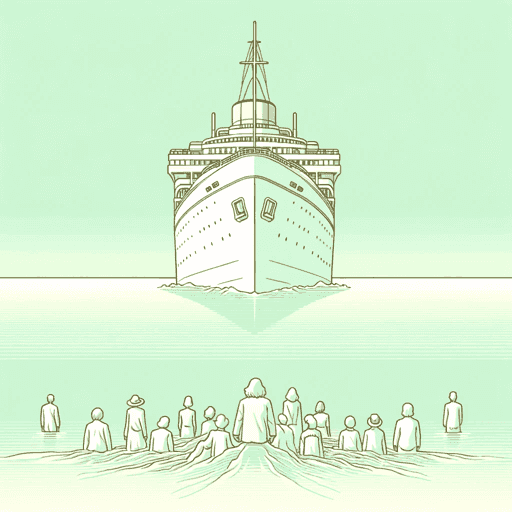
Elsewhere
75 pages • 2-hour read
Gabrielle ZevinElsewhere
A modern alternative to SparkNotes and CliffsNotes, SuperSummary offers high-quality Study Guides with detailed chapter summaries and analysis of major themes, characters, and more. For select classroom titles, we also provide Teaching Guides with discussion and quiz questions to prompt student engagement.
Part 2, Chapters 1-5Chapter Summaries & Analyses
Part 2: “The Book of the Dead”
Part 2, Chapter 1 Summary: “Welcome to Elsewhere”
Back at their cabin, Thandi excitedly tells Liz that they’ve arrived; a PA announcement confirms this a moment later. Liz questions why Thandi is so happy, and Thandi shrugs that there’s no point being sad. Saying she needs some time to herself, Liz tells Thandi to go on without her. Once alone, Liz listens to the sound of the other passengers leaving the ship and reflects that, while being dead might be tolerable if she were old, it seems “terribly lonely” as things stand (42).
Meanwhile, Liz’s grandmother Betty is driving to the pier to meet her. The two have never spoken—Betty died of breast cancer shortly before Liz was born—and Betty is nervous. Nevertheless, she resolves to do her best to be a friend to Liz for her daughter Olivia’s sake.
Liz remains in her cabin as the noise on board the ship dies down; she hopes to stow away and sneak back to Earth. When someone begins opening her door, she hides under her bunk, watching as a roughly seven-year-old boy in a uniform enters. Undeceived, the boy introduces himself as the Captain—a position he has held for nearly a century. Liz is confused, but she says she wants to return to Earth. When the Captain explains that she’d simply end up as a ghost, Liz begins crying. The Captain consoles her, but he reiterates that she needs to disembark.
Betty greets Liz at the pier, hugging her and introducing herself. Liz questions how Betty (who looks to be in her thirties) can be her grandmother, and Betty says that people age backwards in Elsewhere. This alarms Liz, but Betty assures her that she’ll enjoy her new life.
Part 2, Chapter 2 Summary: “A Long Drive Home”
As she drives, Betty points out various buildings; some were designed by architects who were famous on Earth, though not all artists continue practicing their craft in Elsewhere. Privately, Liz observes that Elsewhere looks largely the same as Earth—a fact that only heightens her frustration.
Liz asks Betty to explain her earlier remarks about getting younger, which Betty somewhat hesitantly does: “When I got here, I was fifty. I’ve been here for just over sixteen years, so now I’m thirty-four. For most older people, Lizzie, this is a good thing. I imagine it isn’t quite as appealing when one is your age” (50). Continuing, Betty explains that when a person reaches seven days old, they’re placed in a river and returned to Earth.
Realizing that she’ll never become an adult, Liz grows angry, yelling that it’s unfair that she won’t have the chance to go to college, marry, or even get her driver’s license. Betty tries to cheer Liz up by letting her drive the rest of the way home. As Liz continues to brood, she becomes careless with her driving, hitting the retaining wall when Betty tells her to exit the freeway.
The crash dents the car, but Liz and Betty are unhurt. Betty explains that people in Elsewhere can be injured but not killed: “everything eventually heals when one ages backward” (54). Liz starts crying, and Betty tries to hug her before giving up and driving the rest of the way home. She offers to help Liz get her license, but Liz considers the offer pointless.
Part 2, Chapter 3 Summary: “Waking”
Liz dreams that she wakes from a coma and resumes her former life. However, when she actually wakes, it is to her grandmother announcing that her “acclimation appointment” is at 8:30 AM. Liz doesn’t see any point in getting up, but Betty insists, saying she can borrow some clothes to wear in place of her pajamas.
Liz is unable to find anything she likes amongst Betty’s clothes, and she becomes even more depressed as she wishes for her old closet and wardrobe. Betty tries to assure her that she understands how difficult the transition can be and says Liz can buy some new clothes later. Just before leaving, Liz looks out the window and notices a garden overflowing with trees and flowers. Betty explains that she loves gardening but can’t bring herself to properly trim it, because flowers have such short lives.
Liz declines Betty’s offer to let her drive, saying there’s no point. Betty then apologizes for her “tour guide routine” the night before (63); she was eager to impress Liz, whom she has watched periodically from the Observation Decks (a place where residents of Elsewhere can pay to observe people on Earth). As Liz considers whether she’d like to check in on Zooey, who was noticeably absent from Liz’s funeral, Betty points out “the Registry”—the building where her appointment will take place. She offers to come inside, but Liz says she wants to do this alone.
Part 2, Chapter 4 Summary: “A Circle and a Line”
Liz gets lost inside the registry and is late by the time she finds her way to an irritated receptionist. The woman ushers her into a darkened room to watch an orientation film narrated by a talking parrot; the video covers some of the topics she had previously discussed with Betty, and it also informs her that contact with Earth is forbidden and that an “avocation” is required. As the film delves into the metaphysics of human existence, likening it to both a circle and a line, Liz begins to fall asleep.
After waking Liz up and scolding her, the receptionist introduces her to Aldous Ghent—a cheerful, sixty-something “acclimation counselor” with a messy office. As the two discuss the circumstances of Liz’s death, Aldous reveals that he and his wife Rowena once lost their young son in a firearm accident; unfortunately, by the time he and Rowena died, their son had returned to Earth. Liz also admits that she didn’t initially realize she had died, and Aldous assures her that that's common, especially for young people. Moving on to the topic of acclimation, Aldous asks whether Liz has thought about an avocation. Liz isn’t enthusiastic about the idea, but she eventually says that she has always been passionate about animals (especially dogs).
As the two talk more about Liz’s former life, Liz begins crying; she only now realizes how happy and lucky she truly was. Aldous comforts Liz. He explains that people who die aged 16 or under can choose to return to Earth within their first year in Elsewhere. However, exercising this “Sneaker Clause” would mean returning as a baby rather than as her old self. When Liz presses him about the possibility of returning to her former life, Aldous cautions her against pursuing the issue. Life on Elsewhere, he insists, is really no different than life on Earth: “I think you’ll find […] that dying is just another part of living, Elizabeth” (78-79).
Part 2, Chapter 5 Summary: “Last Words”
Aldous escorts Liz to the “Department of Last Words,” where she’s asked to confirm what her final words were. Liz can’t remember, and she is dismayed to learn that the last thing she said was “um,” though she also finds it “strangely appropriate” in its meaninglessness (81).
While thinking about this, Liz runs into Thandi, who embarrassedly admits that her last words included a lot of cursing about being shot. As Aldous comes to collect Liz, Thandi says that she’s now living with her cousin Shelly, and she urges Liz to visit.
Aldous tells Liz that he’s learned of a position at the Division of Domestic Animals (DDA) that she might enjoy. He asks whether she speaks “Canine” and is shocked to learn that “they still aren’t teaching it in Earth schools” (84). Her interest piqued, Liz lies that she learns languages easily, but she says she needs some time to herself before taking any job. Aldous accepts this but warns her not to put off starting her new life for too long. This irritates Liz, who retorts that her real life was on Earth. She then storms outside, where Betty is waiting for her, and she asks to go to the Observation Decks (OD). Reluctantly, Betty agrees.
Part 2, Chapters 1-5 Analysis
The afterlife that Zevin portrays in Elsewhere is in many ways just an extension of life on Earth. As Liz notes on the drive to her grandmother’s, it looks like Earth: “Elsewhere could have been a walk to the next town or an hour’s ride in the car or an overnight plane trip” (49). It’s also home to most of the trappings of modern human life, including cars, shopping, workdays, and governmental agencies like the one Liz visits for her acclimation appointment.
However, the most notable similarity between Elsewhere and Earth involves the subjective experience of life in each place. In most respects, the residents of Elsewhere are no more enlightened than people on Earth when it comes to metaphysical questions about the nature and purpose of life. As Aldous tells Liz in Chapter 4, life on Elsewhere doesn’t confer any knowledge about what (if any) god or power lies behind the cycle of human existence, or of what the purpose of that existence is: “You want to know where God is in all of this, am I right? [...] God’s there in the same way He, She, or It was before to you. Nothing has changed” (78). As a result, those living in Elsewhere are left struggling with the same sorts of anxieties that characterize human life in all places and times—in particular, the fact that existence on Elsewhere, like existence on Earth, is finite.
Perhaps even more than the loss of her family and friends, it’s this aspect of life in Elsewhere that Liz finds hardest to accept. For one, the reverse aging that occurs in Elsewhere seems to preclude most of what Liz had hoped to achieve on Earth. In a sense, Liz viewed her day-to-day existence on Earth as a precursor to the “real” life she would enjoy after growing up: “[S]he had felt that she had been waiting for all the good things to happen: living alone, going to college, driving a car” (76). As a result, Liz is devastated to learn that she won’t physically age beyond 15. In addition, the knowledge that she will be on Elsewhere for a relatively short period of time leads Liz to question the wisdom of trying to achieve anything at all. Here, for instance, is how she describes the thought of working for the DDA: “What is the point of learning a whole new job (not to mention a whole new language) when she’d just be going back to Earth in fifteen years anyway?” (85).
One possible response to this is the one Thandi provides when Liz asks why she’s not upset or worried about her situation: “No point in being sad that I can see. I can’t change anything” (40). At the time, this makes very little impression on Liz, but it’s an idea she comes to embrace by the end of the novel. Although much of existence (on Elsewhere or Earth) lies outside of Liz’s understanding or control, she does have the power to choose how to respond to her circumstances: either by dwelling on the bad or by focusing on the good.

Unlock all 75 pages of this Study Guide
Get in-depth, chapter-by-chapter summaries and analysis from our literary experts.
- Grasp challenging concepts with clear, comprehensive explanations
- Revisit key plot points and ideas without rereading the book
- Share impressive insights in classes and book clubs