17 pages • 34-minute read
Entrance
A modern alternative to SparkNotes and CliffsNotes, SuperSummary offers high-quality Study Guides with detailed chapter summaries and analysis of major themes, characters, and more.
Poem Analysis
Analysis: “Entrance”
Rilke placed the poem first in the collection, The Book of Pictures, likely intending it as a literal entrance into the poems the reader is about to engage with, providing his own suggestion for not only how poetry comes into being but also how one might best approach reading it. He seems to suggest right at the beginning that poetry is not the exclusive preserve of the few; it is a way of being (and of reading) that can be cultivated. This is why he begins the poem with the phrase “Whoever you are” and repeats it exactly in the fourth line, which is noticeably shorter than the others and contains only this phrase. The poet is happy not to define his audience; he is not speaking to a particular group of poets or a small coterie but to anyone who is open, receptive, and curious.
The image of the person (or people) to whom the poem is addressed—going outside at night, leaving the comfort of their room—is a potent one. It suggests that a poet must be prepared to leave his or her comfort zone behind, because if the mind remains stuck in a familiar routine, seeing things in the same old way, it will only know staleness and limitation (a notion that is stated more explicitly in Lines 5-6). The person must free himself from that and enter “infinity,” a world of limitless possibilities in which something both original and true may be created or perceived. Line 3 not only emphasizes this but also implies that it should not be difficult: “Infinity is open to your sight.” The first quatrain thus proposes a necessary mental act of liberation, of stepping out beyond the familiar. This applies both to writing a poem and to reading one. Although the poem invites a metaphoric rather than literal interpretation, it is not for nothing that Rilke sets it outside in the open air, at night. He always associated night and darkness with infinite possibility and new, expansive understandings of the depth and range of life, so the natural setting here is appropriate at that level too. The outdoor setting in nature also emphasizes that the creative process is quite literally a “natural” one. It is not something that must be pushed for or hard-won in the halls of academia; one only has to step outside into the depths of their own psyche and face whatever dark potential is there, and the alchemy of creation will begin.
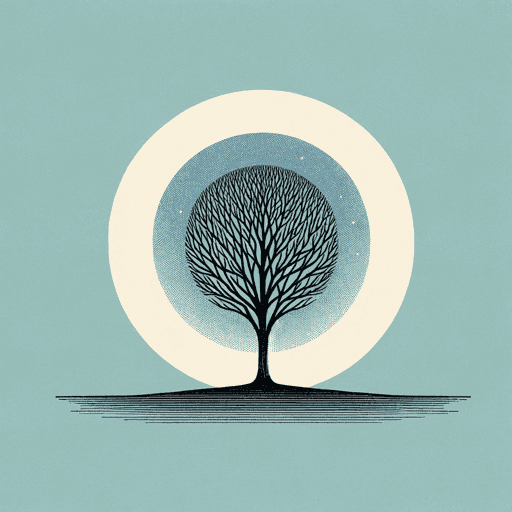
The second quatrain emphasizes the dead weight of the familiar, which is the enemy of fresh vision and perception. Humans fall into habits of perception that do not serve them well. As Line 5 says, they have “forgotten” how to see. Their perceptions have become so dulled and blunted by routine and repetition over the years that the true or essential nature of things eludes them. In Line 7, the poet encourages them to take one gigantic (or so it might seem to them at first) creative act: to imagine a tree coming into existence in the dark, expansive night sky. The sky or heavens (Line 8) represents the open mind cleared of all the baggage of accumulated experience and perception, ready to create and perceive something new. This must be done carefully and consciously. (Line 7 of Rilke’s poem contains the German phrase “ganz langsam,” which means “very slowly.” This is omitted from Gioia’s translation, although other translators, including C. F. MacIntyre, Robert Bly, and Edward Snow include some version of it.) The tree is “tall, alone” (Line 8) because it represents a firm first step, the first imprint of an image or a word in the expansiveness of a receptive, open mind.
The third quatrain begins with the startling reflection that in this simple act of creativity, the “you” addressed in the poem has made an entire world, a world that has not been made stale by custom but is fresh with a kind of pristine perception. Everything now is seen differently because of that one creative act which sets the person’s mind and whole being on a new footing. The poetic world so created now “ripens” (Line 10) in the silence of the creative mind even as the words continue to form “in your mouth” (Line 10). (Gioia’s translation omits the word “silence”—“Schweigen” in Line 10 of Rilke’s original—but the word links back to the earlier reference (Lines 7-8) to the tree being created in the vast blankness of the heavens: the expansive creative mind works in silence.) It then takes a while for the new poet to grasp the full significance of the world he or she has created, but when this has been accomplished, it is time to let it go and allow it to exist independently of its creator and also to allow the next wave of creativity to arise (Lines 11-12).

Unlock all 17 pages of this Study Guide
Get in-depth, chapter-by-chapter summaries and analysis from our literary experts.
- Grasp challenging concepts with clear, comprehensive explanations
- Revisit key plot points and ideas without rereading the book
- Share impressive insights in classes and book clubs