Entrance
17 pages • 34-minute read
Dana GioiaEntrance
A modern alternative to SparkNotes and CliffsNotes, SuperSummary offers high-quality Study Guides with detailed chapter summaries and analysis of major themes, characters, and more.
Literary Devices
Form and Meter
The poem consists of three rhyming quatrains, as in the original German. (A quatrain consists of four lines of verse.) Gioia the translator has attempted the difficult task of remaining true to the rhyme scheme of the original poem without straying from the meaning of the words. In the first two quatrains, Line 1 rhymes with Line 3 (“tonight” and “sight”), and Line 2 rhymes with Line 4; then Line 5 rhymes with Line 7 and Line 6 with Line 8. The final quatrain has a different rhyme scheme. Line 9 rhymes with Line 12, and Line 9 with Line 10. The rhyme scheme can thus be presented in its entirety as abab cdcd effe.
Unlike Rilke’s original, which consists entirely of perfect rhymes, the English translation contains two partial or near-rhymes: “secure” (Line 2) and “you are” (Line 4); and “mouth” (Line 10) and “truth” (Line 11), in which the vowel sound is different but the final consonants are the same.
The meter is predominantly iambic pentameter. (An iambic foot consists of an unstressed syllable followed by a stressed syllable, and a pentameter consists of five poetic feet.) Line 9 is a good example of regular iambic pentameter: “And you have made the world and all you see.” The translator inserts an extra syllable into Line 1, which can hardly be avoided because “Whoever” contains three syllables rather than the two that the meter calls for. In Line 7, the last two feet, “a huge, black tree” consist of an iamb followed by a spondee (two stressed syllables), which makes the tree stand out strongly against the anticipated metrical rhythm even more so than in the German original, which maintains the iambic rhythm of these two feet.
One line, Line 4, is shorter than the others. In the German version, it is a dimeter (two poetic feet). Once more, as in Line 1, the translator into English must add an extra syllable, to accommodate the word, “Whoever.” The short line, which repeats exactly the opening words of the poem, serves to emphasize what the poet intends to be the universality of the poem and the guidance it offers about the creative act: anyone, no matter what their background, talent, or interests, can do it.
Image and Metaphor
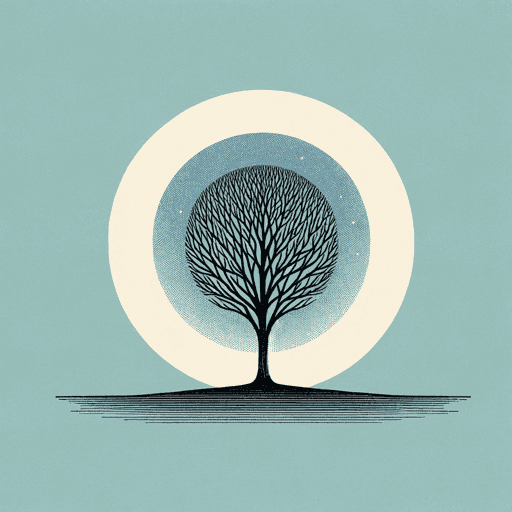
The imagery at the beginning presents a clear and concrete picture of a room in a house and a person stepping out of it into the night. Beyond the four walls of the room, the outside presents itself as “infinity”; the cosmic imagery touches on the darkness of the night and the heavens. The big black tree that appears in Line 7 is also a very concrete and specific image that stands out against the otherwise empty background. The tree can be understood in a metaphorical sense. In a metaphor, one thing is identified with another thing, whether an object or an abstract notion. In this poem, the appearance of the tree against a blank background represents the creative act of the person who has allowed themself to step out of the familiar grooves of the mind—the comfortable room in his house—and envisioned something new and fresh. The tree is the creation, the living thought that was born and set into the world to grow and expand. The blank darkness around it is the fertile void that inspired it and from which it came from, patiently holding the image of the tree and waiting with empty potential for the next person brave enough to step into the darkness and imagine something new.

Unlock all 17 pages of this Study Guide
Get in-depth, chapter-by-chapter summaries and analysis from our literary experts.
- Grasp challenging concepts with clear, comprehensive explanations
- Revisit key plot points and ideas without rereading the book
- Share impressive insights in classes and book clubs