59 pages • 1-hour read
Equus
A modern alternative to SparkNotes and CliffsNotes, SuperSummary offers high-quality Study Guides with detailed chapter summaries and analysis of major themes, characters, and more.
Act I, Scenes 1-10Chapter Summaries & Analyses
Content Warning: This section of the guide discusses animal cruelty and mental illness.
Act I, Scene 1 Summary
The stage directions for Equus call for the stage to be made of a wooden square atop a wooden circle, surrounded by three wooden benches. The benches represent various rooms throughout the play and are used by the cast when characters do not appear in scenes. On these benches, the actors occasionally perform the Equus Noise, a vocal mix of humming, stamping, and thumping that represents the horse-god, Equus.
The play opens with a teenage boy named Alan Strang sat in a spotlight at center stage. Alan is with a horse named Nugget, who he strokes and caresses. From one of the benches, a psychiatrist name Martin Dysart watches Alan while smoking a cigarette. He compares the boy and the horse to a couple kissing. Dysart admits to the audience that he is not thinking of the boy; he is thinking about the horse and “what it may be trying to do” (21).
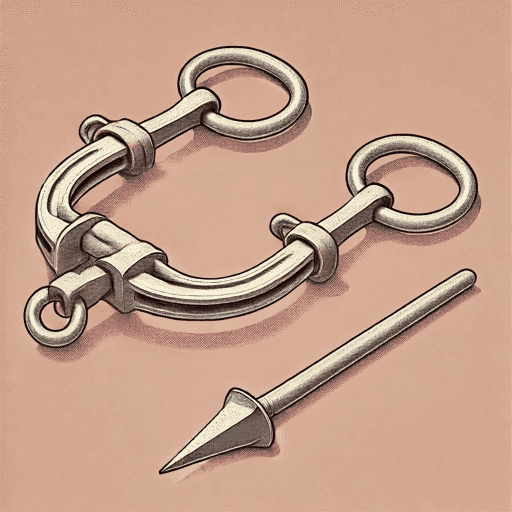
Dysart stands and speaks to the audience. He talks about his confusion. Dysart feels lost and purposeless. He compares himself to a horse with a bit—a piece of equipment that fits inside a horse’s mouth, attaching to the bridle and reins—in its mouth. The bit is used to control and direct the horse. Dysart feels trapped by “old language and old assumptions” (22), believing that there is a better kind of existence that he is prevented from attaining by this bit in his mouth. Dysart doubts his profession, noting that psychiatry cannot fully comprehend the mind of a horse, much less a human. The case of Alan Strang, he says, has brought to a head all the concerns and anxieties about psychiatry he has long harbored. He describes how he first met Alan.
Act I, Scene 2 Summary
As Dysart sits in his office, the nurse enters to tell him that Hesther Salomon—a magistrate and a friend of Dysart—has come to see him. Hesther enters, wanting to talk about “the most shocking” (23) case she has ever dealt with: Alan Strang. Alan was to be sent to prison, but she successfully argued for him to receive hospital treatment instead. She believes that Dysart is the only person who can help Alan. Dysart tries to refuse, claiming that he has too much work, but Hesther presses him. Any other doctor, she says, would be “revolted” (24) by Alan’s crime. Seventeen-year-old Alan, Hesther says, used a hoof pick to blind six horses at the stables where he worked. In court, Alan did not say anything in his defense. Instead, he just sang to himself. Hesther discerns something “very special” (25) in Alan; she senses vibrations when near him, which startle her. Hesther leaves the office. Dysart turns to the audience and explains that—at the time—he did not expect this case to be so different. The nurse brings Alan Strang into the office, where Dysart tries to shake his hand. Alan is unresponsive.
Act I, Scene 3 Summary
Dysart examines Alan’s file. As he examines the documents, he tries to ask Alan questions. Dysart learns that Alan works at an appliance store and that he lives with his parents. Rather than direct answers, Alan responds with advertising jingles for famous brands. Dysart feigns enjoyment of the jingles. His enjoyment prompts Alan to glower at him. The first meeting satisfies Dysart. He asks the nurse to take Alan to his own bedroom, where he will stay while at the hospital. As Alan is led away, he and Dysart lock eyes. When he leaves, Dysart studies Alan with a “fascinated” (28) stare.
Act I, Scene 4 Summary
The nurse leads Alan to one of the benches on the stage. This bench represents Alan’s room. She tells Alan to behave; Alan curses at her. The nurse exits, so Alan lies down in his new room.
Act I, Scene 5 Summary
Standing at the center of the stage, Dysart speaks to the audience. He recalls a “very explicit dream” (29) from the night he first met Alan. Dysart dreamed of himself in ancient Greece. He was a priest, dressed in ceremonial robes and a mask, with a ritual knife in his hand. Dysart was the head priest initiating a series of 500 child sacrifices. The children would be held down by other priests as Dysart used his knife to cut open and dissect the children. Dysart believed that he had been made the chief priest due to his “unique talent for carving” (29). During the ritual, Dysart felt ill. Knowing that he must hide his distress lest the assistants doubt the importance of their work, he continued with the sacrifices. Dysart felt his mask begin to slip. The assistants saw the sweat on his brow. They grabbed the knife from him. At this moment, Dysart awoke.
Act I, Scene 6 Summary
Several days later, Dysart explains his dream to Hesther. She tells Dysart that he should stop being “ridiculous” (30). He has a body of excellent work treating the psychiatric problems of children, she reminds him. Dysart admits that he has begun to doubt whether he is right for this job. He began feeling that the work is “unworthy” (30). In his dream, he recalls, each of the sacrificed children had Alan’s face. Alan’s stare is distinct; to Dysart, the stare seems like an accusation. In recent sessions, Alan has begun to speak. The breakthrough occurred following a series of nightmares. The nurse came into Alan’s room and found him shouting “Ek” (31) in distress. Alan rushed to Dysart’s office with the apparent desire to speak.
As Dysart is describing this, Alan leaps up and reenacts the moment when he came to Dysart. He barges into the office. Frank Strang is Alan’s father, Dysart explains. Frank dislikes television and refuses to let Alan watch it. The play moves to a scene in which Frank speaks to Alan and his wife, Dora Strang. Frank believes that television is a drug; though it seems to offer something to the viewer, it is actually “taking something away” (32). He tells Dora to throw out the television, but Dora and Alan protest. Everyone watches television, Dora argues. Frank takes this as proof that he is correct.
In Dysart’s office, Dysart talks about Frank as a person. To him, Frank seems like a “relentlessly self-improving” (33) figure. Frank is a socialist and an atheist. Dysart is interested in Alan’s relationship with his mother. Alan is proud of Dora, Dysart says, and he is close with her. On stage, a short interaction takes place: Alan tries to explain to Dysart that his mother is very intelligent. He quizzes Dysart about history, asking him to name the author of a number of quotes. Dysart notes the “guilty snigger” (34) in Alan’s voice when he mentions religion. Dysart wonders whether religion might be the key to helping Alan. Dysart talks to Hesther again, mentioning that he will investigate the religious aspects of the relationship between Alan and Dora. He has invited himself to visit the parents on Sunday, believing that any religious tension will be more evident on the sabbath.
Act I, Scene 7 Summary
Dysart pays a visit to the Strang family home. Since he visits on a Sunday, Dora is home. Frank, who works at a printing press, is not home. He is at work because he “doesn’t set much store by Sundays” (35), Dora tells Dysart. In the house, Dysart speaks to Dora about Alan. Dora is still shocked by what her son has done. He loves horses, so she cannot imagine him hurting the animals. Alan hung a picture of a horse in his bedroom when he was a child, and she remembers reading him a story involving a horse called Prince. In the story, Prince the horse allows only his master to ride him due to his immense loyalty. Dora recalls another time when she was discussing history with her son. She remembers telling Alan that the first Europeans to arrive in the Americas brought horses with them. Since the people of the Americas had not seen a horse before, they believed that the horse and the rider were a single being—a strange god. In a similar way, she mentions the appearances of horses in the Bible. Alan used to watch Westerns on television, though his father did not like him to watch TV. Dora allowed him to watch the shows when visiting his friend’s house.
Frank comes home. Dora continues to talk. The Strang family has always had a connection with horses, she explains. She remembers her grandfather dressing up in “bowler hat and jodhpurs” (37) to go riding. Alan was always fascinated by “equus” (38), the Latin word for horse. Dora does not believe that Alan ever learned to ride; she believes that he refused to learn. Both his parents found this strange. Frank believes that Dora indulges Alan too much and that this is why he does not seem intelligent. He blames Dora’s intense religiosity. Frank is an atheist, he tells Dysart, and he believes that the Bible is the real reason for everything that has happened. He mentions Alan’s longstanding fascination with the “kinky” (39) aspects of religion, such as scenes of Jesus Christ being tortured. Dysart asks the parents about Alan’s knowledge of sex. Dora remembers telling her son that sex is more than just a biological act: She told him that sex is spiritual. When Dora begins to cry, Frank hugs her and leads her to the side of a stage.
Act I, Scene 8 Summary
Alan suffers from a nightmare. As he writhes around in his sleep, he seems as though he is trying to “tug something back” (41). He shouts the word “ek” (41), which is echoed by recorded voices in the theater. Dysart enters Alan’s bedroom as he cries out. After one final shout, Alan wakes. Dysart and Alan stare at one another in silence. Dysart leaves.
Act I, Scene 9 Summary
The following day, Alan speaks to Dysart during their scheduled session. His answers are evasive; he suggests that he will only answer Dysart’s questions if Dysart responds in kind. Dysart agrees to answer Alan’s questions, but only if they both speak the truth. As they begin to talk, however, Alan does not answer honestly. Alan asks Dysart about dreams and about Dysart’s marriage. These questions make Dysart uncomfortable. He asks Alan about “ek” (43), only for Alan to respond with an advertising jingle. Dysart ends the conversation. This makes Alan upset. Dysart refuses to continue unless Alan is willing to answer honestly, especially about Alan’s first memory of horses. Alan rages, but Dysart ignores the boy’s tantrum. When Alan eventually calms, the characters sat at the side of the stage begin to hum the Equus Noise. Alan sullenly prepares to share his memory.
Act I, Scene 10 Summary
Alan describes his memory, acting it out on the stage as Dysart watches. The memory takes place when Alan was six. He was visiting a beach and saw a man on horseback riding along the shoreline. A Horseman appears on stage and runs around, then heads straight for Alan. Though the rider changes direction at the last moment, Alan is shaken. The rider apologizes and offers to give the boy a ride. The Horseman lifts Alan up onto his shoulders, and they run around the stage together. In the distance, Frank and Dora see their son riding faster and faster. They tell the Horseman to stop. When he does, Frank angrily accuses him of picking up Alan without asking his parents. Alan was safe, the Horseman insists. Frank demands that Alan get off the horse; Alan refuses. Frank becomes angry. He pulls at Alan until Alan falls. As a wound begins to bleed, Frank ignores his injured son. He accuses the Horseman of putting Alan in a “stupid” (47), dangerous position. They swap insults, and the Horseman rides away. The horse splashes water over Frank, Dora, and Alan. Frank shouts at the Horseman. Dora laughs instead. She is amused that they are covered in water and sand.
Alan ends his recollection, and Dysart thanks him for sharing. He tells Alan that he has never ridden a horse. After the incident, Alan says, he never rode a horse again. Dysart interrupts: Alan worked in a stables, he says, so Alan must have ridden a horse then. Alan insists that he did not. He did not care about riding, he says. Dysart presents Alan with a tape recorder, a device he uses for “patients who’ve got things to tell [him], only they’re ashamed to say them to [his] face” (50). Alan can record his thoughts and give the tape to the nurse, Dysart says. Alan dismisses this as “stupid” (50), yet he takes the tape recorder as he retires to his room.
Act I, Scenes 1-10 Analysis
In this section, Equus begins with a monologue by Dysart. While Alan and his treatment are the focus of the play, Dysart is the protagonist. His words open and close the play, while his journey of discovery positions him as the detective in a mental health mystery. The play begins with a frank and honest confession from Dysart: He is “desperate” (22), having lost all his faith in psychiatry and in society. This spiritual fatigue marks him not as a healer but as a man in search of his own salvation. Rather than simply reintroducing Alan into society, Equus is a story about Dysart being swayed to Alan’s perspective, learning how he came to believe that “extremity is the point” (22). This shift underscores the play’s meditation on The Conflict Between Societal Norms and Individual Desires, as Dysart slowly recognizes that normalcy may be a form of spiritual death.
Dysart concedes that psychiatry cannot know the thoughts, emotions, or motivations of a horse. If the entire field cannot comprehend a horse, then Dysart wonders how they can comprehend the more complex human mind. The horse thus becomes a symbol of the unknowable—an entity beyond human logic or clinical analysis, echoing Dysart’s growing realization that psychiatry, while orderly, lacks the language to explain ecstasy, worship, or myth. By beginning the play with this tacit admission of failure, Stafford undermines the audience’s faith in a traditional narrative. This will not be Alan’s story of recovery, but the story of how Alan fell into uncertainty. Equus dramatizes the tension between understanding and feeling, between treatment and belief. More importantly, it is the story of how Dysart, the would-be agent of order, begins to long for disorder—passion, danger, and awe. Psychiatry and the Search for Meaning in Life becomes one of the central tensions of the play as Dysart begins to suspect that his tools—diagnosis, treatment, and normalization—are insufficient when confronted with the mystery of human passion.
Hesther believes that Dysart alone can help Alan, stating that there is “nobody [else] within a hundred miles” (24) who can help Alan. This marks Dysart as unique, which inadvertently positions him beside Alan. They are both unique: Dysart, like Alan, is alienated from the society around him, trapped in roles he performs rather than inhabits. At first, Dysart performs the role of expert healthcare provider. He responds to Hesther and others with a dry, glib manner that suggests that there are few things that surprise him. He will not be outdone by a patient, his demeanor suggests, no matter how unconventional or violent they may be. In this sense, his glibness is a defense mechanism. He presents himself as a successful doctor to distract from his own painful feelings of inadequacy. He does not want to bring himself to believe that he may be in some way vulnerable, so he projects the image of a cynical doctor even though he knows that it is not true. Psychiatry and the search for meaning in life is embedded in Dysart’s every line, as he begins to view his own profession not as salvation but as a series of rituals that mask emptiness. His emotional detachment, while socially sanctioned, renders him spiritually inert—a sharp contrast to Alan, whose emotional intensity becomes a form of faith.
Dysart’s dream is a key insight into his psyche. As a psychiatrist and a student of Freud, who authored The Interpretation of Dreams, Dysart is unwilling to dismiss the significance of his dream. He may not believe himself a prophetic figure, but he believes that dreams function as a mirror to the patients’ psyches. In describing his dream through monologue, however, he reverses his typical psychiatric dynamic. He is the confessor, offering his dreams to audience for psychiatric interpretation. This inversion is made possible through the play’s frequent breaking of the fourth wall. Dysart comes to suspect that his worst inclinations are true: His dream tells him that he sees himself as a ritualistic child executioner. Even if he knows that the actual truth is different, the metaphorical truth—onto which he places so much significance—cannot allow him to forget how he truly feels.
The dream is significant precisely because Dysart believes it to be significant. It dramatizes the core irony of the play: that the one charged with curing Alan may be more repressed and hollow than the boy himself. In its imagery of sacrifice and ceremony, the dream also highlights The Role of Religion and Worship in Modern Society—Dysart’s vision invokes an ancient, pagan world in which ritual had meaning even if it was brutal. Dysart, like Alan, yearns for a kind of spiritual authenticity that modern life no longer offers. The role of religion and worship in modern society is not merely a background theme; it emerges in Dysart’s longing for grandeur, sacred meaning, and a lost sense of transcendence that neither religion nor psychiatry can fully offer. Both man and boy are trapped in systems—one of medical rationalism, the other of mythic obsession—that fail to provide wholeness.

Unlock all 59 pages of this Study Guide
Get in-depth, chapter-by-chapter summaries and analysis from our literary experts.
- Grasp challenging concepts with clear, comprehensive explanations
- Revisit key plot points and ideas without rereading the book
- Share impressive insights in classes and book clubs