59 pages • 1-hour read
Equus
A modern alternative to SparkNotes and CliffsNotes, SuperSummary offers high-quality Study Guides with detailed chapter summaries and analysis of major themes, characters, and more.
Important Quotes
Content Warning: This section of the guide features depictions of animal cruelty, sexual content, and mental illness.
“What use is grief to a horse?”
(Act I, Scene 1, Page 21)
Dysart begins the play with a comment on the unknowability of an animal’s psyche. As a psychiatrist, he has spent his life trying to comprehend human emotions such as grief, yet he finds himself lost and disillusioned. He may be asking what use grief might be to a horse, but his experience with horses and humans will lead him to the difficult realization that he cannot adequately explain what use such emotions might be to humans. The unknowability of animals only reminds him of the unknowability of humans.
“One more dented little face. One more adolescent freak. The usual unusual.”
(Act I, Scene 2, Page 25)
Hesther brings Alan to Dysart because she believes that he is the only psychiatrist with the empathy and compassion needed to treat the youngster. Yet, at the point when he is reflecting on the case, Alan has become cynical and jaded. His patients, in his recollection are just dented little faces. The cynicism shown in the narration alludes to the ways in which Alan’s case will leave a lasting impression on Dysart and his relationship to psychiatry. Dysart’s jaded outlook reflects The Conflict Between Societal Norms and Individual Desires, as the clinical impulse to categorize obscures deeper emotional truths.
“The only thing is, unknown to them, I’ve started to feel distinctly nauseous. And with each victim, it’s getting worse.”
(Act I, Scene 5, Page 29)
Dysart’s explicit, violent dream is a terrifying analogy for his professional anxieties. He has begun to doubt the efficacy of psychiatry and his role in treating the mental health of children; his subconscious frames him as a reluctant priest, carving open children. But Dysart tries to hide his anxiety, fearing for himself. His hidden anxiety—manifesting as a dream—foreshadows the similar anxieties which others such as Alan hide from the world. With everyone hiding their anxiety so as to appear normal, the very definition of normal is being interrogated. Dysart’s crisis of purpose encapsulates Psychiatry and the Search for Meaning in Life, as his profession begins to feel more like ritualized harm than healing.
“Because he put out the eyes of that smarty little—”
(Act I, Scene 6, Page 34)
For a brief moment, Alan loses track of his responses to Dysart and voices support for an English king who famously tried to blind a prisoner. His enthusiasm and sudden shock speaks to Alan’s intelligence. He is well-read enough to know his history, yet aware enough of his surroundings to realize that any support shown for someone who blinded a person will reflect poorly on him. Alan shows how closely he guards his intense emotions.
“Upper class riff-raff!”
(Act I, Scene 10, Page 48)
Frank’s argument with the Horseman gestures toward Frank’s socialist views. As a working class man whose wife believes that she has married beneath her status, Frank is insecure and proud of his social class at the same time. The Horseman, about whom little is known but whose speech and demeanor suggest that he is wealthy, irritates Frank in particular because the Horseman represents a form of upper class entitlement. This class-based resentment fuels Frank’s outburst, further fueling a disagreement which quickly becomes more about class and privilege than Alan’s safety.
“At least, he hung it in exactly the same position, and we had no more of that awful weeping.”
(Act I, Scene 12, Page 52)
Dora provides an insight into how Alan’s horse religion was formed. After Frank took down the picture of Jesus Christ, Alan wept. This “awful weeping” (52) is criticized by Alan’s mother, suggesting that emotional expression and honesty is condemned in the household. Only when Alan replaces a picture of an old god with a new one does the weeping stop. The parents do not care about why the weeping has stopped, only that it stopped. They do not care about Equus, only about Alan appearing to be normal. This marks the moment when Alan replaces one form of ritual worship with another, underscoring The Role of Religion and Worship in Modern Society as a personal, desperate response to emotional repression.
“I bet all cowboys are orphans!”
(Act I, Scene 13, Page 56)
Alan envies cowboys because they are free. He sees them riding their horses and he associates this image with freedom. Notably, however, he presumes that this freedom is conditioned on the absence of their parents. Cowboys are free so, by Alan’s internal logic, they must be free of their parents. Alan does not so much envy cowboys because they are cowboys, but because he envies their presumed freedom from their parents. In reality, Alan is admitting how much he wishes he could be free of his own parents. Alan’s fantasy reveals the conflict between societal norms and individual desires, as he imagines freedom as an escape from the very structures—like family—that define conformity.
“Flankus begat Spankus. And Spankus begat Spunkus the Great, who lived three score years.”
(Act I, Scene 14, Page 58)
Frank tries to remove religion from his son’s life, only to prompt Alan to develop his own religion. As Frank overhears Alan reciting his own private liturgy, however, reveals that Alan’s religion is closely modeled on Christianity. The genealogy of Equus follows the lists of lineage found in the Bible, right down to the archaic language and syntax. Alan mimics this Biblical style because, to him, the aesthetic construction of religion adds credibility and authenticity. His religion is an equestrian form of Christianity, rather than something truly unique, because—to Alan—Christianity is the only form of religion he has ever known. Alan’s liturgy mimics biblical cadence to give legitimacy to his new faith, illustrating how the role of religion and worship in modern society becomes distorted when institutional belief fails to nourish the spirit.
“He knew exactly what questions to try.”
(Act I, Scene 17, Page 69)
Alan’s questions to Dysart are carefully designed to expose Dysart’s most painful emotions. He asks about Margaret, having deduced that Dysart’s marriage is a loveless and that Dysart is afraid and ashamed of this. Dysart knows this but cannot help himself from becoming angry. He can, however, admire the amateur psychiatry demonstrated by Alan, revealing Alan’s natural intelligence. Alan and Dysart are more alike than Dysart expected.
“Do you know what it’s like for two people to live in the same house as if they were in different parts of the world?”
(Act I, Scene 18, Page 71)
Dysart’s description of his home life is a quiet admission of quaint tragedy. He and his wife life in different worlds, wishing they had different lives, yet they share the same physical space. Each wishes that they were somewhere else, though neither wishes to be in the same place as the other. Yet they both accept that they have grown too old and too comfortable to change. They have made peace with their loveless, pointless existence, accepting that they will never have what they really want. They are so alike in their tragedy, yet ironically not enough alike to fight back against it.
“The Normal is the indispensable, murderous God of Health, and I am his Priest.”
(Act I, Scene 19, Page 74)
Alan is in the hospital because he blinded six horses, yet Dysart is gradually coming to see his own role in treating Alan as just as violent. To treat Alan, he must kill the boy’s spirituality, sacrificing his uniqueness on the altar of so-called normalcy. Normalcy, with “Normal” (74) capitalized, is a socially constructed expectation rather than anything inherently good, Dysart comes to believe. As a result, Dysart is left asking himself whether he or Alan is the truly violent one. This line is a defining expression of psychiatry and the search for meaning in life, revealing how institutional treatment may suppress, rather than nurture, the human soul.
“Chinkle-chankle.”
(Act I, Scene 20, Page 79)
As they explore Alan’s memory, Alan reveals many of the features of his Equus religion to Dysart. Phrases such as “chinkle-chankle” (79) are nonsense words, yet Alan repeats them with a reverence that imbues them with meaning. For Dysart and the audience, however, these nonsense words are a reminder that Alan is still young. He is like a child inventing a game, even though this game results in the brutal blinding of six horses. This juxtaposition reminds the audience of why Alan should be understood, rather than simply punished.
“All those who show him off for their vanity. Tie rosettes on his head for their vanity.”
(Act I, Scene 21, Page 84)
As Alan’s ritual becomes more intense, he directs his anger at the people—like those in his mother’s memories—who turn something as pure and innocent as riding a horse into a display of class distinction. They are vain, Alan believes, and this vanity is a sin. Only Equus can absolve them of this sin of vanity, so they are included in the liturgy that Alan has invented. He has sought to include them as a way to distinguish him from those who ride for anything other than pure, spiritual devotion. Alan’s fury toward horse competitions exposes the conflict between societal norms and individual desires, where performance replaces passion and authenticity is sacrificed for spectacle.
“Now he’s gone off to rest, leaving me alone with Equus.”
(Act II, Scene 22, Page 87)
Act 2 of Equus begins with Dysart demonstrating the effect that Alan has had upon him. Now, Dysart confesses to the audience, Alan is gone, yet Equus remains with him. Equus is more than just a figment of Alan’s imagination, but a symbol of a larger sense of social unease with which Dysart can sympathize. Dysart may not believe in the horse-god exactly as Alan does, but he feels Equus within him nevertheless.
“Look, Doctor: you don’t have to live with this. Alan is one patient to you: one out of many. He’s my son.”
(Act II, Scene 23, Page 90)
Dora does not believe in the efficacy of psychiatry and she fears that Dysart will only blame her and Frank for Alan’s crime, yet she reveals how little she understands about the effect which Alan has had upon Dysart. Dora is wrong: Alan is far more than just one of many patients for Dysart. Alan is changing Dysart, just as he changes everyone around him. Dora is simply so afraid of being accused of bad parenting that she cannot comprehend how singular her son truly is.
“I’m not ignorant. I know what you get up to in here. Shove needles in people, pump them full of truth drug.”
(Act II, Scene 24, Page 92)
Due to the severity of Alan’s crimes, few people are prepared to entertain the idea that he is intelligent. Dysart, however, comes to realize that Alan has a very particular kind of intelligence. Alan wants to tell the truth about what happened to him, Dysart believes, but he knows that he cannot. Just as he created an elaborate religion in the form of Equus to resolve his inner tension, Alan invents the idea of the truth drug as a way to give himself permission to talk. Dysart recognizes this intelligent mechanism for psychological resolution because, as a psychiatrist, he can recognize treatment techniques even when they manifest in such unorthodox ways.
“Then in the morning, I put away my books on the cultural shelf, close up the Kodachrome snaps of Mount Olympus, touch my reproduction statue of Dionysus for luck—and go off to hospital to treat him for insanity.”
(Act II, Scene 25, Page 95)
Dysart describes the way in which, like Alan, he yearns for a different kind of existence. He wants to break free of the prison he has constructed for himself, in which the only thing that satisfies him are vague reproductions or facsimiles. His life is unfulfilling, his life is a lie, yet it is Alan who is considered to be mentally unwell. Dysart realizes that everyone suffers from a similar form of alienation to some extent, and he envies Alan for having the capacity to actually act upon it. This disconnect between fantasy and function highlights psychiatry and the search for meaning in life, as Dysart’s longing for myth clashes with the sterile rituals of modern psychiatry.
“And would you phone my home and tell my wife I may be late?”
(Act II, Scene 26, Page 97)
Dysart has abandoned the pretense that his life will find any meaning through his marriage. He does not even call his wife himself, nor attempt to explain why he will not see her tonight. He knows that she will not care. Instead, Dysart is more interested in Alan and the treatment as a possible relief to the sense of alienation which, he now acknowledges, has obliterated his marriage.
“Actually, I’d like to leave this room and never see it again in my life.”
(Act II, Scene 27, Page 100)
Dysart suspects that Alan introduced the idea of a truth drug so as to give himself permission to speak freely. In a sense, Dysart has already done the same. In his demand for absolute honesty in his question and answer sessions with Alan, he introduces the opportunity for his own emotional frankness. He is willing to admit that he dislikes psychiatry and would like to give it up; through Alan, he has discovered the strength and the opportunity to voice his true emotions, though he needs the structure of a rule set to do so.
“I suppose it’s just a substitute, really.”
(Act II, Scene 28, Page 103)
While flirting with Alan, Jill mentions the idea that young girls project their romantic ideations onto horses. Alan is reluctant to engage with this idea, as he has already embarked on a similar form of emotional substitution on a grand scale. Even if young girls do not construct an entire religion around their horses, the way in which they adapt their repressed desires into a love for horses mirrors Alan’s own apparent unique belief in a way which makes him feel uncomfortably “normal.”
“I came here tonight to see the manager. He asked me to call on him for business purposes.”
(Act II, Scene 30, Page 107)
Frank is angry that he caught his son in a pornography theater, but then he is ashamed that his son will suspect that he visits such places often. To escape from this shame, Frank begins to construct an elaborate false reality of his own. He would rather live inside this lie than admit to operating so beyond the boundaries of social expectation. While his life may not be as elaborate as the Equus mythology, it serves the same purpose of providing a comforting framework for coping with shame and alienation.
“They all do it! All of them!”
(Act II, Scene 31, Page 110)
Frank fears that his son will judge him for visiting a pornography theater but the actual reaction is very different. Rather than marking out his father as uniquely perverse, Alan experiences a moment of radical empathy. The pronounced alienation which made him feel as though everyone was so far apart now, to Alan, seems more as a source of shameful community. Frank is just like every other man, Alan realizes. And since Alan was also in the theater, he is just like other men, too. Rather than alienating Frank from his son, the chance encounter actually brings them closer together in Alan’s mind.
“You won’t have to see them. All right?”
(Act II, Scene 32, Page 114)
As the play draws to a climax, the audience is infused with a terrible sense of dramatic irony. Jill suggests that she and Alan go into the stables, but the audience knows how it will end. Her suggestion that Alan will not have to see the horses, however, shows how little she understands him. It is not seeing the horses that Alan fears, but them seeing him. Jill has completely misunderstood Alan’s trepidation, a misunderstanding which will have tragic results.
“No more, Equus.”
(Act II, Scene 34, Page 121)
As Alan’s shame and anxiety rise to an intolerable level, his comments take on a dual meaning. The comma suggests that he is pleading with Equus for the emotional and mental pain to stop, yet this line is spoken in a play, in such a manner that the comma’s placement may not be noticed. Alan is pleading with Equus for no more judgment, but he is also pleading for no more Equus. Alan’s final rejection of his god dramatizes the destructive potential of unresolved spiritual obsession, a chilling conclusion to the play’s meditation on the role of religion and worship in modern society.
“There is now, in my mouth, this sharp chain. And it never comes out.”
(Act II, Scene 35, Page 125)
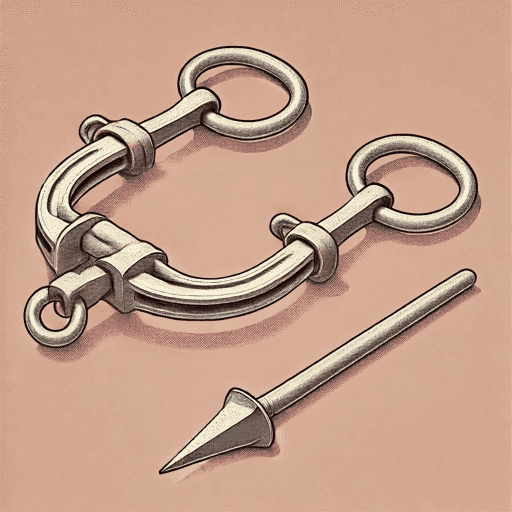
At the end of the play, Dysart accepts that his alienation mirrors that of Alan. He, too, feels the metaphorical bit in his mouth. The “sharp chain” (125) traps him in society’s cage of expectation and normalcy. Alan’s actions may not have been good, Dysart knows, but he now understands with Alan’s motivations. He understands Alan, just as Hesther hoped he would. Unfortunately for both Dysart and Alan, this understanding comes in the form of opening himself to Alan’s pain rather than finding a resolution. Dysart’s final image literalizes the conflict between societal norms and individual desires, as he recognizes that he, too, is bound by expectations he can no longer believe in.

Unlock every key quote and its meaning
Get 25 quotes with page numbers and clear analysis to help you reference, write, and discuss with confidence.
- Cite quotes accurately with exact page numbers
- Understand what each quote really means
- Strengthen your analysis in essays or discussions