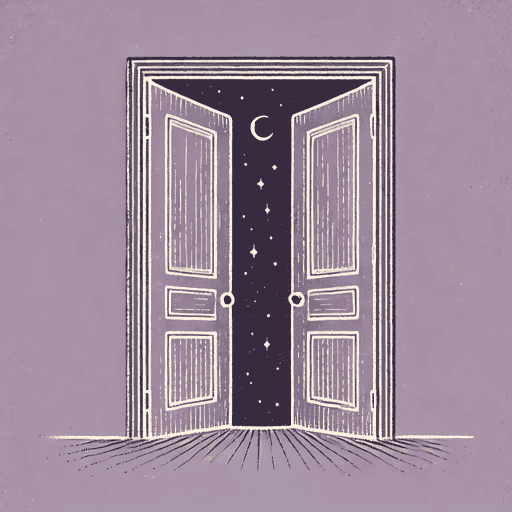
Every Heart A Doorway
48 pages • 1-hour read
Seanan McGuireEvery Heart A Doorway
A modern alternative to SparkNotes and CliffsNotes, SuperSummary offers high-quality Study Guides with detailed chapter summaries and analysis of major themes, characters, and more.
Part 1Chapter Summaries & Analyses
Part 1: “The Golden Afternoons”
Part 1, Prologue Summary: “There Was a Little Girl”
Content Warning: This section of the guide includes discussion of death, bullying, and transgender discrimination.
Eleanor West runs a boarding school for children who have visited magical worlds, most of whom are girls. She never includes the students in the entrance interviews because this would give them a false first impression of her. When she meets with prospective families, she tells them the soothing lie that their loved ones have “a rare but not unique disorder” that causes delusions in girls approaching womanhood (12). In actuality, Eleanor knows that the children are not delusional because she has been to another world as well. She’s heartbroken that roughly one third of the prospective students she could help do not enroll, but she takes comfort in the knowledge that those entrusted to her care are surrounded by people who understand their situation. Eleanor lacked this sort of community when she returned to this world, and she still longs to go “back to the place where she belong[s]” (14).
Part 1, Chapter 1 Summary: “Coming Home, Leaving Home”
Eleanor West’s Home for Wayward Children is a manor with a vibrant garden. Eleanor is almost 100 years old, but she appears to be in her sixties because her travels in other worlds have granted her longevity. She was only seven years old when she first entered a magical world through “the opening between the roots of a tree on her father’s estate” (17), and she sometimes wonders what will happen if someone realizes that she is Ely West, who went missing long ago.
One day, Nancy Whitman, a teenage girl with black-and-white-streaked hair, arrives at the manor. The girl is astounded when Eleanor speaks openly of magic and other worlds. Eleanor made six journeys to a Nonsense world by the time she was 16, and she can tell that Nancy traveled to an Underworld because of her pale skin, white hair, and discomfort in sunlight. Nancy explains that she found a door to the Halls of the Dead in her family’s cellar, that she spent years there, and that she never wanted to return. Eleanor sympathizes with the girl and guides her to a shady room on the first floor. Nancy’s roommate is a girl named Sumi who lived in a Nonsense world. When Sumi insults Nancy’s hair, Nancy angrily explains that her hair is white streaked with black because the Lord of the Dead ran his fingers through her hair the first time they danced. Sumi continues to antagonize her new roommate by mocking her hopes of finding her way back to the Halls of the Dead.
Stillness is greatly valued in the Halls of the Dead, and bright colors are taboo. Nancy spent years learning how to become a perfect living statue, which earned her the favor of the Lady of Shadows. She is horrified when she discovers that her family filled her suitcase with brightly colored clothes. In a letter packed inside the suitcase, Nancy’s mother pleads for her to stop “wallowing in what [her] kidnappers did” and become her “real daughter” again (27). Nancy sinks to the floor and weeps. She tells Sumi that the Lord of the Dead insisted that she make a visit to her original world so that she could be certain that she wanted to stay in his Halls forever.
However, she’s already sure that she wants to stay with him, and she doesn’t understand why a door hasn’t reappeared to take her home. Sumi takes Nancy’s suitcase and announces that they’re going to visit someone. Nancy reluctantly follows her.
Part 1, Chapter 2 Summary: “Beautiful Boys and Glamorous Girls”
Sumi tells Nancy that her parents are dead and that she plans to spend the rest of her life at the school. She leads Nancy to the room of Kade Bronson, a handsome boy who spent three years in a Fairyland called Prism and “killed a Goblin King with his own sword” (38). He was banished back to Nebraska when the fairies realized that he was a transgender boy instead of a girl, and his family doesn’t want him to come back to them. Kade manages clothing exchanges among the students, and he gives Nancy a basket of black, white, and gray clothes to replace the garishly colored contents of her suitcase. After the girls leave Kade’s room, Sumi notices that Nancy is blushing. She asks Nancy if she’s sexually attracted to Kade, but Nancy explains that she’s asexual.
Dinner is served in an immense ballroom, and Eleanor asks all the students to be gentle and understanding toward the new student as she adjusts. Feeling overwhelmed, Nancy goes as still as a statue. She was taught this defense mechanism in the Halls of the Dead to keep ghosts from stealing her soul. As Nancy considers her seating options, she recalls navigating her high school’s cafeteria and feels grateful that she no longer worries about things like cliques and social status. She notices that Kade sits apart from the three other boys and spots two groups of girls. One centers around a remarkably beautiful girl, and the other converges around a punch bowl filled with pink liquid.
After weighing her options, Nancy sits with Sumi and twin sisters named Jacqueline “Jack” and Jillian “Jill” Addams. Jack explains that, instead of the usual directions of North, South, East, and West, portal worlds can be described by their positions on the axes of Logic, Nonsense, Wickedness, and Virtue. Jack and Jill went to a high Logic, high Wicked world and have been back for a year and a half. Nancy has been back in her original world for seven weeks and four days. Although she spent years in the Halls of the Dead, she was only missing from her family home for six months, “[o]ne month for each of the pomegranate seeds that Persephone had eaten” (52).
Part 1, Chapter 3 Summary: “Birds of a Feather”
After dinner, the students attend group therapy with a child psychologist named Lundy. The therapist is a grown woman who looks like an eight-year-old because she made a bargain to age backward during her time in the Goblin Market. The subject for the night’s session is Wicked worlds. Kade argues that Virtue and Wickedness are meaningless labels because he was expelled from a supposedly Virtuous world once his transgender identity was discovered. Nancy believes that the Halls of the Dead is a Virtuous world because the place seemed “kind, at the root of things” (55), but Sumi argues that Nancy can’t be sure. Jack has a theory that the students are largely indifferent to their worlds’ moral alignments because the sense of belonging and acceptance they found there takes precedence.
The next morning, Nancy has orientation with Lundy. She struggles to keep up with the therapist’s complex explanations of the four cardinal directions plus minor directions, such as Wild and Whimsy. When Nancy asks why there are so many more girls than boys at the school, Lundy explains that boys seldom disappear into other worlds because their absences are noted much more quickly: “We notice the silence of men. We depend upon the silence of women” (58). Lundy reveals that there are other schools for students who have visited portal worlds, including a sister school in Maine for children who hated their travels and want nothing more than to forget. When Nancy asks how many students have managed to return to the realms they consider their homes, Lundy answers that she knows of only three. Given the enormous odds against students finding their way back, the School for Wayward Children aims to help students move on.
Part 1 Analysis
Part 1 introduces the reader to Nancy and the other characters who are engaged in The Search for Belonging at Eleanor West’s Home for Wayward Children. The protagonist’s status as a new student facilitates the exposition in these early chapters. For example, her orientation covers fantasy elements like the cardinal directions of Nonsense, Logic, Wickedness, and Virtue that organize the students’ widely varied portal worlds into an overarching system. In addition, Nancy’s disorientation with her new surroundings makes her a sympathetic figure and contributes to her search for belonging. Like most of the students and faculty, Nancy considers her portal world the place where she truly belongs, and she desperately wants to go back. In Chapter 3, Jack advances the theme by explaining that a sense of belonging matters more to the students than their worlds’ moral alignment: “For us, the places we went were home. We didn’t care if they were good or evil or neutral or what. We cared about the fact that for the first time, we didn’t have to pretend to be something we weren’t” (57). The characters’ conviction that their portal worlds are their true homes gives rise to the search for belonging and plays a key role in their motivation as the novella continues.
The school provides an imperfect alternate source of belonging to the stranded world-walkers. Eleanor envisions the boarding school as a community that offers safety, understanding, and acceptance: “This isn’t a place for lies or pretending everything is all right. We know everything is not all right. If it were, you wouldn’t be here” (21). However, belonging comes more easily to some students than others. Nancy experiences isolation because students from cheerful worlds shun those who traveled to places they consider gloomy or frightening, like the Halls of the Dead. In addition, Kade spends meals “sitting by himself” partly because the discrimination that exiled him from Prism is also present at the school (46). It’s significant that the School for Wayward Children doesn’t live up to Eleanor’s vision of acceptance and belonging even before the murders begin because these pre-existing divisions lead to scapegoating and conflict later in the story.
McGuire uses the lens of fantasy to examine The Tension Between Familial Expectations and Individual Needs. From the outset, the author establishes that the children’s adventures in the portal worlds are every bit as real as their time on Earth. Thus, the story’s tension arises not from a question of what is real and what is imagined but rather from the families’ denial of their children’s lived experiences: The parents “dismiss[] their memories as delusions, their experiences as fantasy, their lives as some intractable illness” (11). By pathologizing the changes they see in their children, they cut off any chance of genuine acceptance and understanding even as they maintain that they only “want[] what [i]s best” for their children (12). As the contents of Nancy’s suitcase illustrate, the parents’ ideas of what is best for their children often runs contrary to the children’s needs. Kade quickly emerges as a key figure for this theme because his family refused to accept him for who he is after he discovered that he is transgender in Prism: “Parents don’t always like to admit that things have changed. They want the world to be exactly the way it was before their children went away on these life-changing adventures, and when the world doesn’t oblige, they try to force it into the boxes they build for us” (38). The students’ parents fail to act in their children’s best interest because they refuse to bend their understanding of the world or their expectations for their children’s lives.
Nancy and her fellow students must also contend with The Dangers of Hope and Loyalty. These qualities are often portrayed as virtues in fantasy adventures, but McGuire offers a more nuanced examination of these qualities. Because the students may never see their true homes again, unfulfilled hope can bring them terrible pain. Lundy tries to prepare the children for this eventuality by being blunt about their unfavorable odds: “They say lightning never strikes twice. Well, you’re far more likely to be struck repeatedly by lightning than you are to find a second door” (62). In addition, Sumi expresses the perils of hope when she tells Nancy that “[h]ope is a knife” (29), and she tries to shield herself by saying, “Once they throw you out, you can’t go back” (26). As the novella continues, hope and loyalty both endanger and strengthen the protagonist and her allies.
McGuire uses symbols and motifs to illustrate the protagonist’s desires and struggles. For Nancy, pomegranates symbolize home. The fruit is mentioned in her memories of the Halls of the Dead, and her hair ribbon is “the color of pomegranate seeds” (16), emphasizing her constant homesickness. Doors and keys serve as motifs of the search for belonging because the portals that transport people to other realms are referred to as doors. The image of doors appears in the novella’s title and adds to the emotional impact of scenes, such as Nancy’s conversation with Sumi at the end of Chapter 1: “‘I don’t know why my door isn’t here.’ The tears clinging to her cheeks were too hot” (29). Characters like Nancy, Jill, and Jack must satisfy different criteria to find or create a door back home, and this plays a pivotal role in their character arcs as the story continues.
Nancy’s suitcase is a motif for the tension between familial expectations and individual needs. Much like her parents’ ill-fitting expectations, the suitcase is a piece of baggage that Nancy’s family expects her to carry. Its contents, a note from her mother and the brightly colored clothes she used to wear, pressure Nancy to conform to her parents’ idea of her and become their “little rainbow” again (27). McGuire stresses that this pressure is incompatible with Nancy’s needs and detrimental to her well-being when the suitcase’s contents cause her to weep “hot, hateful tears” (28). By helping Nancy place the suitcase out of sight and acquire clothing that she’s comfortable wearing, Sumi and Kade begin to develop friendship with Nancy and demonstrate that she’s allowed to prioritize her well-being. However, she must eventually face the suitcase again and reach a resolution regarding her families’ desires and her own needs later in the novel.

Unlock all 48 pages of this Study Guide
Get in-depth, chapter-by-chapter summaries and analysis from our literary experts.
- Grasp challenging concepts with clear, comprehensive explanations
- Revisit key plot points and ideas without rereading the book
- Share impressive insights in classes and book clubs