Fairest
50 pages • 1-hour read
Gail Carson LevineFairest
A modern alternative to SparkNotes and CliffsNotes, SuperSummary offers high-quality Study Guides with detailed chapter summaries and analysis of major themes, characters, and more.
Chapter 31-EpilogueChapter Summaries & Analyses
Chapter 31 Summary
Content Warning: This section of the guide includes discussion of suicidal ideation.
Master zhamM’s vision takes place in Gnome Caverns, so Aza wonders if it would be safer to leave. The messenger returns from the Featherbed Inn with a letter from Ijori. The prince apologizes for believing Ivi’s lies, professes that he always thought Aza was beautiful, and reveals that he is searching for her. He vows, “You are my love. I hope someday to be yours once again” (254). The letter from Aza’s parents informs her that guards searched the inn and accused her of being part-ogre, but her family adamantly defended her character. The prince’s visit to the inn has done wonders for their business, and the crown will pay for the renovations to the inn although they will no longer receive the promised 50 acres. Her family’s faith in her moves Aza to tears.
Master zhamM sends another messenger to look for the prince, but he advises Aza not to write to him yet. Instead, she composes a song praising his loving, gentle nature. Aza composes more songs for the gnomes and is paid in gems. She also turns 16 during her time in the caverns. She attends a trial in the gnome court, at which Master zhamM is a judge. She’s scandalized when he decides not to punish a thief, but he explains that he looked into the future and saw that punishing the thief would only make him more likely to steal again, while mercy would help him reform. Aza rejects this reasoning and broods on the injustices Ivi committed.
Chapter 32 Summary
Six weeks after Aza’s arrival at Gnome Caverns, the armorers return from the castle. They report that the king has regained consciousness but cannot speak, and Ivi remains in charge but accepts the council’s guidance. Although the court believes Uju’s story that Aza died saving him from ogres, they still think she used illusing to attain the rank of lady-in-waiting.
Master zhamM’s responsibilities take him away from Gnome Caverns, and he and Aza feel a sense of foreboding at this parting. She goes to the market to buy a gift for him, and a vendor tempts her with a tray of human food, a rarity in the caverns. When she bites into an apple, the fruit tastes “bitter and searingly sharp” (267). A chunk of the poisoned apple wedges in Aza’s throat, and she collapses. Her spirit is wrenched away from her body and sucked into Ivi’s hand mirror.
Chapter 33 Summary
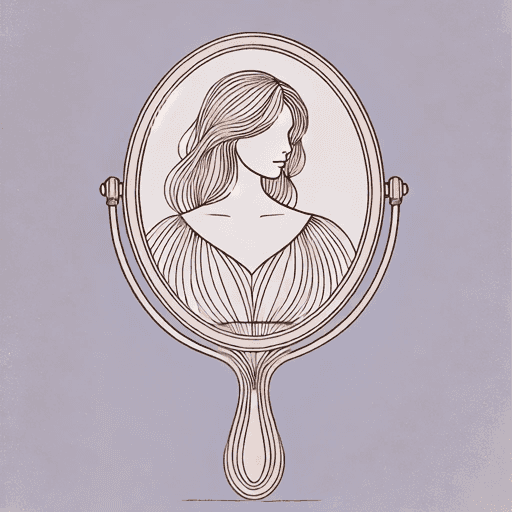
Aza is trapped inside a sparsely furnished beige room with Skulni. He reveals that Ivi used a potion to disguise herself as the gnome who sold her the apple. He tells Aza that her body is dying and that she will gain his powers when she takes his place. Ivi received Skulni and the potions as wedding presents from the fairy Lucinda. When someone who has drunk the potions dies, they go into the mirror so that Skulni can have a break from his labors until the hand mirror gains a new owner. Skulni used Aza’s beautiful reflection to lure her into drinking the potion so he could be free. However, Aza’s body is still alive, so Skulni can’t escape. He plots to bring about Ivi’s death instead.
Chapter 34 Summary
Skulni plots to persuade Ivi to kill Uju, the king, or the prince so that she’ll be executed. Aza struggles to find a way to thwart him and weeps as she thinks longingly of Ijori. She reflects on how people mistreated her because they deemed her ugly and how her desire to be beautiful has created dire problems for her.
Skulni says that he will allow Aza to sit in his chair if she sings to him, so she sings about virtues like “friendship, love, humor, kindness, self-sacrifice” (283). Skulni doesn’t honor their deal, and she struggles in vain to remove him from the chair.
Chapter 35 Summary
During her conversations with Skulni, Aza learns that his machinations are “behind every tragedy and catastrophe in [Ayorthian] history” (285). With each day, Aza feels her body grow closer to death. On her third day in the mirror, Ivi returns to the castle and weeps as she tells Skulni that she killed Aza. Skulni advises the queen to take action against Uju, claiming that the guard will expose her secrets because she failed to knight him.
However, Aza’s illusing allows her to communicate with the queen even though she isn’t in Skulni’s chair. She tells the queen that she’s trapped in the mirror and warns her that Skulni is conspiring against her. The queen demands to know if Aza is still beautiful, and she attempts to destroy the mirror when Aza reveals that she is. The jealous queen decides to die by suicide so that she can be with Skulni, who has convinced her that he worships her beauty. As the queen prepares a draught of poison, Aza sings and launches herself at the mirror.
Chapter 36 Summary
Aza breaks the mirror, causing Ivi to drop the poison, Skulni to vanish, and herself to be pulled back into her body. The effects of the beauty potion have worn off. Aza feels her heartbeat slow and stop, but someone saves her by making her cough up the apple. The next day, she awakens and studies her natural reflection in a mirror. She resolves to learn to accept her appearance and marvels at the beauty of her htun hair.
Ijori visits Aza and kisses her. Uju told him the truth after seeing how grief-stricken the prince was at the news of her death. He blames himself for the perils she faced: “If I had believed you, if I had argued for you, they might not have imprisoned you, and you wouldn’t have run away” (297). Aza tells Ijori and zhamM about Skulni, Ivi, and the threat to Uju’s life. She insists on returning to the castle despite their concerns for her safety. The next day, Aza and Ijori begin their journey to the castle. A party of gnomes, including Master zhamM, accompanies them on the first leg of their journey. When she parts ways with zhamM, Aza sings a song of farewell and gratitude, telling him that he has “a chamber in [her] heart” (302).
Chapter 37 Summary
Aza plans to warn Uju, stay away from the queen, and hope the king awakens soon so that she can explain everything to him. Ijori lifts Aza’s self-esteem when he tells her that he has always admired her grandeur and dignity.
When Aza and Ijori arrive at the castle, everyone is astonished because Uju said that she was dead. The beauty potion stops working for Ivi after the mirror broke, and she secludes herself in her chambers. The king’s condition worsens without his wife’s visits. Aza persuades Ivi to go to him by reminding her how much Oscaro loves her and by assuring her that she is still pretty even without the potion. The king and queen embrace.
Chapter 38 Summary
The council confines Aza to her chamber until the king is well enough to judge her case. She’s visited by Ijori and a growing group of loyal friends drawn to her lovely singing voice and kind nature. When the king regains his ability to speak, his first words are directed to his wife: “My…dear…beautiful…love” (311). Aza is summoned before the king, and she tells Oscaro how Skulni manipulated Ivi. He believes her but refuses to punish his queen because he loves her, and she was instrumental to his recovery. Sir Uellu apologizes for ever thinking that someone with a voice as beautiful as Aza’s could be capable of evil, and she corrects him, saying, “Voices and faces aren’t manifestations of good or bad” (314).
Ijori proposes to Aza, and she gladly accepts. As Aza prepares for the first Sing since the king’s recovery, she reminds herself of the grandeur Ijori sees in her and quiets her inner critic. At the Sing, the king announces that although Ivi saved him from his coma, she’ll live in another castle, and he will abdicate his throne in favor of Ijori in three years. Ivi performs a song in which she apologizes to the people for her actions.
To Aza’s surprise, her family, zhamM, and the duchess attend the Sing. Ijori reveals that the event will double as their wedding ceremony because they want to evade Lucinda and her perilous gifts. Prince Ijori and Aza sing of their love for one another and promise to serve their kingdom well. Aza delights the crowd with her illusing, and everyone applauds for the newlyweds.
Epilogue Summary
Skulni is never seen in Ayortha again after the mirror breaks. King Ijori and Queen Aza defend their kingdom from ogres, and her illusing helps with this. The Featherbed Inn prospers, and Aza’s parents and sister move to the court, leaving the inn in her brothers’ care. Areida becomes a gifted physician and remains close to a friend she met at finishing school, Ella of Frell. Aza and Ijori have three children, and they all inherit her htun hair and ability to illuse. She never attempts to alter her appearance again, but Ayorthian beauty standards shift and come to regard her as stately. Aza, her family, and the kingdom of Ayortha live happily ever after.
Chapter 31-Epilogue Analysis
Levine reimagines elements from “Snow White” to give Aza a happily ever after. The poisoned apple is one of the most iconic elements in the classic fairy tale, but it’s actually one of three methods the wicked queen uses to try to kill the princess in the original story. She also attempts to take Snow White’s life by constricting her breathing with lace and by poisoning her with a comb, which makes the poisoned apple the third gift that Snow White accepts from a mysterious old woman. Ivi’s disguise as the gnomish peddler who gives Aza an apple is immediately recognizable to readers familiar with the Brothers Grimm story while making Levine’s heroine less gullible. In another shift, in the original fairy tale, the prince inadvertently saves Snow White by moving her coffin, which dislodges the poisoned apple caught in her throat. Ijori directly and purposefully makes Aza cough up the obstruction, a change that reflects Levine’s efforts to make the prince a more rounded and active character.
Another key difference is Ivi’s remorse, which proves that, while she is shallow and hurtful, she’s not beyond redemption: “How could I have killed her? I used to like her so much. When she was the oaf, she was my friend” (286). Ivi’s change of heart gives the ending a lighter tone. The protagonist’s royal wedding serves as the resolution in both texts, but Ivi is shown mercy rather than put to death like the wicked queen. In addition, Levine subverts a common trope in fairy tales and fantasy by making it so that Aza “never discovered the identities of [her] birth parents” (324). This authorial decision reinforces that the heroine has embraced her inherent worth and doesn’t need the revelation of a royal bloodline to assign her value.
Ijori helps Aza understand The Importance of Authenticity. Their time apart ultimately brings them closer than ever, and they rebuild their trust and become more honest with one another. For example, Ijori’s letter confides, “I never thought you ugly. I should have told you long ago” (254). At first, Aza’s pursuit of beauty makes it difficult for her to accept that her authentic self is worthy of love and affection: “Now that I was beautiful, I didn’t want to believe he’d never thought me ugly” (254). Over time, she strives to imitate his appreciation for her natural qualities, such as “grandeur and dignity” (304). During their wedding, Aza encapsulates the theme by celebrating how Ijori transforms her self-perception: “[L]oving you makes me love myself more” (322). Aza and Ijori’s love story illustrates how healthy relationships help people value their authentic selves.
In the novel’s final chapters, Aza confronts the ways that beauty standards have impacted her and strives to build self-worth. She reflects on how people have been “rude and cruel” to her all her life because of her appearance (281), and she realizes that she has been “as hard on [her]self as [her] worst critics” (315). This newfound awareness of how she has internalized others’ cruelty helps Aza make the conscious resolution to be kinder to herself. She shows growth and maturity by recognizing how her pursuit of beauty led to trouble and danger, and her experiences teach her to accept her appearance. Further developing the theme, Ijori’s admiration helps Aza begin to envision a future in which beauty standards no longer dictate her self-worth: “Perhaps I could learn to wear myself without apologies, with dignity. Perhaps I could become what Ijori already saw. Perhaps someday I might even be able to smile at myself in a mirror. Not yet. But maybe someday” (304). This excerpt illustrates that unlearning harmful messaging and developing a healthy self-regard take time. In the Epilogue, the author offers a reminder that beauty standards are trends, not immutable laws: “[F]ashions in beauty change, and perhaps my ascension to royalty hastened the alteration. […] My size became stately. Only Ijori deemed me a beauty, but I was considered handsome” (324). This shift in Ayorthians’ perceptions adds to the resolution’s hopeful tone and provides another reason not to become overly invested in beauty standards.
Aza’s climactic confrontation with Skulni proves The Power of Music and develops the novel’s symbols and motifs. Mirrors serve as a motif of The Impact of Beauty Standards on Self-Worth, and Skulni exploits Aza’s low self-esteem to trap her in the magic mirror: “The beautified reflection is my most useful power. It was my bait with you” (275). Thematically, Aza’s confinement in the mirror becomes a metaphor for how she allowed beauty standards to restrict her self-worth. However, her voice, which symbolizes her inner strength and identity, empowers her to break free: “Still singing, I made a fist and punched the mirror with all my strength” (290). By breaking the mirror, Aza not only liberates herself but also saves Ivi and defeats Skulni, who plagued Ayortha for centuries. Although beauty standards restrict the protagonist, she liberates herself by realizing her inner strength and the power of music.
Levine uses color symbolism and the motif of mirrors to reinforce the lessons the protagonist gains over the course of the novel. After she defeats Skulni, ordinary mirrors hold less terror for Aza. Levine uses the scene in which Aza studies her reflection before the final Sing to show how her self-worth is increasing: “I looked again in the real mirror in front of me. Dignified. Dignified and grand. I closed my eyes and saw myself again. Milk-white face, blood-red lips. Dignified and grand” (316). By remembering and repeating Ijori’s compliments, Aza works to deconstruct the damaging beauty standards instilled in her. The gnomish color htun, which represents overlooked beauty, also supports Aza’s shifting perception of herself. In Chapter 36, Aza recognizes that her natural htun hair is “beautiful,” and this comforts her after the potion wears off. The Epilogue reveals that Aza and Ijori’s children inherit the protagonist’s htun hair and ability to see the color. This metaphor signifies that she’ll help her children appreciate themselves and pass on the lessons about self-worth she gained through her adventures.

Unlock all 50 pages of this Study Guide
Get in-depth, chapter-by-chapter summaries and analysis from our literary experts.
- Grasp challenging concepts with clear, comprehensive explanations
- Revisit key plot points and ideas without rereading the book
- Share impressive insights in classes and book clubs