Fear And Trembling
43 pages • 1-hour read
Søren KierkegaardFear And Trembling
A modern alternative to SparkNotes and CliffsNotes, SuperSummary offers high-quality Study Guides with detailed chapter summaries and analysis of major themes, characters, and more.
Key Figures
Søren Kierkegaard
Søren Kierkegaard was a Danish philosopher, theologian, poet, social critic, and author. Born in 1813, he is widely regarded as the first existentialist philosopher. Like later existentialists, he prioritized the self as the basis for all philosophy, viewing humans as free agents capable of making decisions and finding spiritual truths. In most of his earlier works, including Fear and Trembling, Kierkegaard wrote under pseudonyms so that he could engage with philosophical topics and questions from a variety of perspectives. In doing so, he employed the Hegelian dialectic, though he disagreed with Hegel’s views and felt that social and literary critics of his time were far too quick to employ Hegelian philosophy in their criticism.
Kierkegaard’s father had been a laborer on church lands before he moved the family to Copenhagen, where he became rich through his work as a wholesaler. Kierkegaard had six siblings, four of whom died. From his father, he inherited a strict religiosity as well as a generally depressed personality and outlook on life. As a young man, Kierkegaard studied theology. He was engaged to a woman named Regine Olsen but suddenly broke off their engagement for reasons that were never quite clear to him. Much of his writing deals with why he broke up with her and the ethical responsibility he felt. Fear and Trembling was written shortly after his breakup with Olsen. Over the next decade, he became frustrated with the Danish church and publicly challenged the clergy through various pamphlets and articles. He died of a lung infection in 1855. Against his wishes, the Danish church performed his funeral service.
At the time of his death, Kierkegaard was not well-liked in Copenhagen, and his work was not widely known, especially outside of Scandinavia. It was not until the 20th century that his works became as influential as they are now. Today, his philosophy is often seen in contrast to the rigid structure of Hegelianism, just as Kierkegaard intended.
Abraham
Central to Fear and Trembling is the story of Abraham and Isaac as recounted in the Book of Genesis. In Genesis, God tells Abraham to leave his home and settle in Canaan, a land God promises to Abraham and his children. He is told by God that he will be great and will create a great nation from his offspring, for he is blessed. Abraham and his wife Sarah oblige but are not given a child by God as was foretold. Abraham instead fathers a child with Sarah’s handmaid, Hagar. They name the boy Ishmael, but he and Hagar are banished to the desert.
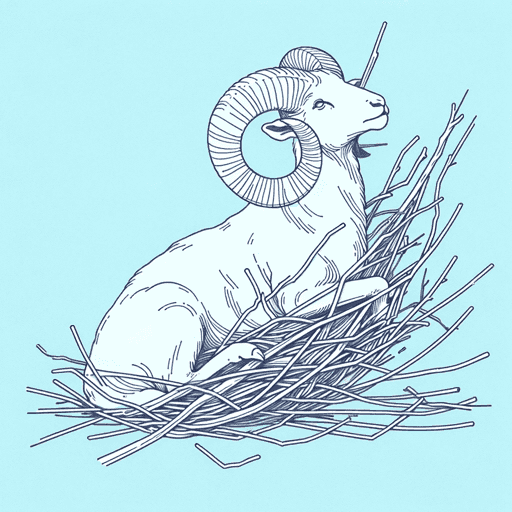
At the age of 99, God promises Abraham once again that Sarah will bear him a child. A year later, she gives birth to Isaac. Isaac becomes Abraham’s most beloved son, for he is the one who will father the nation God promised Abraham. At some point in Isaac’s youth, God commands Abraham to go to Mount Moriah and sacrifice Isaac. Abraham tells no one what he is doing, and he and Isaac ride off to the mountain. There, Isaac carries the wood upon which he will be sacrificed. Isaac asks Abraham where the animal for the burnt offering is, and Abraham tells him that God will provide a lamb. At the moment Abraham is about to kill Isaac, he is interrupted by an angel and shown a ram in the bushes. He sacrifices the ram instead of Isaac. Because he followed God’s orders, he is rewarded with prosperity and more descendants.
In Fear and Trembling, Kierkegaard asks where Abraham’s faith came from and argues that no one can understand why Abraham behaved the way that he did. Kierkegaard uses the story of Abraham to ask larger questions about the role of faith in the world and the nature of human existence, concluding that Abraham is a knight of faith, one who transcends the universal and engages with the eternal by embracing the absurd.

Unlock analysis of every key figure
Get a detailed breakdown of each key figure’s role and motivations.
- Explore in-depth profiles for every key figure
- Trace key figures’ turning points and relationships
- Connect important figures to a book’s themes and key ideas