Feathers
46 pages • 1-hour read
Jacqueline WoodsonFeathers
A modern alternative to SparkNotes and CliffsNotes, SuperSummary offers high-quality Study Guides with detailed chapter summaries and analysis of major themes, characters, and more.
Part 3Chapter Summaries & Analyses
Part 3, Chapter 7 Summary
Content Warning: This section of the guide includes discussion of child death, pregnancy loss, racism, ableism, bullying, and mental illness.
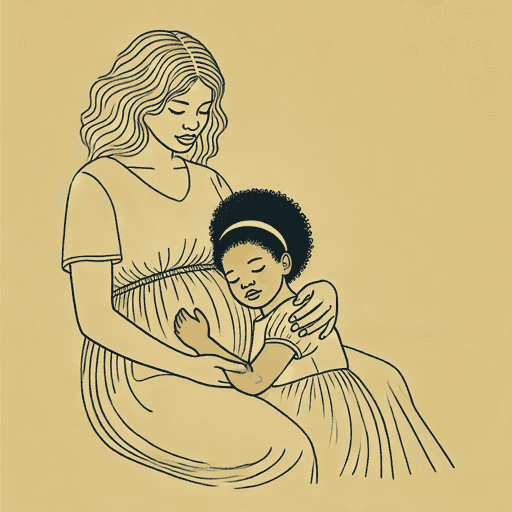
When Frannie returns home that afternoon, her mother is resting. This worries Frannie because her mother has faced physical and mental health challenges connected to Lila’s death and two pregnancy losses. When Frannie was eight, her mother was hospitalized for weeks after a pregnancy loss, and she was quiet and sad when she came home. Eventually, Mama recovered and expressed great gratitude and love for Sean and Frannie.
Sean tells Frannie not to worry about Mama, signing that she’s simply tired. Frannie thinks that if Jesus came back, she’d want to ask him how he holds onto hope even though people like her mother are in pain. She goes to her mother’s bedroom and kisses her forehead. Mama reassures her that she’s all right and is simply tired from raising her children. When Frannie points out that there are only two, Mama answers, “Already feels like more most days” (44). Frannie tells her mother about the Jesus Boy, and Mama points out that people can become accustomed to events that seem strange at first, like the presence of a new student. Frannie whispers, “Some days, it feels like it’s always gonna be wintertime” (46). Mama holds her hand.
Part 3, Chapter 8 Summary
Frannie and Sean playfully banter over which one of them prepares various dishes better as they cook dinner together. The siblings are ecstatic when Daddy comes home. He’s a driver for an interstate moving company and has been gone for two days. Daddy brings roses and lilies for Mama, but he drops them on the table and hurries to her room when he learns that she isn’t feeling well. Mama stays in bed while the rest of the family eats dinner. Daddy tells the children that Mama is having another baby. Sean and Daddy are both excited about the news, but Frannie is troubled. She likes being the youngest in the family, and she worries that her mother is too old to have another child. While the siblings wash the dishes after dinner, Frannie hears music coming from a neighboring apartment. Knowing that Sean can’t hear it makes her feel sad, but she knows that he has “his own music going inside his head” that she can’t hear (56). Simply standing beside her brother eases Frannie’s sadness and worries.
Part 3, Chapter 9 Summary
The next day is Saturday, and Sean and Frannie have an argument when he turns off her favorite cartoons. Mama spends much of the day in bed, but she gets up to ask them to stop fighting. An irritated Frannie starts on her chores, and Sean goes to his room. While she’s cleaning the bathroom, Frannie thinks about the Jesus Boy and wonders where he lives. She goes grocery shopping with her father that afternoon. Both of them are worried about Mama, and Frannie voices her fear that the baby will die. Daddy tells her, “You don’t need to worry about what happened before. All you need to look at is what’s happening now” (58). He admits that their happiness may only last a few months, but he tries to live in the moment. Frannie is still afraid for her mother. Thinking about Jesus, she wishes that she could heal people’s pain and weariness with a touch.
Part 3, Chapter 10 Summary
On their way home from the grocery store, Frannie asks Daddy to drop her off at the recreation center so that she can watch Sean play basketball. She overhears a few girls commenting on her brother’s handsome appearance and making condescending, ableist remarks about his deafness. Frannie feels dispirited when she sees her brother and two of his friends, who are also deaf, losing to a team of boys who can hear, so she goes out into the hallway. The Jesus Boy comes out of the boys’ locker room and smiles at Frannie. She asks him how he knows sign language, and he explains that he’s always known it but can’t remember when he learned it. He mentions that life on the predominantly white side of the highway was difficult for his family because he doesn’t look like his father: “I used to wish that I would wake up and look just like him. I still do sometimes. I look at him and he’s so cool and…” (65). When some children stare at the Jesus boy, Frannie shoos them along, which makes him smile.
Trevor enters the recreation center and tries to pick a fight with the Jesus Boy. A “tall, dark-skinned man” walks over to the Jesus Boy (66), who introduces him as his father. Trevor stalks off without another word. After the Jesus Boy and his father leave the recreation center, Sean exits the basketball court. He teases his little sister for following him around and then proudly tells her that he made the shot that secured victory for his team. As the siblings step out into the snow, Frannie feels warm inside.
Part 3, Chapter 11 Summary
Later that afternoon, the city experiences record-breaking snowfall. Grandma comes over, and Frannie tells her about the Jesus Boy. Frannie’s grandmother urges her to be kind to her new classmate: “You just remember there’s a time when each one of us is the different one and when it’s our turn, we’re always wishing and hoping it was somebody else” (72). Grandma, Sean, and Frannie fall into a comfortable silence and drift off to sleep.
Part 3, Chapter 12 Summary
On Sunday, Samantha calls Frannie and invites her to attend her father’s church, OnePeople Baptist. When Frannie says that she plans to stay home and watch cartoons instead, Samantha becomes frustrated and asks her friend why she isn’t worried about what will happen after she dies. Frannie voices that she doesn’t believe in an afterlife, and she realizes that she doesn’t share Samantha’s fear of mortality because the loss of Lila and the two other babies means that death is a constant presence in her home. Frannie tells her friend that the snow reminds her of Samantha because it’s quiet and peaceful in a way that feels sacred. Samantha asks, “Can you come to church with me, Frannie? […] Just ’cause I want you to?” (77). Frannie agrees.
While Mama likes the idea of Frannie going to church, she reminds her daughter that the choice is entirely hers. Religion offers Mama a sense of hope that she wants to share with her relatives. She dislikes the church led by Samantha’s father because she thinks they condemn people, but she understands that Frannie wants to honor her friend’s request. Frannie recalls the Dickinson poem and tells her mother, “There’s hope in this house. And at your church. And at OnePeople. At our school. Across the highway and on this side too. Everywhere” (80). Mama hugs her daughter close and sheds a single tear.
Samantha’s father, Reverend Joseph H. Brown, has his church in a former candy store nestled between a diner and a laundromat. When they reach the church, Frannie squeezes Samantha’s hand, and her friend smiles back at her hopefully.
Part 3, Chapter 13 Summary
On Monday morning, a girl approaches Sean and flirts with him while the siblings are walking to school. Frannie says what her brother signs, and she grows angry when the girl says ignorant things about his deafness. Sean is dejected when the girl walks away, and Frannie asks, “There’re lots of pretty deaf girls at your school […] Why even bother with hearing ones?” (83). Sean reminds his sister about his idea of bridges connecting each window to another world. He explains, “The hearing girls are the bridges. They’re the other worlds. They’re the worlds I can’t just walk across and into” (83). Sean adds that Frannie doesn’t understand because she can already go wherever she wants.
Part 3, Chapter 14 Summary
Before school begins for the day, Frannie admires the pristine snow covering the school yard and playground. When she sees the Jesus Boy, she thinks of the sign for Jesus, “the middle finger of one hand brushing over the palm of the other” (84). Trevor tries to pick a fight with the Jesus Boy, and Frannie is stunned when Rayray intervenes and asks, “Why you gotta be so…so mad all the time, Trev?” (86). When Trevor persists, the Jesus Boy asks if Trevor wants to fight him because he has a father and Trevor doesn’t. Trevor calls him white, and the Jesus Boy says that neither of his parents are white. Frannie wonders how many times people have made similar assumptions about the Jesus Boy and treated him the way Trevor does.
The Jesus Boy mentions that Trevor’s father is white, and Trevor tries to punch him. Because his arm is in a cast and the ground is slippery, Trevor falls. The sight of the bully sprawled and crying in the snow makes most of his classmates laugh, but Frannie and the Jesus Boy hurry to help Trevor up. Trevor curses at both of them, but he looks and sounds pitiful.
Part 3, Chapter 15 Summary
As Frannie and the Jesus Boy enter the school building, Rayray asks them if they’re all right, “his face softer and more serious” than Frannie has ever seen (91). Rayray is grateful to the Jesus Boy for standing up to Trevor because he no longer fears the bully now. Rayray asks him if he’ll stay at Price, and the Jesus Boy answers that he will because he has nowhere else to go.
The Jesus Boy confides in Frannie that part of him wants to hit Trevor and part of him wants to exchange social roles with the other boy. He says, “I could be the new Trevor around here—with people being scared of me and all. […] Trevor would be the Jesus Boy” (92). The pain that he caused Trevor makes Frannie and her classmates realize that the new student is as human and complex as any of them. The Jesus Boy holds the door for Frannie, and they walk to Ms. Johnson’s class together.
Part 3, Chapter 16 Summary
That afternoon, Frannie and Samantha walk home. It’s snowing again, and Frannie feels as though spring will never come. Samantha is deeply disappointed by the realization that the Jesus Boy is an ordinary boy who was prepared to hit Trevor. She laments how quickly belief can erode: “[W]hen you don’t have that thing to believe in anymore, you don’t have anything” (94). Frannie watches her friend walk away in silence because she doesn’t know what to say to her.
Part 3 Analysis
The confrontation between Trevor and the Jesus Boy in Chapter 14 marks the story’s climax—a moment that Woodson builds toward from the beginning of the novel when Trevor starts to antagonize the new student in Chapter 1. In Parts 1 and 2, the Jesus Boy’s classmates see him as a tranquil, mystical outsider to the point that some believe he may be Jesus Christ. By deliberately saying something cruel to the bully, the Jesus Boy casts off the holiness that others ascribe to him and forces them to recognize his humanity: “And the hurting proved to all of us that the Jesus Boy was just a […] human boy all complicated and crazy as the rest of us” (93). The climax also marks an important moment for the protagonist’s character development. Frannie allows the empathy that she demonstrates earlier in the story to motivate her to move from observation to action when she hurries to help Trevor “[t]he minute [she sees] him falling” because she recognizes his vulnerability and humanity despite his unkindness (90). Part 3 brings the novel’s main interpersonal conflict to a head and sparks key shifts in the major characters’ development.
Woodson develops the novel’s thematic interest in The Impact of Perceived Racial Differences on Community Dynamics by positioning Trevor and the Jesus Boy as foil characters. Both students are white-passing, and Trevor tries to squash speculation about his own ethnicity by attacking the Jesus Boy’s. Trevor continues this pattern of bullying even after he encounters the Jesus Boy’s father, who is Black. The Jesus Boy pushes back, saying, “I ain’t your white boy […] You color-blind?” (88). The similarities between Trevor and the Jesus Boy give him insight into Trevor’s vulnerability, allowing him to strike back in ways he knows will hurt Trevor, such as talking about his “white daddy living across the highway” (88). During the climactic argument between the Jesus Boy and Trevor, some of their classmates try to defuse the situation by unpacking the complexity of racial identity. For example, Chris calls the Jesus Boy “spirit-colored” (88), suggesting that the question of the Jesus Boy’s ethnicity matters less than the things they have in common. After the Jesus Boy makes Trevor cry, his classmates realize that the new student is “just a boy. A white-black boy” (92). This wording marks a shift from the children’s earlier understanding of the Jesus Boy as exclusively white and potentially supernatural, indicating their growing comfort with ambiguity rather than a need for binary absolutes. The confrontation between Trevor and the Jesus Boy stems from scrutiny toward the boys’ ethnicities and opens a path to greater understanding and inclusion within the classroom community.
The revelation that Frannie’s mother is pregnant again causes the protagonist to reflect on The Role of Faith and Hope in Facing Challenges. This development intensifies Frannie’s concerns and gives her an urgent need for the hope that still feels beyond her grasp. She asks her father, “What if you and Mama come home crying again […] What if we think a baby’s coming but it doesn’t come all the way?” (55). At this point in the novel, Frannie still has some reservations about the way people treat religion, as demonstrated by her observation that “[i]t’s not like whichever cat’s the most holiest wins or something” (75). However, she desires the faith and hope that she sees in Samantha, and this longing contributes to her decision to go to church in Chapter 12, as she notes, “Samantha saw the real Jesus in the Jesus Boy and maybe I wanted to see that too” (79). Part 3 shows Frannie wrestling with spiritual questions and struggling to find the belief she admires in others within herself. In the novel’s final section, Frannie achieves an insight that allows her to form a more personal relationship with faith and endure challenges with hope.
In Part 3, winter emerges as a symbol of the challenges that make it difficult to hope. Just as Frannie struggles to imagine an end to the bleak, snowy weather gripping the city, she has a difficult time being optimistic in these chapters, reflecting, “Some days, it feels like it’s always gonna be wintertime” (46). The symbol of winter emphasizes Frannie’s concerns about her mother, adds to the section’s pensive mood, and supports the theme of the role of faith and hope in facing challenges.
In Chapter 12, Frannie makes significant progress toward finding hope—a journey that Woodson emphasizes by returning to Dickinson’s poem and the symbol of feathers. Frannie expands upon feathers’ symbolism by explaining that hope is also “light” enough to “float everywhere”: “There’s hope in this house. And at your church. And at OnePeople. At our school. Across the highway and on this side too. Everywhere” (80). Frannie’s epiphany creates a link between hope and community, underscoring The Search for Belonging as a central theme in the novel. The hope that Frannie has cultivated since the start of the story pushes back against societal divides by arguing that hope isn’t only for those with wealth or white privilege. Sean also seeks to break down the societal divides symbolized by the highway. In Chapter 13, bridges return as symbols of connection when Sean explains his desire to experience what life is like for other people: “The hearing girls are the bridges. They’re the other worlds. They’re the worlds I can’t just walk across and into” (83). The hearing girls who dismiss Sean because of his deafness show that ableism, like racism, is another factor that leads to societal division and must be broken through so that genuine connections and community can flourish.

Unlock all 46 pages of this Study Guide
Get in-depth, chapter-by-chapter summaries and analysis from our literary experts.
- Grasp challenging concepts with clear, comprehensive explanations
- Revisit key plot points and ideas without rereading the book
- Share impressive insights in classes and book clubs