Forget Me Not
64 pages • 2-hour read
Stacy WillinghamForget Me Not
A modern alternative to SparkNotes and CliffsNotes, SuperSummary offers high-quality Study Guides with detailed chapter summaries and analysis of major themes, characters, and more.
Symbols & Motifs
Content Warning: This section of the guide includes discussion of death; emotional abuse; child death; graphic violence; substance use; sexual content; child abuse.
Forget Me Nots
The title of the novel, Forget Me Not, invokes the flower of the same name, which is deeply associated with Natalie Campbell, as well as suggesting the importance of remembering lost loved ones. Early on, Claire fights with remembering her sister, whose clear image she chases continually in dreams. Since Claire was only 11 when Natalie died at 18, Claire’s memories are fuzzy. However, Claire wants to make sure Natalie is not forgotten and even becomes a journalist to show that girls like Natalie are “much more than their final moments. That the days they lived deserve just as much attention as the day that they died” (39). As a journalist, Claire hopes to “make sure lost girls are never forgotten” (318). This emphasis on remembrance makes the forget-me-not flower a key symbol for Natalie within the narrative.
A small blue wildflower, the forget-me-not is a symbol of love and remembrance. They are often given as a sign of loyalty and as a vow to hold someone close even across distance or through hardship. As a child, Claire finds a “spray of small flowers […] a burst of blue petals with yellow suns in the center” (42) in Natalie’s pocket, which seem to her a clue to some secret about who Natalie was seeing the summer she disappeared. Later, at Galloway, she spies the same “pale blue petals huddled together making some faraway memory itch” (165). She later discovers the rusted camper is “surrounded by a bed of [light blue] wildflowers, delicate petals spreading out in each direction” (259). Later Claire learns that forget-me-nots were Natalie’s favorite flower, and Liam planted “them for her in that secret spot they had shared, an effort to honor her memory” (318). Claire notes that they were “irrepressible and wild” (318) just like her sister. Their placement in the field ties Natalie, Claire, and Liam together just as the initial spray was “tied together like a daisy chain” (42).
The Poisonous Lily of the Valley
Just as Natalie is associated with the forget-me-not, Lily is symbolized by a wildflower: The lily of the valley. This small unassuming plant has delicate bell-like white flowers. It has a pretty smell that is often used in perfumes and the blooms are popular in bouquets. In myth and literature, it is often a symbol of sweetness, purity, and motherhood. Lily tells Marcia that Mitchell named her after the flower because the plant, like her, is “dainty but tough” (153). However, the flower and its connotations soon become a symbol of The Deceptive Nature of Appearances, as Lily is a toxic person.
Lilies of the valley are often associated with home in Lily’s mind. As Lily puts it, “They can make the most hostile environments home” (153). Lily is obsessed with having a permanent home and decorates the barn Mitchell’s group stays at. A Christian legend states the lily of the valley first bloomed when Eve’s tears fell as she left the Garden of Eden. Lily’s own fear of being exiled from her own little paradise with Mitchell leads her to make her environment hostile instead of comforting, as she begins to use her namesake flower as a weapon.
Lily notes to Marcia that the lily of the valley can be “invasive under the right conditions” (153), which is also a good description of Lily’s widening thirst for control. This is exemplified by her scrawling Lily was here everywhere she goes. In her research on plants, Claire learns that all parts of the lily of the valley are “highly poisonous” (165) and can cause “cardiac arrest and, eventually, death” (165). This is a good description of Lily, who grows toxic toward anyone whom she feels isn’t fully committed to Mitchell’s plan or who might threaten to take him away from her physically and emotionally. Claire later deduces that Lily has used the leaves of the lily of the valley to make the fatal tea that kills Katherine, Marcia, and Natalie.
The Orange Camper
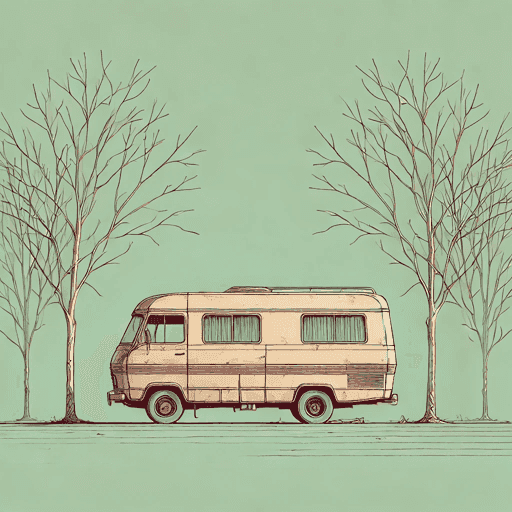
Katherine Ann Prichard’s orange camper serves as a major symbol regarding the death of the hippie ideal of a positive lifestyle devoted to sex, drugs, and love. This is symbolized by Mitchell and Katherine driving in her camper from Berkeley and establishing a group of like-minded individuals on the farm. It seems adventurous and positive at the outset, which is represented by the bright orange color of the camper, the beauty of the farm, and the agreeability of its participants. Marcia’s embrace of what seems like excitement and freedom is shown by her meeting Mitchell in the vehicle.
When he first meets Marcia, Mitchell attracts her by espousing the idea that the only thing that matters is individual freedom from societal conventions. However, this soon becomes a cover to participate in crime and do whatever he (and the “family”) pleases. When Lily poisons Katherine to stop Mitchell from leaving, the camper gains a tainted feel. Mitchell’s manipulations and Lily’s crimes make the camper into a haunted place, showing that any positivity they espoused was ultimately corrupt. Due to its recognizability, the camper is hidden in the woods, where it rusts “atop an altar of flowers like a lost tombstone or private shrine” (260). It clearly indicates that Mitchell’s vision warped into something sinister that ultimately did not function and rusted away.
Still, the truth will out. Buried within the camper are secret talismans that lead to Lily’s many victims: Katherine’s sweatshirt, Marcia’s diary, the stolen roll from Carmen’s camera, and Natalie’s necklace. Further, Natalie and Liam meet there to work out their connection and the identities of their parents. In this way, the camper transforms from a tomb into a vehicle that works to expose and convict Lily and Mitchell of their crimes.

Unlock the meaning behind every key symbol & motif
See how recurring imagery, objects, and ideas shape the narrative.
- Explore how the author builds meaning through symbolism
- Understand what symbols & motifs represent in the text
- Connect recurring ideas to themes, characters, and events