67 pages • 2-hour read
Forty Autumns: A Family's Story of Courage and Survival on Both Sides of the Berlin Wall
A modern alternative to SparkNotes and CliffsNotes, SuperSummary offers high-quality Study Guides with detailed chapter summaries and analysis of major themes, characters, and more.
Symbols & Motifs
Content Warning: This section of the guide features discussions of emotional abuse.
The Heidelberg Castle
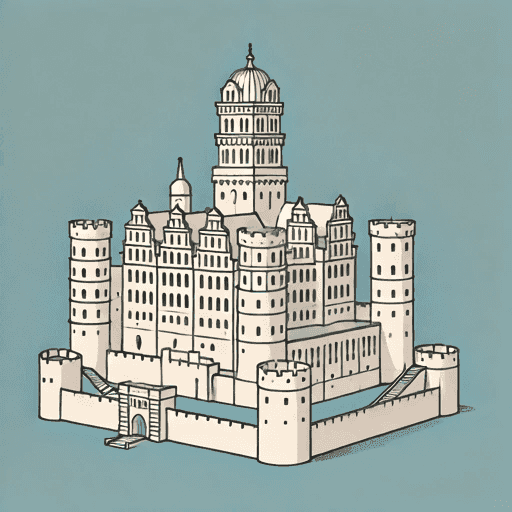
The Heidelberg Castle is a symbol of freedom, intellectual curiosity, and a world of possibility beyond the confines of East Germany. Introduced in Hanna’s childhood through fairy stories and a cardboard model, the castle represents Hanna’s inheritance of intellectual and cultural aspiration from Opa, who teaches his children about art, history, and the vast world outside their provincial village. He encourages them to “‘träumen, entdecken, erforschen’—explore, dream, and discover” this world (14). For Hanna, the castle becomes a tangible goal, an emblem of the life of the mind and spirit that the encroaching authoritarian state seeks to crush. Her desire to see the real castle becomes synonymous with her yearning to escape the ideological prison of the Soviet Zone, underpinned by the castle’s physical location in the West zone. The challenges of this are made explicit when a frustrated Opa, struggling to conform, snaps that “The Heidelberg Castle is now in the West!” (41), making the castle a forbidden paradise.
Hanna’s eventual arrival in Heidelberg and her pilgrimage to the real castle marks the culmination of her quest, transforming the abstract ideal of freedom into a lived reality. The fortress, once a “child’s chimerical fascination” (71), becomes the backdrop for her new life, symbolizing the triumph of the human spirit over authoritarianism. Hanna’s individual dream, nurtured by her father’s previous teachings, proves more resilient than the state’s attempts to limit her imagination and ambition. By reaching the castle, Hanna both achieves her personal goal and fulfills the intellectual legacy of her father, claiming a heritage of discovery that the GDR regime has tried to deny. The castle is a figurative monument to the enduring power of hope and human aspiration.
The Family Wall
The “Family Wall” is a central motif representing the family’s creation of a private, fortified space of love, trust, and moral integrity to withstand the corrosive external pressures of the totalitarian state. Explicitly established by Oma after the construction of the Berlin Wall, this conceptual barrier is the direct antithesis of the state’s physical one. While the Berlin Wall is an instrument of oppression designed to imprison bodies, Oma’s wall is a place of refuge. The narrator explains that Oma “declared the Family Wall a sanctuary […] where the family would preserve their souls by keeping the good in and the bad out” (149). This private ethical sphere is a significant form of personal resistance: Inside this wall, the family nurtures values like loyalty, intellectual honesty, and mutual care, principles that are systematically undermined by the regime’s reliance on suspicion, informants, and ideological conformity. By doing so, the family maintains its identity and moral compass in a world designed to divide and intimidate them.
The motif of the Family Wall intersects with the theme of Family as a Site of Security and Resistance. Metaphorically built in opposition to the public sphere, it is a private realm where truth can be spoken and individuality preserved. Whenever state pressure intensifies—whether through the children’s indoctrination in youth groups or the Stasi’s harassment of Opa—the family retreats behind their conceptual wall to reinforce their bonds. Oma’s insistence that “We are strong because our souls are free” (215) is the core principle of this counter-state realm. The Family Wall allows the family to endure for decades, proving that the intimate bonds of kinship can outlast the coercive power of an authoritarian regime.
The Fur Coat
The fur coat Hanna sends to Oma is a symbol of love, material success, and the disparities created by the Iron Curtain. As a gift, the coat is a tangible expression of Hanna’s enduring connection to the family she left behind, a message of care that bypasses the state’s censors. Its arrival is described as a “miracle,” and Oma’s reaction of collapsing into a chair underscores its significance in a world of scarcity (123). For a woman who has worn the same “threadbare woolen coat for as long as anyone could remember,” the fur coat represents a moment of luxury and a confirmation that Hanna is thriving in the West (123). As a physical link across a sealed border that reaffirms the familial bond, the coat is a manifestation of the family’s private history and a testament to love that cannot be broken by political or geographical divisions.
The coat also symbolizes the danger and inherent sacrifice of free expression in the GDR. Opa initially forbids Oma to wear it, “knowing it would call attention,” which highlights the family’s vulnerability to a regime that pathologizes any connection to the West (123). The coat an item of conspicuous value that marks the family as different and potentially disloyal, with a connection beyond the Wall. The coat is therefore a bittersweet symbol, representing both the success of Hanna’s escape and the stark, painful division between her world of abundance and her family’s world of deprivation and surveillance.

Unlock the meaning behind every key symbol & motif
See how recurring imagery, objects, and ideas shape the narrative.
- Explore how the author builds meaning through symbolism
- Understand what symbols & motifs represent in the text
- Connect recurring ideas to themes, characters, and events