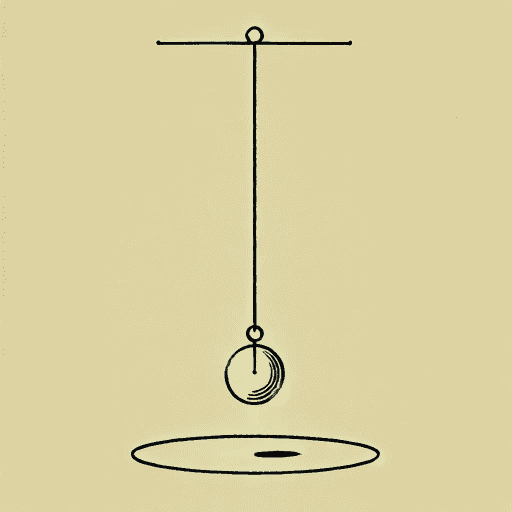
Foucault's Pendulum
73 pages • 2-hour read
Umberto EcoFoucault's Pendulum
A modern alternative to SparkNotes and CliffsNotes, SuperSummary offers high-quality Study Guides with detailed chapter summaries and analysis of major themes, characters, and more.
Important Quotes
Content Warning: This section of the guide includes discussion of graphic violence and death.
“The Pendulum told me that, as everything moved—earth, solar system, nebulae and black holes, all the children of the great cosmic expansion—one single point stood still: a pivot, bolt, or hook around which the universe could move. And I was now taking part in that supreme experience. I, too, moved with the all, but I could see the One, the Rock, the Guarantee, the luminous mist that is not body, that has no shape, weight, quantity, or quality, that does not see or hear, that cannot be sensed, that is in no place, in no time, and is not soul, intelligence, imagination, opinion, number, order, or measure. Neither darkness nor light, neither error nor truth.”
(Part 1, Chapter 1, Page 5)
This early passage establishes the titular pendulum as a motif for The Human Need for Meaning. Casaubon sees the pendulum as a metaphor for the cosmic source of truth, which all of reality pivots around. Since his worldview has already been affected by his obsession with the Templars and the Plan, Casaubon is naturally compelled to project meaning onto objects that can reflect that worldview.
“I don’t know if I did the right thing two nights ago, hiding in that museum. If I hadn’t, I would know the beginning of the story but not the end. Nor would I be here now, alone on this hill, while dogs bark in the distance, in the valley below, as I wonder: was that really the end, or is the end yet to come?”
(Part 1, Chapter 2, Page 12)
Eco employs metafictional techniques to destabilize the reality of his narrative and make the reader conscious of the story’s textuality. This passage demonstrates one such technique, which is the collapse of time. The novel began by establishing that Casaubon in the museum was the present time of the narrative, but this passage suggests that this event is already two days past. Thus, more than an unreliable narration, the structure of the novel itself is unreliable, urging the reader to be suspect of the narrative.
“Here was a man who had said, with his wan smile, that once he realized that he would never be a protagonist, he decided to become, instead, an intelligent spectator, for there was no point in writing without serious motivation. Better to rewrite the books of others, which is what a good editor does.”
(Part 2, Chapter 3, Page 23)
In this passage, Eco characterizes Belbo using the literary term “protagonist,” which extends the metafictional aspect of the story by reminding the reader of the fact that the narrative contains protagonists and other character types. Though he catalyzes the conflict by helping to develop the Plan and bring it to Agliè, the fact that Belbo doesn’t see himself as a protagonist underscores his self-deprecating character traits.
“But the important thing is not the finding, it is the seeking, it is the devotion with which one spins the wheel of prayer and scripture, discovering the truth little by little. If this machine gave you the truth immediately, you would not recognize it, because your heart would not have been purified by the long quest.”
(Part 2, Chapter 5, Page 33)
While commenting on Abulafia, Diotallevi implores Belbo to recognize the distinction between “finding” and “seeking,” two synonymous words that suggest different ways of approaching the truth. The former truth stresses the result while the latter focuses on process. This resonates with the behaviors that distinguish the occultists from the Garamond editors, who each partake in acts of finding and seeking the truth throughout the novel.
“And I found a file devoted entirely to quotations taken from Belbo’s most recent reading. I recognized them immediately. Together we had pored over so many texts during those months […] The quotations were numbered: one hundred and twenty in all. The number was probably a deliberate choice; if not, the coincidence was disturbing. But why those passages and not others?
Today I reinterpret Belbo’s files, the whole story they tell, in the light of that quotation file.”
(Part 2, Chapter 6, Page 43)
This passage demonstrates another metafictional technique, which is self-reflexivity. Casaubon is explaining why each chapter begins with an epigraph, providing Belbo’s files as the repository source of the quotes. This stresses the textual quality of the narrative Eco has created, consequently undermining its reality.
“‘You live on the surface,’ Lia told me years later. ‘You sometimes seem profound, but it’s only because you piece a lot of surfaces together to create the impression of depth, solidity. That solidity would collapse if you tried to stand it up.’”
(Part 3, Chapter 7, Page 50)
Eco uses the character of Lia, who will be introduced later in the narrative, to characterize Casaubon. This choice represents Lia’s function as a critic of Casaubon’s character. Since Casaubon’s unreliable narration makes him prone to misrepresenting himself, the direct attribution of Lia’s observation grounds the reader in a clearer sense of the narrator’s character.
“Whenever a poet or preacher, chief or wizard spouts gibberish, the human race spends centuries deciphering the message. The Templars’ mental confusion makes them indecipherable. That’s why so many people venerate them.”
(Part 3, Chapter 14, Pages 104-105)
This passage, spoken by Casaubon, reflects the human need for meaning as a theme. Eco observes that texts that remain open to interpretation become the subject of prolonged study because they resist the establishment of a definitive reading. The perennial appeal of the Templars, Casaubon suggests, is that no one can discern if their statements are literal or metaphorical, making them open on a basic level of reading.
“‘But Ingolf’s copy wasn’t the original,’ I said. ‘The parchment was the original.’
‘Casaubon, when originals no longer exist, the last copy is the original.’
‘But Ingolf may have made errors in transcription.’
‘You don’t know that he did. Whereas I know Ingolf’s transcription is true, because I see no way the truth could be otherwise. Therefore Ingolf’s copy is the original.’”
(Part 3, Chapter 18, Page 131)
This passage highlights The Instability of History and Truth as a theme. While Casaubon’s complaint harkens to the historicity of the parchment that Ardenti recovered, Belbo argues that historicity is arbitrary, which contradicts the notion of history being stable and objective. This paradoxically nullifies the value of historical sources, making them valuable only insofar as they are objects for interpretation, rather than evidence of a fixed past.
“To escape the power of the unknown, to prove to yourself that you don’t believe in it, you accept its spells.”
(Part 4, Chapter 23, Page 164)
This paradoxical passage foreshadows the quandary that Casaubon, Diotallevi, and Belbo find themselves in as they construct the Plan as a game, hoping to make fun of the Diabolicals who take occult history seriously. By trying to prove themselves above the history they do not believe in, they end up becoming greatly convinced that it is real after all.
“It seems my old classmates—or some of them, at least—were now shooting people who didn’t agree with them, to convince the stubborn to do things they had no intention of doing.
I couldn’t understand it. Now part of the Third World, I made up my mind to visit Bahia. I set off with a history of Renaissance culture and the book on the Rosicrucians, which had remained on a shelf, its pages uncut.”
(Part 4, Chapter 25, Page 172)
This passage underscores the willful remove Casaubon places between himself and the world he lives in. Rather than try to understand his peers’ motivations, Casaubon chooses to retreat into occult history, believing that the past is easier to understand than the present. This stresses his superficiality and the lack of a clear purpose for the knowledge and skills he has built over his life thus far.
“The belief that time is a linear, directed sequence running from A to B is a modern illusion. In fact, it can also go from B to A, the effect producing the cause. [...] What does ‘coming before’ mean, or ‘coming after’? Does your beautiful Amparo come before or after her motley ancestors? She is too splendid—if you will allow a dispassionate opinion from a man old enough to be her father. She thus comes before. She is the mysterious origin of whatever went into her creation.”
(Part 4, Chapter 32, Page 207)
Agliè’s alternative perspective of logic challenges the Western rationalism that Casaubon and his peers have embodied. By suggesting that contradictions have their own discernible logic, Agliè undermines the basic foundations of Western thought and opens Casaubon up to mystical thinking. Subtly, Eco uses this to critique rationalism and invite ways of looking at the world from alternate points of view.
“For you personally, what happened was natural; it probably seemed like a holiday. But not for those my age. For us, it was a settling of scores, a time of remorse, repentance, regeneration. We had failed, and you were arriving with your enthusiasm, courage, self-criticism. Bringing hope to us, who by then were thirty-five or forty, hope and humiliation, but still hope. We had to be like you, even at the price of starting over from the beginning.”
(Part 5, Chapter 37, Page 236)
While relitigating Foucault’s pendulum as a motif for the human need for meaning, Belbo invokes the cultural differences between his and Casaubon’s generations to explain how a sense of meaning can change across time. For Casaubon’s generation, purpose is something they can engage with frivolity while Belbo must reckon with the idea of purpose more soberly. The historical context of their experience in World War II explains how these shifts occur.
“In those months especially, when he was navigating the sea of falsehoods of the Diabolicals, and after years of wrapping his disillusion in the falsehoods of fiction, Belbo remembered his days in *** as a time of clarity: a bullet was a bullet, you ducked or got it, and the two opposing sides were distinct, marked by their colors, red or black, without ambiguities—or at least it had seemed that way to him. A corpse was a corpse was a corpse was a corpse. Not like Colonel Ardenti, with his slippery disappearance.”
(Part 5, Chapter 55, Page 327)
Eco uses irony to paint Belbo’s memories of the war with nostalgia and elaborate on his characterization. The idea that Belbo could better appreciate wartime because of its conceptual simplicity underscores his longing for truth and a clear sense of meaning. This also foreshadows the later revelation of his childhood experience in which he enjoyed communion with the divine source of truth, which was marked by its conceptual simplicity.
“I should remember nothing, yet, on the contrary, I remember everything, not as if I had lived it, but as if it had been told to me by someone else.
I do not know if what I remember, with such anomalous clarity, is what happened or is only what I wished had happened, but it was definitely on that evening that the Plan first stirred in our minds, stirred as a desire to give shape to shapelessness, to transform into fantasized reality that fantasy that others wanted to be real.”
(Part 5, Chapter 57, Page 337)
This passage once again demonstrates the metafictional quality of the narrative as Casaubon refers to the textuality of the narrative by commenting on the unreliability of his memories. What stresses the unreliability of the narration is that it is explicitly tied to the pivotal moment of the Plan’s invention. Casaubon effectively undermines himself as a narrator by informing the reader that the events of the ritual are key for understanding his motivations.
“Any fact becomes important when it’s connected to another. The connection changes the perspective; it leads you to think that every detail of the world, every voice, every word written or spoken has more than its literal meaning, that it tells us of a Secret. The rule is simple: Suspect, only suspect.”
(Part 6, Chapter 66, Pages 377-378)
In this passage, Belbo proposes that synthesis is a high intellectual function, bestowing importance upon facts when one recognizes the potential to link them together. This drives one of the novel’s greater logical problems, which is the question of conceptual simplicity. Belbo believes that every fact is a sign that leads them closer to a unifying truth when in fact, the unifying truth he witnessed in his childhood was marked by its conceptual simplicity.
“Esotericism is the search for a learning transmitted only through symbols, closed to the profane. The occultism that spread in the nineteenth century was the tip of the iceberg, the little that surfaced of the esoteric secret. The Templars were initiates, and the proof of that is that when subjected to torture, they died to save their secret. It is the strength with which they concealed it that makes us sure of their initiation, and that makes us yearn to know what they knew. The occultist is an exhibitionist.”
(Part 6, Chapter 76, Page 433)
This passage is key to cementing The Virtue of Curiosity Versus the Vice of Pride as a theme. Agliè distinguishes between esoterics and occultists by identifying the object of their scholarship. Occultists are exhibitionists because they use the possession of knowledge to display their powers over others. The Templars, implied to be the esoterics in this contrast, were more devoted to the knowledge itself, which is why they committed to protecting it with their lives. This distinction becomes key to evaluating the moral characters of the editors and the occultists throughout the novel.
“‘Excuse me,’ Diotallevi said, ‘but this is going too far. My stomach hurts. I’m going home.’
‘Wait, damn it. When the Templars were disemboweling the Saracens, you enjoyed yourself, because it was so long ago. Now you’re being delicate, like a petty intellectual. We’re remaking history; we can’t be squeamish.’”
(Part 6, Chapter 100, Page 513)
This exchange underscores Belbo’s obsession with the Plan, which comes at the cost of his concern for his longtime colleague, Diotallevi. Belbo dismisses Diotallevi’s physical discomfort, believing he is merely taking offense to his incorporation of the Holocaust into the Plan. This suggests that Belbo has prioritized the completion of the Plan over his relationships with others, establishing the circumstances necessary for him to taunt Diotallevi with the Plan.
“To invent a Plan. The Plan justifies you to such a degree that you can no longer be held accountable, not even for the Plan itself. Just throw the stone and hide your hand. If there really were a Plan, there would be no failure.”
(Part 6, Chapter 105, Page 528)
This passage, taken from one of Belbo’s files on Abulafia, hints at the Plan’s connection to the human need for meaning as a theme. Belbo is suggesting that the Plan is so comprehensive that it can provide an explanation for every tragedy and inconvenience that has ever occurred. This absolves anyone of guilt while also painting each of those tragedies as necessary for the Plan’s fulfillment.
“Your plan isn’t poetic; it’s grotesque. People don’t get the idea of going back to burn Troy just because they read Homer. With Homer, the burning of Troy became something that it never was and never will be, and yet the Iliad endures, full of meaning, because it’s all clear, limpid. Your Rosicrucian manifestoes are neither clear nor limpid; they’re mud, hot air, and promises. This is why so many people have tried to make them come true, each finding in them what he wants to find. In Homer there’s no secret, but your plan is full of secrets, full of contradictions. For that reason you could find thousands of insecure people ready to identify with it.”
(Part 6, Chapter 106, Pages 540-541)
Lia’s criticism of the Plan makes an allusion to Homer’s Iliad to remind Casaubon of what great works of literature and art are supposed to do. Though the Iliad remains open to interpretation, Lia stresses that the meanings that can be derived from the text are all defined by their clarity. In contrast, the Plan shrouds all of its content in secrecy, such that no reader can ever be sure if the Plan is meant to be taken literally or metaphorically.
“‘We were joking…’
‘You don’t joke with the Torah.’
‘We were joking with history, with other people’s writings…’
‘Is there a writing that founds the world and is not the Book? […] Rearranging the letters of the Book means rearranging the world. There’s no getting away from it.’”
(Part 7, Chapter 110, Page 565)
The tragedy of Diotallevi’s death stems from his inability to separate his illness from the consequences of the Plan. Even when Belbo reminds him that the Plan was meant to be a joke, Diotallevi indicates that the Plan was actually aligned with the Torah, which makes the invention of the Plan a transgression against God. Diotallevi dies in a state of conviction of his guilt.
“Perhaps Belbo was reluctant to let her witness his emotion, or perhaps he decided instead that this was the only way he could show his contempt for that crowd, but he held himself erect, head high, chest bared, hands bound behind his back, like a man who had never known fear.”
(Part 8, Chapter 113, Page 594)
This passage marks the transformation of Belbo from a pathetic hero to a tragic hero. Recognizing the imminence of his death, Belbo chooses to be brave for Lorenza, knowing that he will soon return to the divine source of truth. This overcomes his earlier characterization as a coward and makes his death lamentable.
“People are starved for plans. If you offer them one, they fall on it like a pack of wolves. You invent, and they’ll believe. It’s wrong to add to the inventings that already exist.”
(Part 9, Chapter 118, Page 618)
This passage appears as a callback to Lia’s criticism of the Plan. The implication of her statement is that the Plan was not valuable because it accurately captured the truth, but because there are people drawn to subscribe to plans, regardless of their truthfulness or content. This resonates with Belbo’s earlier assertion that belief in a Plan that comprehensively explains history justifies people enough to absolve them of any guilt.
“That day, Jacopo Belbo stared into the eyes of Truth. The only truth that was to be granted him. Because—he would learn—truth is brief (afterward, it is all commentary). So he tried to arrest the rush of time.
He didn’t understand. Not as a child. Not as an adolescent when he was writing about it. Not as a man who decided to give up writing about it.”
(Part 9, Chapter 119, Page 633)
This passage marks the foundational experience of Belbo’s character, his brief communion with the divine source of truth. This reframes his character as someone who has been pursuing a reunion with the divine while also stressing the irony that this encounter occurred before Belbo even had the intellectual skills to understand it. This drives a distinction between appreciation of the truth and understanding of it.
“Where have I read that at the end, when life, surface upon surface, has become completely encrusted with experience, you know everything, the secret, the power, and the glory, why you were born, why you are dying, and how it all could have been different? You are wise. But the greatest wisdom, at that moment, is knowing that your wisdom is too late. You understand everything when there is no longer anything to understand.”
(Part 10, Chapter 120, Page 640)
Casaubon reflects upon the revelation of Belbo’s foundational experience by anticipating the imminence of his death. Casaubon suggests that life can only be understood in retrospect, which makes the experience of life as a present event inherently mysterious. Eco thus suggests that wisdom is not the object of life, but the result of it.
“I would have liked to write down everything I thought today. But if They were to read it, They would only derive another dark theory and spend another eternity trying to decipher the secret message hidden behind my words. It’s impossible, They would say; he can’t only have been making fun of us. No. Perhaps, without his realizing it, Being was sending us a message through its oblivion.”
(Part 10, Chapter 120, Page 641)
Casaubon suggests that it is futile to commit his profound experiences to posterity because it will go unappreciated by its most likely readers, the people who want to use it to find meaning elsewhere. Casaubon refers to an abstract ideal like “Being” to suggest that obscurity and oblivion are the best ways to appreciate his experiences, seeing that the explanations for reality and human existence have likely been made obscure by nature as well.

Unlock every key quote and its meaning
Get 25 quotes with page numbers and clear analysis to help you reference, write, and discuss with confidence.
- Cite quotes accurately with exact page numbers
- Understand what each quote really means
- Strengthen your analysis in essays or discussions