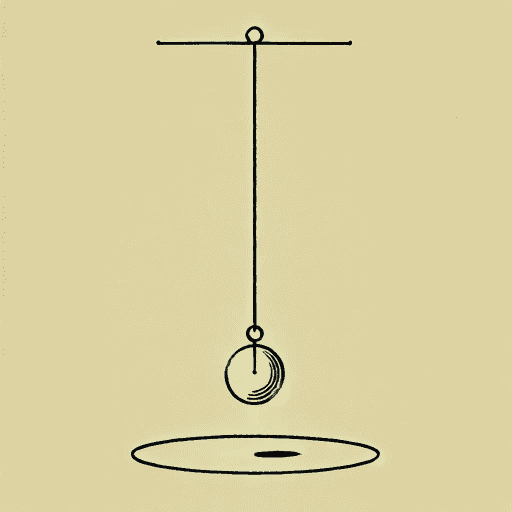
Foucault's Pendulum
73 pages • 2-hour read
Umberto EcoFoucault's Pendulum
A modern alternative to SparkNotes and CliffsNotes, SuperSummary offers high-quality Study Guides with detailed chapter summaries and analysis of major themes, characters, and more.
Character Analysis
Content Warning: This section of the guide includes discussion of illness and death.
Casaubon
Casaubon is the narrator and protagonist of the novel. He is a researcher who works at Garamond Press, though the novel begins when he is still a student of philology at the University of Milan in the late 1960s.
Casaubon is characterized as a scholar with an encyclopedic memory, which enables him to connect disparate pieces of information and supply references at a moment’s notice. His personal arc revolves around the struggle to give his scholarly skills a greater sense of purpose, especially as he comes of age during a tumultuous period of social change and revolution. Casaubon is ideologically carefree, performing political interest for the approval of his peers while disliking Karl Marx for the quality of his rhetoric. In Part 3, Chapter 7, Casaubon describes the comfort of his “aristocratic” scholarship in a world that is becoming increasingly defined by the social drive of the working class: “I could spend the morning debating proletarian matters downstairs and the afternoon pursuing aristocratic knowledge upstairs. In these two parallel universes I lived comfortably and felt no contradiction” (52).
Though Casaubon feels little anxiety toward the increasing specialization of his knowledge, tension arises directly from his continued study of the Knights Templar. He devises the Plan with Belbo and Diotallevi because he sees it as a source of amusement that indulges his intellect. When Lia challenges Casaubon’s interpretation of history and warns him of the moral dangers of the Plan, Casaubon remains so attached to the Plan that he ultimately abandons Lia and their son, Giulio. He subsequently becomes embroiled in the trouble Belbo gets in with Signor Agliè and his fellow occultists. When this results in Belbo and Lorenza’s deaths, Casaubon regrets tempting the occultists’ interest and retreats to the Italian countryside to avoid suffering Belbo’s fate.
Casaubon resolves his arc when he realizes what Belbo’s final defiance means in the larger context of his life. Belbo’s childhood experience of transcendence reframes Casaubon’s understanding of his deceased friend and makes him realize that Belbo devoted his entire life to the pursuit of the transcendence that he longed to return to. By defying the occultists in his last moments, Belbo signaled his loyalty to the secret of his transcendence, which Casaubon relates to because of similar experiences he has had, including the one that marks Casaubon’s final moments in the novel. Casaubon decides to face the occultists with the assurance he, like Belbo, will return to the divine source of truth and beauty.
Jacopo Belbo
Jacopo Belbo is the deuteragonist of the novel. He is an editor at Garamond Press and Casaubon’s older colleague. His senior status at the firm allows him to also function as a mentor for Casaubon, guiding him to pursue a lifestyle that leverages his intellect. However, Belbo also sets the conflict in motion by directly engaging with the antagonists of the novel, led by Signor Agliè.
The end of the novel effectively reveals that Belbo’s character is defined by a childhood experience in which he played trumpet at a funeral service and experienced a transcendent connection to the divine source of beauty and truth. With the certain knowledge that such a source existed, Belbo committed his life to reuniting with it, which informed his decision to pursue a career in the humanities. Even as an adult, Belbo displays a strong sense of nostalgia toward his childhood, which Casaubon interprets as a preference for the simplicity of his life, even though Belbo lived through the tumult of World War II.
Eco characterizes the adult Belbo as an insecure man who wrestles between bravery and cowardice. In the context of his transcendent experience, however, this character trait points to Belbo’s reckoning with the triviality of any given opportunity to demonstrate courage. If Belbo runs from an opportunity, it is because he has decided it is too trivial to involve himself in. At the same time, the novel suggests that Belbo’s discernment is naturally flawed, which is best demonstrated in his fraught relationship with Lorenza Pellegrini. Belbo desires Lorenza but envies the men with whom she chooses to spend her time, like Riccardo and Signor Agliè. When Lorenza starts to show her interest in Belbo, Belbo self-sabotages the opportunity to be with her. For instance, in Part 5, Chapter 55, when Lorenza alludes to sharing a bed with Belbo, Belbo gives a non-committal answer, implying he is not interested in sleeping with her while his colleagues are busy working. Later in Part 7, Chapter 107, Belbo lets his envy of Agliè get the best of him when he goes on a date with Lorenza, believing that she only agreed to go out with him to make Agliè jealous. These failures contribute to Belbo’s obsession with the Plan and his ultimate decision to tease Agliè that he knows the location of the Templars’ final secret.
Belbo’s final scene transforms him from a pathetic figure to a tragic one. When faced with the prospect of death, Belbo chooses to show Lorenza his bravery and defies Agliè during his final interrogation. He knows that death will bring him back to the divine source of truth, and that Agliè and his ilk are unsatisfied with the idea that truth can be simple. The heroism of this act inspires Casaubon to face the occultists at the end of the novel.
Signor Agliè
Signor Agliè is the novel’s antagonist, who acts as a representative for the secret society that threatens Belbo and Casaubon. Agliè presents himself as an elderly mystical figure with an encyclopedic knowledge of occult history, which he attributes to alleged personal experience. Agliè heavily implies that he is an 18th-century occult figure known as the Comte de Saint-Germain, who was rumored to have been immortal. This is later suggested to be a fraudulent claim intended to project an exaggerated sense of power over those he deals with.
Agliè’s antagonism gradually reveals itself across the narrative. Initially, he appears as a supporting character for Casaubon, indulging his curiosity of syncretic religious practices in Brazil. When Casaubon starts working on Project Isis for Garamond Press, Casaubon relies on Agliè’s expertise to discern which manuscripts are suitable for publication. Agliè’s expertise strongly charms Casaubon’s employer, Signor Garamond, allowing Agliè to exert influence over the publisher and gain access to their list of occult authors. During this part of the narrative, Agliè’s antagonism occurs under subterfuge as he is implied to disguise himself as a mysterious scholar named Rakosky, the person who forces Colonel Ardenti’s sudden disappearance.
Agliè’s rivalry with Belbo catalyzes the conflict and makes his antagonism overt. Though Agliè never directly challenges Belbo, he stokes Belbo’s envy by courting the attention of Belbo’s romantic interest, Lorenza Pellegrini. The novel suggests that Agliè and Lorenza have an intimate relationship through the use of their nicknames, “Sophia” and “Simon.” However, Lorenza herself asserts that the nature of her relationship with Agliè is not sexual. When Belbo tries to take revenge against Agliè by teasing him with the location of the Templars’ great secret, Agliè takes his claim seriously and starts directly antagonizing him, framing him for a failed terrorist plot and blackmailing him into cooperating with his associates.
Agliè introduces the novel’s thematic distinction between esoterics and occultists, indicating that the former love knowledge for its own sake while the latter leverage knowledge to benefit their vanity. Though Agliè presents himself as an esoteric, it becomes increasingly clear that he is really an occultist. At the ritual gathering in the novel’s climax, Agliè tries to assert his power by leading Belbo’s interrogation, but he is undermined by his colleagues, who prove that his persona as the Comte de Saint-Germain is merely a ruse. Unable to extract the truth he believes Belbo has, Agliè resigns himself to the occultists’ riot, allowing them to kill Belbo with Foucault’s pendulum.
Diotallevi
Diotallevi is a supporting character who functions as a sidekick for Casaubon and Belbo. He works as an editor at Garamond Press, focusing on the firm’s reference material catalog. Though not ethnically Jewish, Diotallevi is a devout believer in Jewish mysticism or Kabbalah. This allows him to supply the mystical or numerological ideas that support the construction of the Plan.
Diotallevi’s contribution to the Plan is largely done out of scholarly interest. He trains himself to think like one of their occult authors (or Diabolicals) and ends up learning to find connections between historical and occult events. This underscores the tragic quality of Diotallevi’s illness since Diotallevi cannot help but interpret his tumor as divine retribution for helping Casaubon and Belbo to manipulate the truth to their advantage. While nothing suggests this is true, Diotallevi’s conviction in his belief stresses the corruption of his thinking. In any case, Diotallevi’s illness is the first event that forces Casaubon and Belbo to reassess their obsession with the Plan, since they realize that their fixation on seeking historical connections prevents them from observing the decline in Diotallevi’s health.
Lia
Lia is the romantic interest of Casaubon and the mother of his son, Giulio. Lia is introduced as an intellectual match for Casaubon, someone who performs a similar line of work in encyclopedia research.
Lia’s critical ability enables her to offer an alternative perspective to Casaubon’s interpretation of what is happening throughout the narrative. There are two moments where this becomes key to facilitating Casaubon’s relationship with the Plan. The first happens in Part 5, Chapter 63 when she reassures Casaubon that principles of logic follow from the principles of physical reality. This effectively prevents him from becoming obsessed with the Plan the way that Belbo and Diotallevi do, especially since she follows this argument up with the revelation of her pregnancy. From this moment on, the narrative frames Lia in opposition to the Plan: Either Casaubon devotes himself to his game or he pays attention to Lia and later on, their son, Giulio.
The second key moment comes in Part 6, Chapter 106 when Lia challenges the integrity of the Plan by reinterpreting the Provins message. Her reading of the message as a laundry list undermines the foundation of the Plan, stressing the fact that the Plan is almost entirely based on assumption rather than concrete evidence. This intensifies the dichotomy between Casaubon’s intellectual life and family life, forcing him to prioritize the former out of vanity.
Lorenza Pellegrini
Lorenza Pellegrini is the romantic interest of Belbo and the object of Belbo’s rivalry with Agliè. Lorenza is introduced in Part 5, Chapter 34 as a regular at Pilade’s bar who seizes Belbo’s attention. Lorenza exposes Belbo’s pathetic qualities by refusing to consummate his romantic desire for her. Though Lorenza is married when they first meet, Belbo is envious of the men she chooses to have affairs with. Nevertheless, he indulges her requests to bring her around Milan out of devotion to her. Lorenza does this because of her amoral character, which she explains when she tells the story of Sophia, the first human, whose existence occurred outside the bounds of morality.
Lorenza eventually tries to reciprocate Belbo’s feelings. However, Belbo’s insecurity causes him to sabotage these attempts, which further frustrates their relationship. Belbo’s failure is highlighted by the fact that Lorenza eventually leaves him on his own, even in the middle of dates.

Unlock analysis of every major character
Get a detailed breakdown of each character’s role, motivations, and development.
- Explore in-depth profiles for every important character
- Trace character arcs, turning points, and relationships
- Connect characters to key themes and plot points