Foucault's Pendulum
73 pages • 2-hour read
Umberto EcoFoucault's Pendulum
A modern alternative to SparkNotes and CliffsNotes, SuperSummary offers high-quality Study Guides with detailed chapter summaries and analysis of major themes, characters, and more.
Part 1-Part 4, Chapter 24Chapter Summaries & Analyses
Content Warning: This section of the guide includes discussion of racism, religious discrimination, antigay bias, graphic violence, and death.
Part 1: “Keter” - Part 4: “Hesed”
Part 1, Chapter 1 Summary
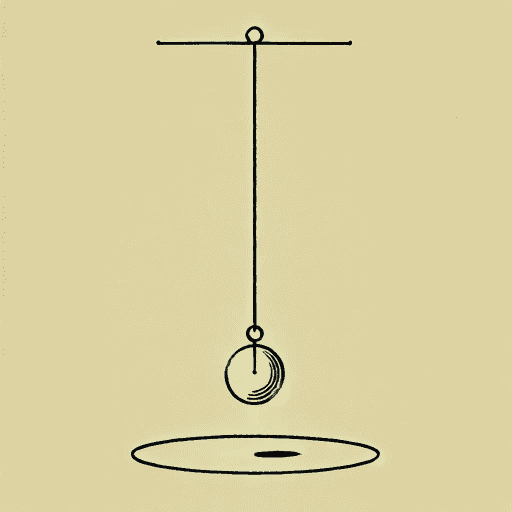
A junior editor named Casaubon reflects on the mechanics of the Foucault’s pendulum at the Musée des Arts et Métiers in Paris. Casaubon imagines a giant pendulum tracing a path along the Earth, uniting various landmarks. He also imagines a fixed point around which the whole universe moves.
A boy and a girl discuss the pendulum with uncertainty. Casaubon resents them and thinks about his colleague, Jacopo Belbo, who first told him about the pendulum. Casaubon walks through the museum, looking for hidden entryways and hiding places. He reflects on the museum as a repository of arcane knowledge, an idea that he, Belbo, and another colleague named Diotallevi arrived at when they devised a game called the Plan.
Part 1, Chapter 2 Summary
Just before the museum closes, Casaubon briefly considers hiding in the car exhibit. He proceeds into an exhibit displaying Antoine Lavoisier’s chemistry laboratory and theorizes that the exhibit is meant to mock the Enlightenment. In the next hall, Casaubon finds a periscope sentry box to hide in. He waits past closing time and prays that none one will find him. To stay awake, he focuses on his past.
Part 2, Chapter 3 Summary
The narrative jumps back two days prior. Belbo calls Casaubon from Paris and nervously tells him that the Plan is true after all. Belbo is being pursued by the Templars, who believe he possesses an important map. Belbo urges Casaubon to access his computer, Abulafia, and read his files. The call cuts after Casaubon hears a scuffle on the other end.
Casaubon doubts Belbo’s claims about the Plan being true. He arrives at Belbo’s apartment and finds a printout of the first file Belbo wrote, entitled “Abu.” In the document, Belbo marvels at Abulafia’s capacity to compensate for the limits of the human mind, including the ability to forget.
Part 2, Chapter 4 Summary
Part 2, Chapter 5 Summary
Casaubon remembers a conversation between Belbo and Diotallevi. Diotallevi was skeptical of Belbo procuring a computer since Belbo was a failed writer. As a firm believer in Kabbalah, Diotallevi also worried that the computer could distort texts into the original Torah that links humanity to God. Belbo reassured Diotallevi that he could control Abulafia with modesty. He demonstrated this by commanding Abulafia to display all the permutations of God’s name, but Diotallevi was unimpressed.
To access Abulafia in the present, Casaubon realizes he must arrive at the correct permutation of God’s name in Italian. He tries producing different permutations, but becomes increasingly skeptical of his theory. Looking at a photograph of Belbo’s romantic interest, Lorenza Pellegrini, Casaubon sees the word “Sophia” written in inscription. He uses it as a password and fails to gain access once again.
Part 2, Chapter 6 Summary
Abulafia asks Casaubon if he has the password. Mockingly, Casaubon types “no,” which unlocks the computer. Casaubon begins printing and reading Belbo’s files, which shock him. One of the files contains 120 quotations from Belbo’s recent reading; Casaubon explains that these quotations form the epigraphs at the start of each chapter. He believes these quotations will help to interpret his story, but admits the possibility that his interpretation is wrong.
The novel jumps forward to a time after Casaubon’s visit to the Musée des Arts et Métiers. Casaubon alludes to being on a hilltop house. He reveals that when he was hiding in the periscope, he still wasn’t certain that Belbo’s claim about the Plan had been true. It was only when he tried to remember the past 15 years that he began to regret the Plan.
Part 3, Chapter 7 Summary
The novel jumps back to the late 1960s. Casaubon is a student at the University of Milan who enjoys the dissonance of conflicting ideas. He participates in the 1968 uprisings against the government, but mainly does so for the promise of sex with fellow activists. Casaubon studies philology, believing that his aristocratic knowledge will be useful in a proletarian society. He selects the trial of the Knights Templar as his thesis subject because he is frustrated by the unsubstantiated occult texts on the subject. This leads him to meet Belbo in 1972.
Part 3, Chapter 8 Summary
Casaubon meets Belbo at Pilade’s Bar. Much older than Casaubon, Belbo is a regular at Pilade’s known for his disarming manner and his penchant for abstract thought.
Casaubon narrates that among the files he recovered from Abulafia, he found several diary entries Belbo kept to reflect on past events. These entries reflect Belbo’s motivations for developing the Plan. One such entry is presented, a file entitled “A bevy of fair women.” The entry enumerates the women Belbo fell in love with but could never have, including Cecilia, a crush who was in love with another boy.
Part 3, Chapter 9 Summary
Casaubon realizes that the file he just presented included a reference to a trumpet, which reminds him of another conversation with Belbo. While talking about manuscripts under review, Belbo commented that the object of one’s desire is never what one believes it is, and he told a childhood anecdote about a toy trumpet he saw in a dream. He assumed that he wanted the trumpet, which his parents could not afford. When his aunt and uncle promised to buy him a trumpet, they took him to the toy store, where he realized he did not know which kind of trumpet he wanted. They got him a clarinet instead because it was cheaper. Belbo concluded, however, that had he gotten a trumpet, he wouldn’t have been happy.
Part 3, Chapter 10 Summary
Casaubon returns to the night of his first meeting with Belbo. When Casaubon mentions that he is studying the Templars, Belbo comments that it is a subject for “lunatics.” He elaborates that publishers divide people into one of four types: lunatics, morons, fools, and cretins. Cretins and fools never produce any writing of merit. Morons have a tendency to use the wrong logic to arrive at the right answer, which can pose problems for an editor who has to refine their work. Lunatics, on the other hand, find connections in everything, so they feel no need to look for proof to validate their claim. Casaubon indulges Belbo’s explanation by demonstrating moronic logic, which amuses Belbo. Belbo invites Casaubon to review a manuscript on the Templars at his office, Garamond Press.
Part 3, Chapter 11 Summary
Belbo is privately melancholic. Casaubon proves this with another file from Abulafia, entitled “Seven Seas Jim.” The document reveals Belbo’s frustrated ambitions to become a writer and the frustration of having to write using other people’s words. He imagines an editorial meeting with William Shakespeare, in which he gives feedback on a draft of Hamlet (1609). Belbo compares himself to a midwife for the works of others.
Part 3, Chapter 12 Summary
Casaubon visits Garamond Press the next day. Casaubon meets Diotallevi, who handles reference books and impresses him with his wit. Diotallevi excuses himself to prepare for the Sabbath. Belbo clarifies, however, that Diotallevi is not ethnically Jewish, but practices Kabbalah.
Belbo shows Casaubon the Templar manuscript. Casaubon assesses that it retreads old unsubstantiated theories, which compels Belbo to reject it. They agree to meet for drinks at Pilade’s, so that Casaubon can share everything he knows about the Templars.
Part 3, Chapter 13 Summary
Casaubon begins his explanation in the year 1118. The order of the Poor Fellow-Soldiers of Jesus Christ was founded following the Christian conquest of Jerusalem. They vowed to defend pilgrims and were given lodging in the Temple of Solomon, after which they were renamed the Knights of the Temple. New recruits romanticized the work of the Templars, allowing its number to quickly swell and gain significant power.
In 1128, Saint Bernard formalized the articles of the Templars’ monastic rule. The rule was so restrictive, however, that some Templars soon became envious of the secular Crusaders who enjoyed the spoils of war. Templars who deserted their post spread rumors that fed the order’s bad reputation. Nevertheless, the Templars enjoyed widespread support from the Christian sovereigns and were granted financial privileges that allowed them to operate profitably each year.
After Casaubon describes the Templars’ role in the ultimate defeat of the Crusades over a century later, Belbo and Diotallevi register his affection for the Templars.
Part 3, Chapter 14 Summary
King Philip IV saw the Templars as a rival power due to their wealth and military strength. After a failed attempt to join the Templars, Philip spread rumors to sully their reputation. In 1307, Pope Clement V opened an inquiry against the Templars, but gave them an opportunity to escape. The Templars remained in place, allowing for their mass arrest later that year. Most of them confessed they were guilty of the charges against them, including blasphemy and idolatry, though they clarified that they only did so in jest.
Subverting the Church’s authority, Philip issued sentences on the Templars, effectively causing their dissolution. In 1314, the last grand master of the order, Jacques de Molay, continued to defend the Templars’ honor and was executed.
Belbo and Diotallevi wonder if the rumors of the Templars’ blasphemy were based on any truth. Casaubon explains the rumors away with various theories. For instance, the accusation that Templars would kiss each other’s buttocks derived from an Indian doctrine related to a serpent cosmic force called Kundalini, which resided in the base of the spine. This would open the third eye, which was appealing to neo-Templars hoping to transcend ordinary human perception. Casaubon concludes that people are inclined to find meaning in things they cannot understand, especially the Templars’ most outlandish ritual behaviors.
Part 3, Chapter 15 Summary
One day, Casaubon participates in a major protest at the university and bumps into Belbo. When the protest breaks into violence, Belbo helps Casaubon escape through a side street, a technique he learned growing up in an unnamed rural town during World War II. Casaubon encourages him to write about it, but Belbo laments that all the good war memoirs have already been written.
Part 3, Chapter 16 Summary
Casaubon presents another file from Abulafia, entitled “Canal.” The document shows Belbo wondering whether it is wiser to be a coward in the face of dangerous, trivial opportunity. In the town where Belbo grew up, there were two rival gangs, the Alley and the Canal gangs. Belbo joined the former by virtue of where he lived. One night, the Alley and Canal gangs agreed to battle. Belbo accompanied his gang leader’s group, but remained in the rear out of cowardice. The battle ended with a truce. The next time there was a battle, Belbo went to the front and was wounded, which traumatized him.
Part 3, Chapter 17 Summary
A year after the protest, Casaubon bumps into Belbo again. Belbo invites him to the office. During this time, Belbo receives a visitor who wants to share a new manuscript on the Templars. The visitor is a veteran named Colonel Ardenti.
Ardenti explains that his manuscript concerns the arrest of the Templars. He theorizes that the reason they did not resist arrest was that they had planned around it to ensure the protection of a secret power in their possession. While the public Templars were being dissolved, a secret directorate sustained Templar operations. Other survivors reformed the Templars across Europe under new names.
Ardenti suggests that Jacques de Molay’s nephew, Comte de Beaujeu, moved the secret of the Templars to Provins, Champagne, where they received support from its local ruler, himself a Crusader. This implicates the Crusades as an endeavor the Templars initiated to consolidate their power over Europe and the Holy Land.
Part 3, Chapter 18 Summary
Provins’s extensive tunnel network made it a suitable location to host the Templars in secret. In 1894, dragoons located hidden chambers underneath Provins’s tithe granary. Ardenti suspects that this is where the Templars hid their treasure. He investigated one of the dragoons whom he believed to have found the treasure and learned that he suddenly disappeared in Paris. Ardenti found a copy of a parchment the dragoon recovered from the Templars’ chamber, which he offers to share with Belbo and Casaubon. Casaubon is skeptical that the dragoon may have made errors in transcribing the parchment.
Part 3, Chapter 19 Summary
The transcription presents two sections of text, which Ardenti interprets as a plan to reorganize the Templars across six countries and avenge Molay. The plan involved sending knights to six locations where the Templars had hidden seals. In each location, the knights would stand guard for 120 years before opening the seal, after which the knights in the succeeding five locations would repeat the cycle projected to end in 1944. This would prepare them for the year 2000, in which they believed the Antichrist would come to Earth. They would then join the Antichrist to complete their revenge.
Diotallevi confirms Ardenti’s theory using numerology and Kabbalistic tradition. Encouraged, Ardenti reveals his belief that the Templars’ plan was focused on the Holy Grail.
Part 3, Chapter 20 Summary
Ardenti discusses the various interpretations of the Holy Grail, from the literal cup of Jesus Christ to a symbolic source of cosmic power. Ardenti discusses the six locations cited in the plan: the castle (a secret lodge in northern Europe), the bread (the site of the Last Supper in Jerusalem), the refuge (Tibet, the origin point of the Aryans), Our Lady Beyond the River (the cathedral of Chartres), the Hostel of the Popelicans (the ruins of the Cathars between Italy and France), and the stone (Stonehenge).
Ardenti suggests that because there is no evidence to indicate that the plan was fulfilled, an unknown event interrupted the Templars’ plan. If the plan is still open for fulfillment, Ardenti wants to find people who have found similar clues, so that they can work together to solve the Templars’ mystery. He reveals that earlier that day, he met one such person who expressed interest in writing him a Preface. The person, a traditional studies scholar named Rakosky, urged him not to bring the manuscript to publishers yet, but Ardenti was too eager to wait.
Belbo dismisses Casaubon and Diotallevi from the office so that he can discreetly make an offer to Ardenti.
Part 3, Chapter 21 Summary
The following day, Belbo tells Casaubon that he sent Ardenti to another publisher, but Ardenti disappeared before he could make his appointment. They get a call from a police inspector named De Angelis, who informs them that Ardenti has been presumed murdered.
Belbo warns Casaubon not to disclose any details about Ardenti’s manuscript. De Angelis explains that Ardenti was seen entering the hotel with two men. A porter was called up to the room. When he entered, he found Ardenti strangled on the bed and the room in a mess. The porter went to retrieve a doctor and policemen, but when he returned, Ardenti’s corpse was gone.
Part 3, Chapter 22 Summary
Belbo tells De Angelis about their meeting with Ardenti, but omits any details about the manuscript. De Angelis reveals that Ardenti is a false identity and that he is suspected to have been a scam artist. Rakosky is identified as one of the men who accompanied Ardenti to his room, though it is later revealed that this identity is likely false as well. Based on the investigation, Rakosky and the other man were looking for Ardenti’s manuscript.
Back at the office, Belbo reassures Casaubon that they have nothing to worry about. Over the next year, Casaubon finishes his thesis. He falls in love with a Brazilian woman named Amparo and moves to Brazil with her.
Part 4, Chapter 23 Summary
Casaubon becomes integrated into Amparo’s social circle of Marxist thinkers. Casaubon tries to stay away from politics, but maintains a scholarly interest in their frequent references to religious syncretism. Amparo, on the other hand, openly resents religion as an establishment tool.
Part 4, Chapter 24 Summary
Casaubon receives a letter from Belbo. On a recent visit to the site of occultist Alessandro Cagliostro’s death, Belbo learned of a group of occultist students called Picatrix, who were organizing a ritual evocation of Cagliostro’s spirit. Belbo witnessed the ritual and was disturbed when the possessed individual referenced the Provins message Ardenti spoke of.
Belbo soon discovered that De Angelis was in attendance as well, having been led there after he learned that Ardenti was associated with Picatrix. When Belbo shared his reaction to the ritual, he accidentally revealed some of the manuscript’s contents. Two days later, De Angelis informed Belbo that the possessed individual had, like Ardenti, mysteriously vanished. De Angelis used this to motivate Belbo into revealing more information. Belbo refused. He warns Casaubon that De Angelis may seek him out next.
Part 1-Part 4, Chapter 24 Analysis
The first three parts of the novel establish the narrative frame and the immersive nature of the conspiracy that drives the plot forward. Eco begins the story in medias res, opening on Casaubon after much of the narrative has already occurred. Consequently, much of what the novel exposes is told in retrospect, explaining why Casaubon chose to hide in the periscope. Even as Part 4 opens on the possibility of a growing threat against Casaubon and Belbo, their survival is guaranteed by the early exposition that both men eventually end up in Paris. It also creates a sense of foreboding around their discovery of the conspiracy surrounding the Templars. While their past selves assume that Ardenti’s story is a historical trifle, the narrative suggests that they are destined to discover the seriousness of what Ardenti is confiding in them.
This is underscored by Casaubon’s direct foreshadowing of the end of the novel. He initially suggests that the action in Paris is the true present of the narrative. However, in Part 2, Chapter 6, the novel jumps forward even further, revealing that Casaubon has already survived his ordeal in the museum. Eco does this to destabilize the reader’s sense of reality in the novel, establishing The Instability of History and Truth as an important theme of the novel. The fact that the narrator, Casaubon, cannot establish a clear and direct order of events while under pressure suggests that a singular, stable truth is irrelevant to the story he is trying to tell. The establishment of meaning hinges on Casaubon’s ability to remember events while in the periscope. If he forgets or leaves something out, it also gets left out of the construction of narrative meaning. By Part 4, Chapter 24, Eco affirms this by relating events from Belbo’s report, things that Casaubon cannot possibly verify from his own perspective of events. The truthfulness of his story is therefore suspect.
Eco, a Postmodernist, deploys metafictional techniques to further destabilize the reality of the narrative. Casaubon directly references the textuality of his narrative in Part 2, Chapter 6 when he reveals that the epigraphs that begin each chapter are taken from Belbo’s Abulafia files. Abulafia becomes a prominent motif for The Human Need for Meaning in this early section of the narrative, especially since Belbo’s files recur across the narrative, such as in Part 3, Chapter 9 and 16. Inasmuch as Belbo is trying to make sense of his life by writing personal missives in his private repository of knowledge, Casaubon is undermining the intimacy that Belbo trusted in by sharing those missives with the reader. Casaubon’s ultimate aim is to make sense of Belbo and why Belbo has led him to Paris and later the hilltop house where the story ends. This reflects Casaubon’s own quest for meaning, a way to understand his relationship with Belbo and why that motivated his decision to follow him.
Casaubon presents Belbo as someone who is self-satisfied, but this is merely a coverup for his many insecurities, such as his failure to become a writer, despite the fact that he possesses the skills required to succeed as one. Belbo is also a mentor for Casaubon, being older and much further along in life than Casaubon the fresh graduate. As Casaubon is making his way through the world, he must reflect on the usefulness of his knowledge and skills in a world that rejects the esoteric nature of his knowledge. Eco foregrounds Casaubon’s college years against the politics of the 1968 protests against fascism and capitalism. Casaubon participates in politics out of peer pressure rather than any real political animus. Even when he moves to Brazil, he is less interested in sympathizing with the proletarian struggle of Amparo’s social circle than he is in understanding his self-perceived intellectual superiority to religious revolutionaries.
This masks Casaubon’s own insecurity, however, which is the futility of the knowledge he is striving to pursue. For several years, he pursues a thesis on the Knights Templar, engaging with various texts to derive the historical truth of their downfall. While that knowledge could be used to inform his understanding of the revolution taking place among his generational peers, it becomes more relevant in the context of Ardenti’s esoteric mystery. Casaubon allows his knowledge to be useful only in its own context, which defeats the purpose of the historical endeavor in the present time. Casaubon is headed toward a career where he endlessly plumbs through the historical records, if only to provide a clearer picture of what the Templars really were. Though Casaubon resists Ardenti’s claims, he is doing so to assert his mission as a historian, someone who can claim mastery over a very narrow subject of study.

Unlock all 73 pages of this Study Guide
Get in-depth, chapter-by-chapter summaries and analysis from our literary experts.
- Grasp challenging concepts with clear, comprehensive explanations
- Revisit key plot points and ideas without rereading the book
- Share impressive insights in classes and book clubs