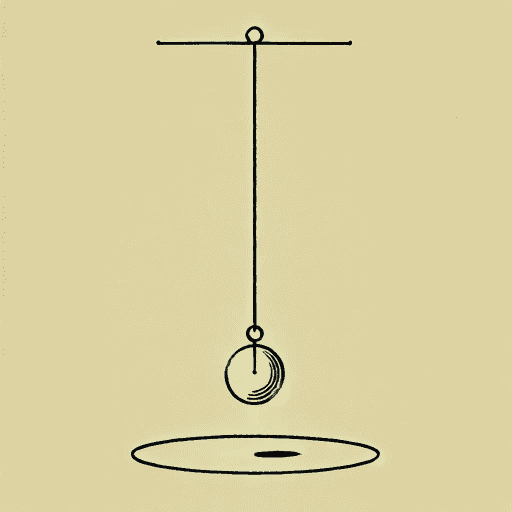
Foucault's Pendulum
73 pages • 2-hour read
Umberto EcoFoucault's Pendulum
A modern alternative to SparkNotes and CliffsNotes, SuperSummary offers high-quality Study Guides with detailed chapter summaries and analysis of major themes, characters, and more.
Part 6, Chapter 97-Part 10Chapter Summaries & Analyses
Content Warning: This section of the guide includes discussion of illness, anti-Semitism, racism, emotional abuse, graphic violence, and death.
Part 6: “Tiferet” - Part 10: “Malkhut”
Part 6, Chapter 97 Summary
A resigned Belbo contrasts great art from low forms of art like the dime novel. He believes that dime novels are better in capturing and predicting reality because they portray unusual people in unusual situations. Casaubon suggests that low art is easier for people to imitate.
Later, Casaubon finds a file in Abulafia entitled “The Return of Saint-Germain,” which sees Belbo’s fictionalized persona, Kelley, assume the identities of the Comte de Saint-Germain and the Conte di Cagliostro as he tries to solve the mystery of the Templars.
Part 6, Chapter 98 Summary
Signor Garamond becomes increasingly dependent on Agliè and starts involving him in the two presses’ administrative affairs. The Garamond editors quietly tolerate his presence, if only to keep the Plan a secret from him.
One day, Belbo is about to tell his colleagues about a discovery when Lorenza unexpectedly arrives. Agliè invites her to his office on the Manutius side. Belbo curses Agliè in front of Lorenza, which irritates her. Diotallevi nearly excuses himself because he feels unwell, but Belbo shares his discovery: The reconstruction of the map depends on the assumption that the Earth is hollow.
Part 6, Chapter 99 Summary
Belbo also shares that in the early 20th century, a German secret society called Thule Gesellschaft began proposing principles of Aryan superiority. During the Nazi regime, Adolf Hitler relied on them for esoteric advice. Casaubon proposes that the reason Hitler was so effective in rousing the German population to anti-Semitic thought was that he had learned to manipulate telluric currents to his advantage.
Part 6, Chapter 100 Summary
Belbo confirms Casaubon’s proposition by connecting it to the hollow Earth theory, which suggests that humanity lives inside the Earth. Hoping to become King of the World, Hitler refocused Nazi research around the Templars’ plan.
Diotallevi tries to excuse himself again, but Belbo is adamant that he pay attention. Belbo explains that the Holocaust was intended to discover the Jerusalemites’ part of the plan among the Jewish diaspora. At this point, Diotallevi can no longer listen and is too sick to stay in the office. After he sends Diotallevi home, Belbo feels guilty over his colleague’s poor health.
Part 6, Chapter 101 Summary
Diotallevi takes a sick leave. Belbo and Casaubon worry that their preoccupation with the Plan prevented them from recognizing Diotallevi’s condition. Lorenza tries to cheer Belbo up by inviting him to spend New Year’s together. Belbo is cold toward her.
Part 6, Chapter 102 Summary
Casaubon is surprised to see Salon visiting Agliè at Manutius. Casaubon and Salon go for drinks, where they talk about Sebonttendorf, the leader of the Thule, who influenced the Nazi leaders to explore Muslim theology.
Later, Belbo reports that Diotallevi has been diagnosed with a benign tumor, for which he must undergo surgery. Casaubon then tells him his new insight: The Templars didn’t exchange knowledge with the Jews, but the Muslims. This puts the sixth location not in Jerusalem, but Alamut fortress.
Part 6, Chapter 103 Summary
Belbo proves his theory with sources connecting the Templars to a secret society called the Assassins of the Old Man of the Mountain via the founding of Shī’ah Islam, which opened itself to esoteric doctrine. The Shiites splintered into two smaller branches, one of which spawned the Assassins, who held their base in Alamut. The Templars came to respect their devotion to their society’s principles, including self-sacrifice. Through them, the Templars learned occult rites and mastery of the telluric currents.
Part 6, Chapter 104 Summary
After learning of the collaboration between the Templars and Assassins, the Jewish esoteric groups attempted to discover the Templars’ secret on their own. The destruction of Alamut led to the confusion that made the Garamond editors believe that the Templars’ secret was in Jerusalem. Casaubon suggests that this could inform the purpose of their fictional society, the Tres, which is to heal the rift between the successors of the Assassins and the Templars.
Part 6, Chapter 105 Summary
Belbo writes a file in Abulafia entitled “And what if it’s true?” It suggests that the existence of the Plan has such a strong impact on Belbo that he is becoming increasingly convinced that the Plan is real. The Plan is his ultimate creative project and the affirmation of his self.
Part 6, Chapter 106 Summary
Casaubon tells Lia about the Plan. Lia disapproves of it because she fears the impact it will have on people who believe it is real. To convince her otherwise, Casaubon lets her read the Provins message. While on vacation in the mountains, Lia suggests that the Provins message is actually a laundry list. She reinterprets all the references in the message according to local landmarks in Provins and concludes that the person who wrote the message was a merchant listing down business transactions. Ardenti only read the message as a Templar conspiracy because he was looking for one.
Lia criticizes the Plan as being vague and unsubstantial. Casaubon spends the rest of the vacation reflecting but unwilling to abandon the Plan. He abandons Lia and Giulio in the mountains and returns to Milan. Belbo then calls him from Paris.
Part 7, Chapter 107 Summary
The narrative returns to the moment after Casaubon accesses Abulafia. After going through Belbo’s files, Casaubon deduces how Belbo ended up in Paris. Belbo went out with Lorenza and arrived at a restaurant where Agliè happened to have a reservation. Lorenza was nervous about Agliè seeing her out on a date with Belbo, and asked if they could leave, dodging Agliè’s friends along the way. They took a detour to avoid passing Agliè on the main road. Belbo couldn’t help but sense that Lorenza had known that Agliè would go to the restaurant.
While stuck in another town, Belbo and Lorenza ended up staying in the house of the town doctor, who happened to be a Manutius author. This irritated Lorenza, who soon abandoned Belbo and took the train back to Milan. Belbo found comfort in revisiting the Plan and resolved to seek revenge against Agliè.
Part 7, Chapter 108 Summary
Belbo visited Agliè in his office and revealed the Plan to him, passing it off as Ardenti’s translation of the Provins message. Belbo falsely explained that he destroyed the pages relating to the Templar map, but still carried its contents in his memory. He teased Agliè that he would never reveal that secret because that would make it worthless.
The following day, Agliè asked Belbo to deliver several antique books on his behalf in Florence. After collecting the suitcase from Agliè, Belbo proceeded back to Rome and indicated to a neighboring passenger that someone would collect his suitcase in Florence. Later that night, Belbo saw a news report that his suitcase was suspected of being a terrorist bomb. Belbo tried to call Agliè for help, but Agliè wouldn’t answer. Instead, he got a call from a stranger threatening to expose him to the police unless he gave them the Templars’ map. The caller told Belbo to meet the neighboring passenger in Paris.
Part 7, Chapter 109 Summary
Belbo became terrified about going to Paris since he didn’t actually have any map to surrender. He first tried to confront Agliè, but saw that his house was suddenly vacant. Through the estate agency, Belbo learned that Agliè was involved with a man named Ragotgky, reminding Belbo of Rakosky.
Belbo hid in the Garamond office, where he discovered a new manuscript that suggested to him that Agliè really was both Rakosky and the Comte de Saint-Germain. Belbo received another call from the stranger, who told him that he was part of the Tres. He then sought out De Angelis’ help, who could no longer help as he was being transferred. Privately, De Angelis revealed that he and his family were also being threatened. Belbo sought Signor Garamond’s help next. Garamond dismissed his concerns and encouraged him to give Agliè the map, revealing that he and Agliè were now collaborators.
Part 7, Chapter 110 Summary
Finally, Belbo visited Diotallevi in the hospital and told him about his situation. Diotallevi responded that both of them were being punished for the sins of possessing and manipulating the Torah. Belbo refused to accept this was true, but after several more days, Belbo relented and traveled to Paris. Belbo tried to convince his blackmailers that the Plan was a hoax, but they wouldn’t believe him. Only then did Belbo call Casaubon.
Part 7, Chapter 111 Summary
Casaubon decides to rescue his friend in Paris. He follows Belbo’s trail and arrives at an occult shop called the Librairie Sloane. Casaubon asks the shopkeeper if he knows Agliè, but the shopkeeper is no help to him. Shortly after, Casaubon hears the shopkeeper making a discreet phone call to an unknown person. Casaubon leaves the shop, realizing that he has exposed himself to Belbo’s captors. Casaubon has nowhere to go but the Musée des Arts et Métiers.
Part 8, Chapter 112 Summary
The novel jumps forward again to Casaubon in the periscope. Nearing midnight, Casaubon emerges and finds his way back to the pendulum. In the nave, people are gathering for a ritual. Casaubon sneaks into a sentry box to witness the rite unseen.
Part 8, Chapter 113 Summary
The nave fills up around a new pendulum that has been hung over the choir. Casaubon recognizes Bramanti among the ritual officiants. The ritual begins with Riccardo requesting for initiation into the Tres. Riccardo claims to have brought a woman for the ritual. After proclaiming other secret societies anathema, Bramanti welcomes the high members of their order, who include De Gubernatis, Camastres, Signor Garamond, Salon, and Agliè.
Agliè escorts Lorenza into the ritual space. He then informs the crowd that they are correcting the error of their failed appointment in 1945, now that they have found a person who possesses the knowledge of the plan. He summons Ardenti and accuses him of being their prisoner’s source. Ardenti defends himself, explaining that he had told the prisoner something different.
Agliè’s colleagues urge him to try extraordinary interrogation methods on the prisoner. A druidess named Madame Olcott calls for the prisoner, Belbo, to be brought to the nave. She then calls upon three people to testify: Edward Kelley, Heinrich Khunrath, and Comte de Saint-Germain. Olcott performs a ritual in which three mediums emit the ectoplasmic forms of her witnesses from their bodies. Agliè tries to disrupt the ritual when the form of the Comte de Saint-Germain begins speaking, denouncing it as a trick, but his colleagues are unconvinced and they order for Belbo to be hanged from the pendulum. Belbo gives Lorenza a brave look. When Agliè tries to interrogate him once again, Belbo is defiant. Agliè resigns and his colleagues begin the sacrifice, killing Lorenza. The ritual breaks into a riot to push the pendulum in various directions. This causes Belbo’s death, turning him into the pendulum’s new fixed point.
Part 8, Chapter 114 Summary
Amid the chaos, Casaubon escapes through a hidden passage. He later reflects that Belbo had been thinking of the pendulum for so long that he already anticipated the method of his death and was prepared to confront it.
Part 8, Chapter 115 Summary
Casaubon makes his way through the streets of Paris and passes several landmarks that bear occult symbols and emblems. He remains wary of any people he passes in case they are occult agents. He resolves to seek out Dr. Wagner.
Part 8, Chapter 116 Summary
Casaubon arrives at Wagner’s house and realizes he has the wrong address. Afraid that Wagner might be an occultist himself, he proceeds back to his hotel and passes under the Eiffel Tower, which he sees as the supreme occultist landmark, a substitute for the pendulum. He worries that it is sentient and takes a taxi back to his hotel.
Part 8, Chapter 117 Summary
The next day, Casaubon returns to the museum to see if there was any sign of the ritual left behind. He is deterred on the way by a widespread student protest. When he reaches the museum, he is surprised to find it spotless. He tries to contact Belbo and Lorenza in Milan, just to see if the ritual gathering had been real.
Unable to stop thinking of the occult, Casaubon calls Wagner the next morning and schedules an appointment. He confides everything he has experienced, after which Wagner tells him he is “crazy.”
Before he leaves Paris, Casaubon calls Garamond Press and learns that Diotallevi died around the same time that Belbo did.
Part 9, Chapter 118 Summary
Casaubon flies back to Italy and tries to make sense of his recent experiences. He accepts that Lia’s interpretation of the Provins message is correct. Rather than create a fictional conspiracy, Casaubon, Belbo, and Diotallevi had accidentally arranged the elements of the conspiracy in the exact order that would draw the Diabolicals’ attention. Agliè hoped to get the secret from Belbo before the ritual so that he could maintain his power over his collaborators. When he realized Belbo didn’t have the secret, he tried to make him defiant to get the crowd to spare him. The crowd was too afraid, however, of disillusioning themselves of the secret’s existence to let Belbo go. Conversely, Belbo allowed himself to die because he saw it as the only way to make his life feel meaningful. Casaubon wonders how Belbo figured this out.
Casaubon returns to Belbo’s rural town and takes refuge in his empty childhood home. He goes through the artifacts of Belbo’s childhood and finds a piece of writing that explains Belbo’s psychology to him.
Part 9, Chapter 119 Summary
Toward the end of World War II, the partisans conducted an assault on a nearby city and won the battle, albeit at moderate cost. Don Tico organized his marching band to play funeral marches for two partisans who were killed in the battle. After a laborious march up the hill to the cemetery, Don Tico was asked to play bugle calls on the trumpet. Since Tico was too exhausted, Belbo volunteered to play trumpet in his place.
Belbo was instructed to play “Assembly.” At the end of his last sustained note, Belbo imagined that he was holding the Sun in place with his trumpet. This triggered a transcendent experience in which Belbo felt connected to the origin point of the universe. Belbo didn’t understand what he was experiencing, but Casaubon, reading what Belbo had written about it, realizes that Belbo spent his entire life trying to return to this connection.
When Belbo’s father told him they would soon return to the city and that he would have to stop playing trumpet, Belbo became crestfallen.
Part 10, Chapter 120 Summary
Casaubon is disturbed that his new insight has left him yearning for peace. He understands that true wisdom can only be attained at the moment of one’s death. Walking on the hill, he picks up a peach, bites into it, and experiences a union with truth similar to Belbo’s experience. He resolves that when the Diabolicals catch up to him, he will act defiant like Belbo did. He grieves that he will never see Lia and Giulio again, but hopes that Giulio will find truth for himself. As for the Diabolicals, they will become frustrated with their failure to find any meaning in Casaubon’s death. Casaubon marvels at the beauty of the hill.
Part 6, Chapter 97-Part 10 Analysis
The final sequence of chapters sees Belbo reach the height of folly as he weaponizes his obsession with the Plan to vindicate himself in his rivalry with Agliè. By teasing Agliè with his supposed knowledge, Belbo unwittingly repeats the cycle of antagonism that the Plan outlines. His surprise over the false terrorism plot against him suggests that he didn’t anticipate Agliè to retaliate in such a drastic way, but also it suggests that he never took the idea of Agliè being an important cult figure seriously. He only trusted that Agliè’s knowledge was a sign of his deep interest in the topic, not his membership into the very system of practices that Belbo and his colleagues believed they were inventing. At the same time, by trying to best Agliè by boasting about his supposed knowledge of the map, Belbo fit into Agliè’s definition of an occultist, thriving in the pride his knowledge brought him, rather than delighting in the beauty of knowledge itself and respecting its secrecy.
In doing so, Belbo transforms himself into the spectacle of knowledge, which resolves The Virtue of Curiosity Versus the Vice of Pride as a theme. Eco suggests this with the theatricality of the ritual that leads to his death. Lorenza is made into a sacrifice because of Belbo’s desire for her. Madame Olcott summons the very same historical figures Belbo fictionalizes in his writing, blurring the line between the reality of Casaubon’s experiences and the things he discovers in Abulafia. Finally, the pendulum is transformed from the key to the Plan to the instrument of Belbo’s death. Eco fixes upon the physics of Belbo’s hanging to drive the symbolic nature of the pendulum: “the wire and the sphere moved, but only from his body down; the rest—which connected Belbo with the vault—now remained perpendicular. Thus, Belbo had escaped the error of the world and its movements, had now become, himself, the point of suspension […]” (597). Belbo himself has replaced the origin of truth or God as the central point of his universe, which validates Diotallevi’s claim that the hubris of their devotion to the Plan has led the three editors to their deaths. The novel thus ends with Casaubon anticipating the inevitability of his death, but not before he arrives at a final insight about Belbo and the quest for knowledge that changes his perspective of death.
The discovery of Belbo’s profound childhood experience reaffirms Agliè’s claim that true esoteric is motivated by their love for knowledge more than the power that knowledge represents. The idea that Belbo had a transcendent experience of art that connected him to the truth and beauty that moves the universe reframes his character, so that he is no longer farcical or pathetic, but tragic. Belbo had been hiding the secret of a profound experience that explains his nostalgia for the tumult of his childhood during the war. This simultaneously recasts the troubled times in which the present action takes place in a new light: Amid social chaos and the fear of oppression, a deep and personal connection with beauty is still possible. To die with this secret untold is to remain loyal to the impact this experience had on Belbo.
Belbo is contrasted against the Tres. Eco collects all the occult acquaintances Casaubon has made throughout the novel and lets them reappear in the climax to stress the narrowness of the social circle they’ve occupied. As for Belbo himself, he dies in an act of brave defiance, a gesture that explicates his growth from the cowardice he has shown all novel long. This inspires Casaubon to meet his death with the same kind of grace. Death terrifies Casaubon because it means he will no longer get to see Lia and Giulio again, but it also means that he will get a chance to reunite with the same source of beauty and truth that his knowledge has taught him to pursue all his life. With this, Eco gives his life a renewed sense of meaning, which resolves The Human Need for Meaning as a theme.

Unlock all 73 pages of this Study Guide
Get in-depth, chapter-by-chapter summaries and analysis from our literary experts.
- Grasp challenging concepts with clear, comprehensive explanations
- Revisit key plot points and ideas without rereading the book
- Share impressive insights in classes and book clubs