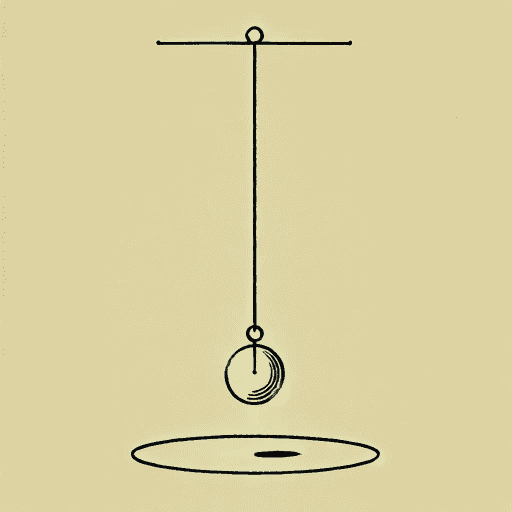
Foucault's Pendulum
73 pages • 2-hour read
Umberto EcoFoucault's Pendulum
A modern alternative to SparkNotes and CliffsNotes, SuperSummary offers high-quality Study Guides with detailed chapter summaries and analysis of major themes, characters, and more.
Part 6, Chapters 73-96Chapter Summaries & Analyses
Content Warning: This section of the guide includes discussion of anti-Semitism, emotional abuse, illness, and death.
Part 6: “Tiferet”
Part 6, Chapter 73 Summary
While immersing himself in research on the Rosicrucians, Belbo secretly starts working on veiled narratives heavily based on his experiences. Casaubon interprets these narratives at new attempts at writing fiction, presenting one such file in Abulafia entitled “The Cabinet of Dr. Dee.” The document projects Belbo’s persona onto a fictionalized version of historical occultist Edward Kelley. Kelley works with Dr. Dee to unite different factions of Templars in search of a secret treasure. After a failed attempt to arrange a meeting with the Frankish Templars, an old alchemist named Heinrich Khunrath offers to connect Dee to the sect. However, Dee dies at the hands of Francis Bacon, who also takes an interest in the magical Dark Lady, Kelley’s interest.
Part 6, Chapter 74 Summary
Belbo reveals that Abulafia is starting to discover previously unseen connections in the Templar mystery, such as the suggestion that Francis Bacon became a patron of the Conservatoire de Arts et Métiers to house Foucault’s pendulum, along with the laboratory that would allow the Templars to determine the nature of their secret. From here they deduce the identity of the master of the French Templar group and realize that the Conservatoire is the refuge designated in the Templars’ plan.
Part 6, Chapter 75 Summary
Casaubon compiles a timeline tracing the developments in Templar history from the 17th to 20th centuries, which includes the histories of their successors, like the Freemasons and the Rosicrucians. Diotallevi is confounded by this history and suggests consulting Agliè to explain the connections. To test the strength of their timeline against Agliè’s expertise of occult history, the editors agree to insert a fake secret society called Tres (an acronym for “Templi Resurgentes Equites Synarchici.”)
Part 6, Chapter 76 Summary
Agliè studies the timeline and verifies the connection between the Templars and Masonry, offering personal recollections to substantiate the facts. He also explains the other societies, like the Illuminati, as offshoots of the original tradition that the Masons tried to maintain. When Belbo comments that occultists are fickle, Agliè makes a distinction between occultists and esoterics: Occultists crave attention while esoterics, like the Templars, are devoted to learning secret knowledge. Before leaving, Agliè comments that the Tres are unfamiliar to him.
The editors realize that the splinter groups were all competing with each other and that Masonry was an attempt to reunite the different sects. Nevertheless, the competitiveness continued, which weakened the integrity of Masonry. They conclude that the original secret of the Templars remains hidden from their descendants. The editors can thus invent a plausible secret.
Part 6, Chapter 77 Summary
Part 6, Chapter 78 Summary
On his way to work, Casaubon bumps into Salon, who shows him his intricate but convincing taxidermy workshop. Salon shows Casaubon a book in his library that suggests the influence of the underground world on the world above. The book also suggests that the Templars remain underground and that the Rosicrucians are a false offshoot of the order.
Part 6, Chapter 79 Summary
Salon explains that his preoccupation with the underground world comes from reading the anti-Semitic text Protocols of the Elders of Zion in his youth. He elaborates how every major landmark and civilization of antiquity bears some access point into the underground, where one can channel the energies of the earth, also called telluric currents. These explanations inspire new ideas for the Plan.
Part 6, Chapter 80 Summary
Casaubon learns that Lia’s water broke while he was speaking to Salon. He rushes to the hospital, where he meets his son, Giulio.
Part 6, Chapter 81 Summary
While caring for Lia in recovery, Casaubon reads more about telluric currents. Agliè provides a tautological explanation that the telluric currents refer to the movement of Kundalini, which is a symbol for telluric currents.
When he returns to work, Casaubon proposes that many ancient civilizations knew about the power of telluric currents. They built great structures to control these currents. The knowledge passed all the way down through Jesus Christ to the Templars during their interactions with the Muslim sects in Jerusalem.
Part 6, Chapter 82 Summary
Casaubon concludes that the Templars’ original secret can be the map of the control point for the Earth’s magnetic forces. These telluric currents enable the Templars to control the weather, reshape the geography of the world, and monopolize the Earth’s natural resources. Every element in the conspiracy is a metaphor for the control of telluric currents.
The editors are stumped over the question of why the Templars would need to divide their map to protect the secret. With Abulafia’s help, they incorporate Foucault’s pendulum into their answer and suggest that the pendulum is necessary to locate the control point on the map. They specify that the pendulum in Paris is the only one suited to discerning the control point’s location, and the other locations in the Templars’ plan are gathering points that would allow the different groups to join each other and converge in Jerusalem.
Part 6, Chapter 83 Summary
Casaubon adds that the Templars would need the right map to locate the control point under the pendulum. They reverse engineer a suitable map that would enable the pendulum to mark Jerusalem as the control point, and narrow the correct map down to one produced by the London Rosicrucians. This map features an unusual design from the point of view of the pendulum.
Part 6, Chapter 84 Summary
Casaubon finds sources from the 17th to 19th centuries supporting his theory that the secret involves telluric currents. He also realizes that Salon’s obsession with the underground world points to an attempt to locate the control point without using the map.
Part 6, Chapter 85 Summary
Part 6, Chapter 86 Summary
Belbo proposes that the world’s modern landmarks, like the Eiffel Tower and the Empire State Building, are more recent attempts to stumble upon the location of the control point.
Part 6, Chapter 87 Summary
Casaubon recognizes that he and his colleagues are getting dangerously close to believing their own fiction, although Casaubon’s family life provides him with a buffer from the act of seeking connections. Diotallevi, meanwhile, starts showing signs of illness, but the other two pay little attention to it as they continue developing the Plan around the rivals of Francis Bacon and his followers. In doing so, they manage to connect Marxism, atomic energy, and Sigmund Freud to the Templars.
Part 6, Chapter 88 Summary
The editors find a challenge in incorporating the Society of Jesus (Jesuits) into the Plan, considering how often the Jesuits overlap with the Rosicrucians in their sources. They find a source identifying a key Rosicrucian figure who had revealed the Templar plan to Ignatius of Loyola. To interrupt the plan, the Jesuits found a way to reconstruct the map through technology. They created a device that functioned like Abulafia, calculating permutations in an instant.
Part 6, Chapter 89 Summary
Rather than Rosicrucianism, the Jesuits invented the Scottish neo-Templars to counter the English Freemasons. Eventually, the Scottish neo-Templars became prominent in their own right, which compelled the Jesuits to oppose their own invention.
Part 6, Chapter 90 Summary
The editors discover a text that suggests that after Molay’s death, the Templars dedicated themselves to world conquest and hijacked Freemasonry to achieve their goal. This text provoked Napoleon into becoming involved with the Masons in the hopes of meeting the Templars’ secret directorate. He unites the European sects, but fails to achieve his goal because of opposition in Russia.
Part 6, Chapter 91 Summary
The Jerusalem Templars splintered into three groups that scattered among the neo-Templars, the English Freemasons, and the Russians. A rival sect called the Paulicians oppose the rise of the Russian faction, so they begin spreading anti-Semitic propaganda to discredit all three splinter groups and antagonize Napoleon.
Part 6, Chapter 92 Summary
The editors identify figures who could have spread the anti-Semitic propaganda to the Russian aristocracy.
Part 6, Chapter 93 Summary
The editors suggest that the propaganda material, The Protocols of the Elders of Zion, can easily be denounced as a hoax because it purports to be centuries old but only references 19th-century issues. Belbo observes that the supposed Jewish plan to control the world almost entirely mirrors the Templars’ message from Provins.
Part 6, Chapter 94 Summary
The editors realize that whenever a sect wants to antagonize another group, they merely replicate the Provins plan and attribute it to their enemy, as the Jesuits had done so with the English Masons.
Part 6, Chapter 95 Summary
The editors trace more examples of the Templars’ plan being plagiarized and attributed between enemies throughout the 19th century. This leads to the conclusion that the Jewish people held the real Templar plan, since the Templar plan aligns perfectly with the plan that eventually appeared against the Jewish people in the Protocols.
Part 6, Chapter 96 Summary
A manuscript provides a real name for the Comte de Saint-Germain, Pierre Ivanovitch Rachkovsky, which bears a resemblance to Rakosky, the name of the man implicated in Ardenti’s disappearance. Rachkovsky is described as a Russian revolutionary who eventually collaborated with the police. While arresting a political opponent for his sponsor, Rachkovsky planted a new attribution for the Provins Plan among the opponent’s belongings, which implicated his sponsor in the creation of the Protocols. Thus, Rachkovsky betrayed his own sponsor.
The story reminds Belbo of a man from his youth named Remo, who claimed he was on both sides of the conflict between the Fascists and the partisans to impress women. Remo was eventually trapped by the Fascists and executed, which proved he was not a Fascist. Belbo concludes that sometimes death is the only way to prove one’s claim.
Part 6, Chapters 73-96 Analysis
These chapters trace the Garamond editors’ immersion into world history, which they rewrite around the Templars to lay the foundations for the Plan. What Eco subtly exposes are the differing motivations that drive the editors to work on the Plan and how it is both influenced by and reinforces their psychology. Casaubon and Belbo are presented as two extremes on the scale of immersion. While they are both devoted to the project of the Plan, Belbo sees the Plan as an important life project whereas Casaubon sees the Plan as an amusement. Casaubon’s reaction to their project is mediated by the developments in his family life. The birth of his son, Giulio, and its impact on his relationship with Lia force Casaubon to detach himself from the obsession with the Plan. Eco drives this by having Lia go into labor while Casaubon gets sidetracked by his conversation with Salon.
Belbo, on the other hand, has nothing else to live for but his work and the Plan. By this point, Lorenza has disappeared from the narrative, suggesting that their split in Belbo’s childhood home was final. As Belbo rewrites the history of the world, he also creates meaning for himself by transforming himself from an unwitting pawn into a master of the grand narrative of human history. Knowledge becomes a way of asserting Belbo’s ego. The more he demonstrates his ability to know, the more he can convince himself that his intellect is useful. This calls to mind the recurring distinction Agliè makes between people who are devoted to knowledge and people who see knowledge as means to an end of power. In Part 6, Chapter 76, he describes it as the difference between occultists and esoterics, which is applicable to Belbo’s state of mind in these chapters: “The [esoterics] were initiates, and the proof of that is that when subjected to torture, they died to save their secret. It is the strength with which they concealed it that makes us sure of their initiation, and that makes us yearn to know what they knew. The occultist is an exhibitionist” (433). The fact that Belbo, Casaubon, and Diotallevi are so obsessed with fictionalizing a history of the world suggests their intention to exhibit their intellectual skills. They demonstrate this in the very same chapter when they decide to insert a fake secret society into the timeline they give to Agliè, as if to test their ability to deceive an expert on the subject. Belbo’s exhibitionism may therefore lead to his downfall and underscore The Virtue of Curiosity Versus the Vice of Pride as a theme.
Within the material of the Plan itself, the editors identify a pattern of organizational slander, which is based on the original plan the Templars devised to perpetuate their order and maintain their secret. This pattern is telling because it suggests that over time, people lost interest in the Templars’ secret and became more obsessed with possessing power over knowledge. This mirrors the arrogance with which the Garamond editors devise the Plan, believing they are intellectually superior to the Diabolicals who rehash the same ideas over and over. Eco cements this with the conclusion that the Jesuits must have arrived at a way to reconstruct the Templars’ lost map by way of technology. The editors immediately compare it to Abulafia, suggesting that they are projecting themselves against the grander scheme of the historical coup they are supposedly uncovering. This in turn stresses The Instability of History and Truth as a theme and underlines the symbolic function of Abulafia within the novel, allowing it to stand as a representation for weaponized knowledge.

Unlock all 73 pages of this Study Guide
Get in-depth, chapter-by-chapter summaries and analysis from our literary experts.
- Grasp challenging concepts with clear, comprehensive explanations
- Revisit key plot points and ideas without rereading the book
- Share impressive insights in classes and book clubs