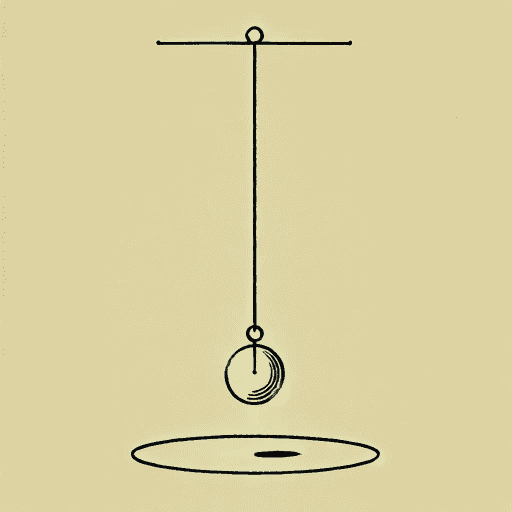
Foucault's Pendulum
73 pages • 2-hour read
Umberto EcoFoucault's Pendulum
A modern alternative to SparkNotes and CliffsNotes, SuperSummary offers high-quality Study Guides with detailed chapter summaries and analysis of major themes, characters, and more.
Symbols & Motifs
Content Warning: This section of the guide includes discussion of death.
Foucault’s Pendulum
The device that gives the novel its title is a prominent motif for The Human Need for Meaning. From the moment it first appears, the characters look to the pendulum for answers to the mysteries that surround them. In Part 1, Chapter 1, for instance, Casaubon marvels at the mechanics of the pendulum as a sign of the universe’s existence around a fixed point or origin, such as a divine being or a cosmic force. He knows that coming to the pendulum will also help him to resolve the mystery of his friend Belbo’s journey to Paris, which is why he chooses to hide in the Musée des Arts et Métiers and return to the pendulum after closing time.
In Part 5, Chapter 37, Belbo describes the pendulum as a sign of hope for his generation, which became disillusioned with the world after living through Italian Fascism in World War II. He draws meaning from the pendulum because it gives him something to believe in, even if that thing is the existence of God: “The idea that everything else is in motion and up above is the only fixed point in the universe [...] For those who have no faith, it’s a way of finding God again, and without challenging their unbelief, because it is a null pole” (235-36). Belbo is not necessarily seeking religion, but based on the context of his childhood experience with divine truth, he is seeking the simplicity of a world that is beautiful for its own sake.
The pendulum becomes the device of Belbo’s death, which also underscores its function as a motif. The occultists hang Belbo from the middle of the string, then push the bell to force it to reveal the location of the Templars’ final secret. The physics of the pendulum transform Belbo into a new fixed point of suspension, symbolically reflecting his invention of the Plan into the fixed point around which the occultists search for meaning.
Abulafia
Belbo’s computer, Abulafia, is a symbol for the limitations of the intellect. It first appears in Part 2 of the novel, functioning as the repository for Belbo’s secrets. While Belbo marvels at Abulafia as a tool to account for the limitations of the intellect, he overlooks the fact that Abulafia isn’t meant to function as a substitute for the intellect. Casaubon’s attempts to access Abulafia are reflective of this, as he tries to guess the password using different fields of information, from his knowledge of Belbo to occult history. Ultimately, the password is revealed to be a form of wordplay as it directly responds to the computer’s prompt of whether the user knows the password. This is indicative of the wit that programmed the password in the first place, stressing the necessity for Belbo’s intellect for it to operate.
This underlying assumption is key to interpreting the function of Abulafia throughout the narrative. Indeed, Abulafia is used as a substitute for the intellect when the Garamond editors use it to find hidden connections across the Diabolicals’ manuscripts. They accept the computer’s output as soon as they can divine a coherent meaning from the document. However, they take the validity of the output for granted and assume that it has made the right associations if they can see it themselves. This becomes the seed of their misinterpretation of the Plan.
Trumpet
The trumpet that features prominently in Belbo’s backstory is a recurring symbol of transcendence and the connection to the divine source of truth. The trumpet is first referenced in Part 3, Chapter 9 when Belbo recalls dreaming of a toy trumpet as a child. The novel frames this first reference to the trumpet as a mysterious occurrence. Belbo cannot explain where the desire to play the trumpet came from except that it appeared to him in a dream. When faced with the opportunity to get one, he could not discern which trumpet to get and had to settle for an alternative instrument. Belbo continued to long for the trumpet, which would gain greater significance as he grew older.
In his youth, Belbo saw the trumpet as the opportunity to impress his crush, Cecilia. These attempts fail for various reasons of coincidence, but they are necessary to build toward the opportunity of playing trumpet at the partisan funeral in the cemetery. It is during this performance that Belbo becomes connected to Truth itself. In this moment, Belbo learns that there is something greater than the affection of Cecilia, which is the union with a cosmic force that moves the universe. In this way, the trumpet becomes part of a larger analogy represented by Foucault’s pendulum, but it becomes significant as a symbol in its own right because it stands for an experience that Belbo longs to return to. Fittingly, his father encourages him to abandon the trumpet when the war is over and their family moves back to the city.

Unlock the meaning behind every key symbol & motif
See how recurring imagery, objects, and ideas shape the narrative.
- Explore how the author builds meaning through symbolism
- Understand what symbols & motifs represent in the text
- Connect recurring ideas to themes, characters, and events