George's Secret Key to the Universe
61 pages • 2-hour read
Lucy Hawking, Stephen HawkingGeorge's Secret Key to the Universe
A modern alternative to SparkNotes and CliffsNotes, SuperSummary offers high-quality Study Guides with detailed chapter summaries and analysis of major themes, characters, and more.
Index of Terms
Amino Acids
Amino acids are organic molecules that link together to form proteins, the fundamental components of living cells. Dr. Reeper demonstrates how lightning striking gases could create amino acids on early Earth, echoing real scientific experiments by Stanley Miller and Harold Urey. Through this scene, the Hawkings introduce readers to a foundational concept in biology—the chemical origins of life—while also foreshadowing Reeper’s moral overreach. The explanation invites curiosity about life’s beginnings while encouraging readers to think critically about how scientific knowledge is applied.
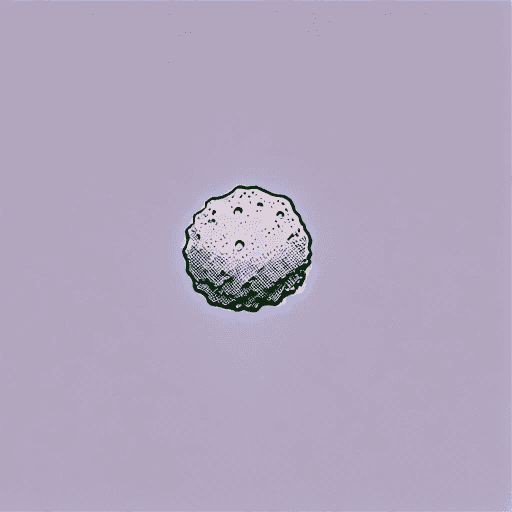
Asteroids
Asteroids are rocky objects that orbit the Sun, primarily within the asteroid belt between Mars and Jupiter. The novel uses George and Annie’s passage through an asteroid field to dramatize what could otherwise be a static astronomy fact. By having the characters experience the danger of colliding rocks firsthand, the novel shows both the scale of the Solar System and the forces shaping it. The sequence reinforces the book’s goal of turning scientific ideas into lived experiences, translating textbook information into an adventure.
Black Hole
A black hole is a region of space where gravity is so intense that nothing—not even light—can escape. George’s Secret Key to the Universe introduces the concept when Eric becomes trapped inside one after following falsified coordinates. Cosmos later explains how black holes form when massive stars collapse, connecting the rescue plot to real astrophysical theory. The episode gives young readers an accessible entry point to one of modern physics’ most complex ideas.
Comet
Comets are icy celestial bodies that orbit the Sun and develop glowing tails of gas and dust as they near its heat. George and Annie’s journey on a comet turns an astronomy lesson into an immersive experience. The comet becomes both vehicle and classroom as they learn how sunlight causes sublimation, creating the comet’s characteristic tail. By letting readers travel alongside the characters, the Hawkings turn abstract information—elliptical orbits, solar radiation, and vaporized ice—into something visual, illustrating how scientific learning can feel like discovery rather than instruction.
Gravity
Gravity is the force that attracts objects with mass toward one another, keeping planets in orbit and anchoring people to the ground. Eric and Cosmos repeatedly use gravity to explain everything from the stability of the Solar System to why George floats differently in space. When George experiences reduced gravity on the comet, he feels the concept rather than merely hearing about it, which mirrors how the novel aims to teach science through sensation and imagination. By grounding cosmic wonder in a single, universal force, the Hawkings show how invisible laws shape both motion and balance across the universe.
Mass
Mass refers to the amount of matter an object contains and determines how strongly gravity acts on it. In the novel, Cosmos distinguishes mass from weight, explaining that while George would weigh less on the Moon, his mass would stay the same. This distinction allows young readers to grasp a key physics principle often confused in everyday life. By tying the explanation to George’s physical sensations—floating, falling, and balancing—the concept of mass becomes more concrete. The scene exemplifies the Hawkings’ broader goal of translating scientific precision into accessible, experiential understanding.
Nuclear Fusion Reaction
A nuclear fusion reaction occurs when atomic nuclei combine under intense heat and pressure, releasing vast amounts of energy. This process powers every star, including the Sun. In George’s Secret Key to the Universe, Cosmos illustrates fusion during the creation of a new star, describing how hydrogen atoms merge to form helium. By linking fusion to the origins of life and matter, the Hawkings convey the lesson that all existence depends on the same universal process of transformation.
Orbit
An orbit is the path a celestial body follows as it moves around another under the influence of gravity. The comet George and Annie ride follows its orbit around the Sun, letting them witness how gravitational pull guides motion throughout the Solar System. By describing these movements dynamically—planets curving through space rather than sitting in static diagrams—the Hawkings illustrate how motion, not stillness, defines the universe.
Particles and Matter
Matter is anything that occupies space and has mass, composed of atoms and subatomic particles such as protons, neutrons, and electrons. Cosmos introduces these building blocks to explain how the same components form stars, planets, and people alike. The lesson connects microscopic and cosmic scales, showing that the universe operates through repeating patterns of structure and energy. By linking chemistry and astronomy, the authors encourage readers to see unity rather than separation in scientific disciplines.
Planet and Dwarf Planet
Planets are large celestial bodies that orbit the Sun, are spherical due to gravity, and have cleared other debris from their orbital paths. Dwarf planets, like Pluto, meet the first two conditions but not the third. The novel’s sidebar explaining Pluto’s reclassification introduces readers to how scientific definitions evolve with new evidence. By including this contemporary debate, the Hawkings emphasize that science is a living conversation—its strength lies in its ability to change as understanding deepens.
Science
Science is the systematic study of the natural world through observation, evidence, and reasoning. Early in the story, Eric defines it simply for George: “[E]xplaining the world around us using our senses, our intelligence, and our powers of observation” (26). This definition frames the book’s entire structure, where narrative adventure doubles as a process of inquiry. Every discovery George makes—from black holes to molecules—demonstrates science as a living method rather than a static body of facts.
Solar System
The Solar System consists of the Sun and all objects bound to it by gravity, including planets, moons, asteroids, and comets. Much of George and Annie’s journey takes place there, transforming the Solar System from a chart into an environment they can traverse. Each planetary stop combines factual information with adventure, letting readers learn through experience rather than abstraction. This imaginative approach reflects the book’s mission to make the real universe as accessible as fiction.
Universe
The universe includes everything that exists—matter, energy, space, and time. In George’s Secret Key to the Universe, Cosmos introduces the concept early, expanding George’s perspective from his backyard garden to the vastness of existence itself. The final chapters return to this idea when George recognizes that all life on Earth originated in the stars.

Unlock all 61 pages of this Study Guide
Get in-depth, chapter-by-chapter summaries and analysis from our literary experts.
- Grasp challenging concepts with clear, comprehensive explanations
- Revisit key plot points and ideas without rereading the book
- Share impressive insights in classes and book clubs