Gild
59 pages • 1-hour read
Raven KennedyGild
A modern alternative to SparkNotes and CliffsNotes, SuperSummary offers high-quality Study Guides with detailed chapter summaries and analysis of major themes, characters, and more.
Themes
The Psychological Impact of Captivity
Content Warning: This section of the guide includes discussion of gender discrimination, emotional abuse, sexual violence, and death.
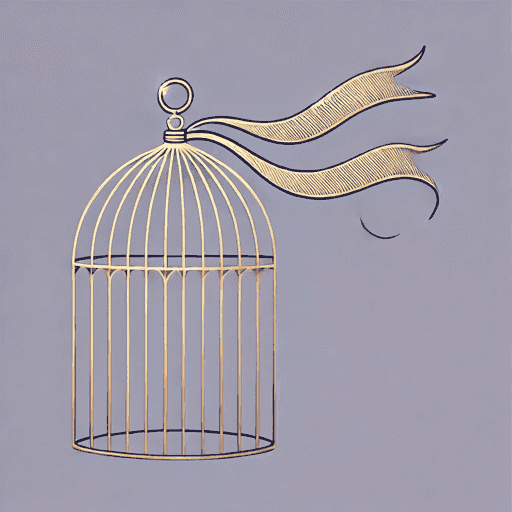
This theme is explored through the protagonist and narrator, Auren. In real-world abusive relationships, the sense of captivity is often emotional or symbolic in nature, but in Gild, Kennedy depicts captivity in its most literal form: an actual cage. This stylistic choice allows her to examine the impacts of intense abuse in its most extreme forms; just as abusive relationships are often concealed beneath romantic language and charm, Auren’s literal cage is also dressed up with golden beauty and luxury accommodations. Yet, as Auren cynically states in Chapter 2, “a cage is a cage, no matter how gilded” (22). Her words demonstrate that on one level, Auren fully understands that her captivity is harmful and wrong, even as she claims that she chose to hide in a cage and prefers its safety to the threats of the outside world.
Auren’s initial preference to remain in her cage rather than facing the world’s threats stands as a crucial component of the psychological impact of captivity. Though Auren herself is unaware of the fact, the narrative clearly shows that she has been brainwashed into accepting her captivity through years of Midas’s manipulation, coercion, and threats. Midas controls Auren by promising her love and protection and simultaneously threatening her with punishment and violence if she “misbehaves.” To cope with this constant abuse, Auren has convinced herself that Midas loves her, and she interprets any cruelty on his part as a result of his supposed desire to protect her from the world or his duty to punish her for acting contrary to his wishes. In this way, Kennedy seeks to depict the most common lies and manipulations that real-world abusers employ to control and terrorize others.
As demonstrated in the novel, this form of manipulation becomes most effective when there is an enormous power imbalance between an abuser and their target; such imbalances often arise due to differences in age, wealth, or status, and as Auren’s situation shows, manipulative tactics works best on those who are most vulnerable—such as children who have already suffered traumatic experiences. This dynamic is illustrated by the fact that when Midas first found Auren, she was a child caught in a system of exploitation, violence, and poverty. Auren’s descriptions of these early events in her life indicate that Midas may very well have rescued her from a dire situation. However, in the years after this first meeting, he then used his savior status as leverage, convincing Auren that his particular brand of abuse is an accurate depiction of love. Lacking any other relationship for comparison, she came to believe that she owes him her loyalty, love, and obedience.
Auren is therefore conditioned by years of captivity and abuse. Despite Midas’s many wrongs, she nonetheless craves his attention, touch, and approval, regardless of whether he is using charm or threats to keep her controlled. Additionally, she mentally protects herself from the trauma of her situation by convincing herself that she deserves any ill treatment she receives. It is therefore crucial that the novel depicts Auren as an unreliable narrator, and accordingly, the stark differences between her misguided beliefs and the events she describes demonstrate the true depths of Midas’s cruelty and abuse even when she cannot perceive it. Additionally, Auren’s trust in Midas is based on her belief that any cruelty she receives from him is better than the threats of violence that she would face in the world beyond her cage. This dynamic implies an unspoken agreement that she will suffer abuse from Midas, and only Midas, in exchange for his protection from everyone else. Ironically, Midas destroys this tacit agreement when he gives Auren to Fulke, shattering her foundation of trust and unwittingly beginning her path toward self-discovery and empowerment.
The Damaging Effects of Patriarchy
The abuse that Auren suffers at Midas’s hands is just one aspect of the damaging effects of patriarchy, as almost every male character in Gild contributes to this theme, collectively representing a culture that protects and rewards violent, misogynistic men. The primary examples of this dynamic include Midas, Fulke, and Captain Fane; each of these men is greedy, obsessed with power, and endlessly willing to subjugate women. All three are possessive, self-centered, and selfish, employing sex as a form of control and violence, and they are willing to commit any violence in the name of accumulating greater wealth and power. However, these power-hungry men are also happy to inflict violence on each other when it benefits them. This pattern emerges when Midas conspires against and murders Fulke and when Fane gleefully asserts his will by murdering Sail and the other guards.
This culture of violence and patriarchy also inspires the various kings to bring their brutal tactics into the larger political sphere, indicating that the use of violence to accumulate power inevitably leads to the even more violent prospect of outright warfare. Thus, Midas murders Fulke not out of hatred or anger but out of a dispassionate and calculated move to take control of Fifth Kingdom and expand his wealth and political power. Likewise, Midas’s machinations motivate King Ravinger of Fourth Kingdom to send out his own army, further destabilizing the realms. As Auren observes in the final chapters, the bulk of Fourth Kingdom’s army is now on the move, clearly preparing for an all-out war with Midas, and it is clear that this brewing violence will not be limited to a battle between rival rulers; instead, it will spill out into the innocent populations of both kingdoms.
Though this aspect of violence fuels the external political conflict in the novel, the central focus of Gild remains on Auren, who is forced to experience a barrage of misogynistic violence. These deeply traumatic interactions are intended to illustrate the physical and psychological damage that occurs when violent men attack and exploit women. While the novel presents extreme examples of this dynamic, Kennedy creates situations that share many elements with real-world concerns; thus, the novel itself becomes a scathing social critique of real-life instances of misogyny, sexual assault, and abuse.
Within the world of the novel, Midas and Fane are the primary perpetrators of such violence, and although Auren is acutely aware of Fane’s physical violence, she remains largely oblivious to the emotional abuse that Midas has inflicted upon her. While Fane represents the more obvious threat, Midas’s abuses and emotional violence have deeply scarred Auren, who must undergo a deeper level of self-discovery before she can come to terms with the long-standing effects of his patriarchy on her life. Thus, the narrative argues that Midas’s forms of violence are just as dangerous as Fane’s. Crucially, the only men in Auren’s life who do not treat her with violence are Digby and Sail. Though they are lowly guards, they treat Auren with genuine care and respect, and this renders them both anomalies in a society that perpetuates misogynistic violence. Unfortunately, with Sail’s death at Fane’s hands, Kennedy implies that in the clash between violence and pacifism, violence usually wins.
The Importance of Self-Discovery and Empowerment
This theme arises in direct opposition to the themes of captivity and violence. After a decade of captivity and abuse, Midas has conditioned Auren to accept her captivity without question or serious complaint, and only in brief moments does she lament her isolation and loneliness and idly wish that she could go outside and see the sky. Because these wishes for freedom are tempered by her fear of the world and her belief that Midas is acting in her best interests, she maintains a misguided trust in him and his decisions. Her first moment of real awareness comes when Midas trades her sexual services to Fulke in exchange for the use of Fulke’s army; this decision damages her sense of trust and ultimately forces her to face the truth of her circumstances. Thus, Midas himself accidentally triggers her moment of awakening and sends her on a path toward empowerment.
However, Auren’s progress in this matter is nonlinear and circuitous, as she must struggle to overcome years of faulty conditioning. This inner conflict becomes a crucial element of her journey as she works to recontextualize her years of abuse within a culture that condones habitual violence against women. Though Auren wishes for freedom and control over her own body and life, she is still caught in patterns of loyalty to her abusive captor and must fight against her own conditioned responses before she can truly break free. This battle becomes the primary internal conflict of the novel as Auren struggles to reconcile her misplaced loyalty for Midas with her own desire for freedom.
In addition to her own doubts, she also faces external obstacles that force her to pause and backtrack. For instance, she briefly experiences some freedom while traveling with Sail and the caravan, and she revels in the first friendship she has made in 10 years. However, this moment of progress is halted by the pirate attack, the violence of which leaves her wishing for Midas’s control and the safety of her cage. Importantly, every time Auren takes a step toward reclaiming her agency and power, she is met with violent resistance from a dangerous man, whether it is Midas, Fulke, or Fane. The novel thus argues that men who are accustomed to controlling women through violence will inevitably retaliate if they feel that their control is threatened. Auren faces such retaliation literally and symbolically, as when Fane tangles and knots her ribbons—the enduring symbol of her power—it is clear that her external circumstances are working to restrain her innate strength. Later, although she successfully wields her power and kills Fane, her inner journey stalls once again when she finds herself captive to Commander Rip. Because her internal search for freedom has yet to be realized, it is clear that this journey will continue as the series progresses.

Unlock every key theme and why it matters
Get in-depth breakdowns of the book’s main ideas and how they connect and evolve.
- Explore how themes develop throughout the text
- Connect themes to characters, events, and symbols
- Support essays and discussions with thematic evidence