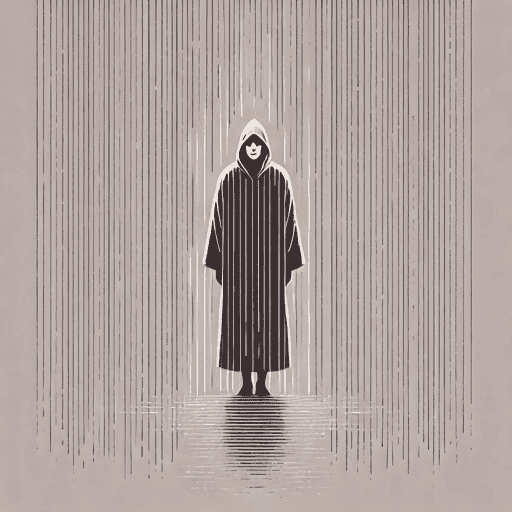
Glass Houses
62 pages • 2-hour read
Louise PennyGlass Houses
A modern alternative to SparkNotes and CliffsNotes, SuperSummary offers high-quality Study Guides with detailed chapter summaries and analysis of major themes, characters, and more.
Chapters 15-21Chapter Summaries & Analyses
Content Warning: This section of the guide includes discussion of illness, graphic violence, death, and substance use.
Chapter 15 Summary
Gamache, Jean-Guy Beauvoir, and Chief Inspector Isabelle Lacoste set up a workspace in the church basement near the root cellar where Katie Evans’s body lies. Lacoste learns Katie is a visiting architect from Montréal, staying at the bed-and-breakfast with her husband and friends. When Lacoste asks about the mask and cloak, Gamache identifies the figure as a cobrador. She wonders how they know this so quickly. Gamache explains that the cobrador appeared at the post-Halloween party and then stood silently on the village green for two days, disappearing at night and reappearing each morning.
Gamache shows Lacoste a photo on his phone. A napkin with his handwriting slips from his pocket; Jean-Guy picks it up, notes a few words, and returns it. In the photo, the cobrador looks imposing—unlike the crumpled form now in the cellar. Gamache says he spoke to the figure; it remained silent and stared at the shops.
He outlines the history: The modern cobrador shames debtors, but the ancient version was different, a conscience created by those who were banished to an island off Spain because they had the plague or were otherwise outcast. Those cobradors returned and followed their tormentors in silence. Authorities eventually captured, tortured, and executed them and then massacred the island’s inhabitants, though some may have escaped.
Lacoste asks if Katie was the cobrador. Gamache provides alibis proving she was elsewhere while it stood on the green. He questions why, if Katie was not the cobrador, she was wearing the costume. Gamache notes that neither ancient nor modern cobradors were violent and that the figure remained passive even when threatened by the mob the previous evening. He wonders why this one killed.
Chapter 16 Summary
In November, villagers gather in Olivier’s bistro, watching through the windows as Gamache, Jean-Guy, and Lacoste approach through drizzle. Olivier looks at Patrick Evans, Katie’s husband, sitting with friends Lea Roux and Matheo Bissonette. Though her death has not been announced, everyone understands the Sûreté’s arrival.
The narrative shifts to the balmy July courtroom, where Zalmanowitz questions Gamache about the villagers’ reaction to police presence, implying Gamache’s close ties to them compromise him. Gamache counters that understanding emotion is essential to investigating murder. Addressing the jury, he explains that murder stems from unchecked emotions and notes that conscience can be a higher authority than the courts.
Zalmanowitz objects, but Judge Maureen Corriveau overrules him and calls a lunch break, privately warning Gamache to watch himself. Outside the courtroom, Zalmanowitz publicly confronts Gamache, accusing him of sabotaging the case. Jean-Guy finds them a private room, where the two reveal they are secretly working together, deliberately creating the appearance of a failing prosecution. They toast their risky plan.
Meanwhile, Judge Corriveau lunches with her partner, Joan, and confides her suspicion that something is wrong with the trial. The Crown is attacking its own witness in unusual ways. She wonders if Gamache and Zalmanowitz are intentionally undermining the case but then dismisses the thought. Joan looks up the Gandhi line, and Judge Corriveau worries that the head of the Sûreté placing conscience above law could undermine the rule of law. Joan suggests it might be progress.
Chapter 17 Summary
Back in the courtroom, Judge Corriveau studies the antagonism between Zalmanowitz and Gamache, imaging them as predators. Her suspicion resurfaces that they might be allies feigning conflict to trap a more dangerous predator. She glances at the defendant.
Zalmanowitz reflects that his genuine, long-standing dislike of Gamache makes their deception easier. A flashback returns to a meeting months earlier in a Halifax diner. Gamache had flown to Moncton and driven to Halifax; Zalmanowitz flew directly there. In that dockside restaurant, Gamache outlined his secret plan, exposing himself entirely. He asked Zalmanowitz to risk his career, reputation, and even imprisonment.
Zalmanowitz’s first thought was that Gamache might be setting him up, but he quickly dismissed it—Gamache was not cruel. Still, the proposition was extreme: After 30 years running the Crown’s office, Zalmanowitz would jeopardize it all. For Gamache, newly chief superintendent, the stakes were equally high.
Zalmanowitz paced the Halifax pier, weighing the personal cost against the magnitude of the threat. The odds of success were slim, but zero if they did nothing. Thinking of his daughter, Charlotte, and the stories he once invented for her about the ships in port, he resolved to create one last story—for Québec. He returned and agreed.
Back in the present trial, months after Halifax, Zalmanowitz asks Gamache how Patrick took the news of his wife’s death.
Chapter 18 Summary
In November, Chief Inspector Lacoste takes Patrick, Lea, and Matheo to the bistro’s back room and tells them Katie is dead. Patrick appears shocked. Olivier brings scotch and tissues. Lacoste explains Katie was found in the church, apparently beaten. Patrick, panicking, links the death to the cobrador. He last saw Katie outside the previous night after dinner at Le Relais in Knowlton around 10 o’clock. He assumed she was with Lea this morning; Lea and Matheo thought she was with Patrick. Lea pours him scotch, which he gulps. Lacoste notices that his dilated pupils suggest he is drugged. Patrick begins to slur, blaming the cobrador, and then slumps unconscious; Jean-Guy lowers him to the floor.
Lea admits she gave Patrick an Ativan before the officers arrived and then realizes she also gave him alcohol. Dr. Sharon Harris, the coroner, determines he has passed out from the combination. Jean-Guy, Matheo, and Harris take Patrick to his room at the bed-and-breakfast.
With Matheo present, Lea speculates that the cobrador killed Katie, perhaps after she discovered his identity during a walk. Lacoste notes that Katie was found in the church. Lea explains Katie’s fascination with church architecture, though the village chapel hardly compares to Notre-Dame. Lea describes the marriage as good, though Patrick was needy and did not want children. She mentions their college friend, Edouard, who died years earlier; she insists he may have simply fallen, though suicide is suggested.
As Harris leaves, she tells Gamache that Patrick was likely given at least two Ativan and possibly an opioid. She also reports that he kept repeating something about a bad conscience. Back inside, the interview becomes tense. Matheo suggests that the cobrador’s target killed the cobrador and that Katie, a witness, was also killed. They describe university as like Lord of the Flies, with Katie a stabilizing force. Gamache invokes the book’s characters—Ralph, Jack, and Piggy—and observes that many murders have roots in the distant past. After the friends leave, Lacoste asks if the killer has fled. Gamache believes that the killer remains in Three Pines, watching.
Chapter 19 Summary
In Sarah’s Boulangerie, Jacqueline kneads dough while Anton watches police activity at the church. She says they should have admitted they knew what a cobrador was, suggesting it came for them because they once worked for someone dangerous. Anton stays silent to protect his true identity, a secret he has kept even from Jacqueline, and wonders what she is hiding. When Lea and Matheo enter, Lea stops abruptly upon seeing Anton. They stare tensely; Anton privately wonders if he recognizes her. Olivier summons Anton to the busy bistro kitchen, where he feels safest and where he hopes the Sûreté will not discover who he really is.
Lacoste invites Gamache to observe interviews, but he declines. She knows that people may reveal more through their lies than their truths when he is not present.
In Gamache’s study, Jean-Guy waits for slow dial-up internet. He recalls a murder investigation run from an outhouse, a “two-holer” that became their code for serious cases. He emails his wife, Annie, who answers with their code. Jean-Guy researches Lord of the Flies.
Myrna finds Clara in her studio, painting the puppies Leo and Gracie with a rough energy, hinting at something feral beneath the surface. Myrna recalls asking Gamache why he became chief superintendent, probing whether ego or power drew him. She looks at Clara’s painting and understands it represents more than the dogs. A young Sûreté agent arrives seeking Ruth, whom he was told to look for as a “crazy old woman” (179).
Jean-Guy finishes reading about Lord of the Flies and turns to the phrase “Burn our ships,” copied from Gamache’s fallen napkin.
Gamache joins Reine-Marie in the bath with wine. She recounts the horror of finding the body. He complains about the limits of the law; Reine-Marie counters that, as head of the Sûreté, he must follow it regardless of personal feelings. She wonders how the killer knew about the root cellar and speculates the cobrador may have hidden there at night. When she asks about the murder weapon, Gamache assumes it was a bat. Her confusion alerts him: She saw no bat—only the body, blood, and stored items. Realizing the significance, Gamache leaves to investigate.
Chapter 20 Summary
Gamache finds Jean-Guy at the computer. Jean-Guy lies about his search, claiming he was reading about The Lord of the Rings when he was actually researching “Burn our ships.” Gamache reveals what Reine-Marie just told him: She saw no bat when she found the body. Jean-Guy volunteers to drive to Montréal to notify Katie’s family, allowing Gamache to stay with Reine-Marie. They discuss Patrick’s condition; Dr. Harris suspects he received at least two tranquilizers, possibly an opioid in addition to Ativan. As Jean-Guy drives toward Montréal, he reflects on his lie and wonders about the phrase “Burn our ships,” linking it to Gamache’s recent lunch with Toussaint.
Gamache walks through the cold mist to St. Thomas’s Church, now a Sûreté incident room. Agents react with surprise and respect to their new chief superintendent’s arrival. He joins Lacoste’s interview with Ruth. Ruth says she was in the church that morning but noticed nothing unusual. She knows about the root cellar, used by rumrunners during Prohibition. She theorizes the cobrador came specifically for Katie and that its purpose was to terrorize her first, signaling that someone knew her secret. Lacoste adds that Katie could not seek help without revealing a long-hidden truth.
After Ruth leaves, Lacoste proposes a theory: Katie arranged to meet the cobrador in the basement to make amends but brought a bat as protection, which the cobrador took and used to kill her. Gamache asks again why Katie was placed in the costume. He then reveals Reine-Marie’s observation—there was no bat in the root cellar when she discovered the body.
Lacoste consults the crime-scene photos. They clearly show a bloody baseball bat leaning against the wall, impossible to miss. They conclude the bat likely was not present when Reine-Marie found Katie but appeared 90 minutes later when Gamache and Jean-Guy arrived. Although Reine-Marie locked the church and Myrna stood watch, there was a 10-minute gap between those moments. Gamache notes what it would take to carry a bloody murder weapon through the village in broad daylight and return it to the scene.
Chapter 21 Summary
In the July courtroom, Gamache is on the stand. Zalmanowitz presents the baseball bat and asks if it was simply left at the crime scene for all to see. In the gallery, Jean-Guy grows anxious, realizing they have reached the key moment. As the question is asked, he feels sick and flees the courtroom.
A flashback returns to a summer afternoon before the trial. In the Gamaches’ garden, Jean-Guy and Gamache build a swing for Jean-Guy’s infant son, Honoré. Amid roses and lavender, Jean-Guy asks what Gamache will say on the stand about the bat not being there when Reine-Marie found the body. Gamache replies that he will tell the truth. Jean-Guy protests that revealing it will destroy their eight-month operation but then understands that Gamache has just lied to protect him from complicity.
Ruth pops her head over the fence. She overhears enough to deduce that they plan to lie under oath to secure a conviction and protect a larger secret. She tells Gamache she approves, calling him a good liar. As they finish the swing, Jean-Guy resolves to be in court to support Gamache, whatever he decides.
In the present, as the courtroom doors close behind Jean-Guy, he hears Gamache answer yes to whether the bat was in plain sight. Gamache has just committed perjury. Jean-Guy feels he has committed personal betrayal by abandoning him at that moment. Outside the courthouse, Jean-Guy kills a fly that lands on him and whispers an apology. He resolves to make Gamache’s sacrifice worthwhile by ensuring their plan succeeds. There is little room for error—their entire operation to undermine Québec’s drug trade hinges on this deception. Thinking of the napkin, he realizes: Gamache has set their ship aflame. There is no going back.
Chapters 15-21 Analysis
These chapters emphasize The Moral Failures of the Law making it the driving force behind the narrative’s central deception. The courtroom, traditionally a stage for truth, becomes a platform for calculated deception. Gamache’s quotation of Gandhi—that “there’s a higher court than courts of justice and that is the court of conscience” (147)—frames his broader strategy, which is immediately tested and debated. Judge Corriveau, the embodiment of the legal system, warns of the danger of such a belief, fearing it could lead to anarchy, while her partner suggests it might be progress. In contrast, Reine-Marie, Gamache’s moral compass, reminds him that as head of the Sûreté, he must uphold the law regardless of personal feeling. These perspectives establish the moral stakes of Gamache’s plan. The law is depicted as a necessary but potentially rigid tool, while conscience offers a path to a greater good at the risk of serious ethical compromise. The conflict culminates in Gamache’s perjury, an act that places his personal judgment above his legal oath and transforms the murder trial into a maneuver in his larger operation.
The novel’s structure, which alternates between the November murder investigation and the July trial, structurally reinforces the theme of The Deceptive Nature of Appearances. This nonlinear timeline highlights the disjuncture between public performance and private reality. The staged antagonism between Gamache and Zalmanowitz is a prime example; their public hostility is so convincing that it nearly deceives Judge Corriveau. The narrative then reveals this deception by flashing back to their clandestine meeting in a Halifax diner. This theme of hidden realities extends to the social fabric of Three Pines, exemplified through Clara’s art. Her unsettling portrait of the village puppies captures a wildness beneath their domestication, with Myrna observing the “savagery they might be capable of. Might be hiding” (178). Her words mirror the novel’s broader contention that civilization—whether in a courtroom or a quaint village—is a construct that masks darker truths.
Armand Gamache’s character arc develops as he transitions from a moral arbiter to the architect of a high-stakes strategy that compromises his ethics. This section marks his full embrace of a pragmatic form of leadership that necessitates sacrificing his own principles. The “Burn our ships” motif, which Jean-Guy discovers on Gamache’s napkin, becomes a central metaphor for this transformation: It signifies a point of no return, a total commitment to a plan that risks his career and reputation. His perjury is the moment he fully commits to this irreversible course. Jean-Guy’s development runs parallel, defined by his struggle with loyalty and complicity. His flight from the courtroom as Gamache prepares to lie is a moment of intense internal conflict. He cannot bear to witness his mentor’s action yet feels he has committed “personal treason” by abandoning him. This act, coupled with his instinctive swatting of a fly and whispered apology, symbolizes the moral weight and irreversible nature of their actions. Jean-Guy is no longer merely Gamache’s subordinate but an active participant, forced to reckon with the psychological cost of their shared deception.
Literary allusion and symbolism inform the narrative, linking the murder investigation to a broader exploration of guilt and the fragility of social order. William Golding’s Lord of the Flies functions as a reference point. When Matheo casually likens their university days to the novel, Gamache probes deeper, asking who was “Ralph and who was Jack” (165), recognizing what the comparison suggests. This framework suggests their youthful dynamics may have had lasting, fatal consequences, as Lord of the Flies depicts Jack and his followers descending into violence and chaos and attempting to murder the more democratically minded Ralph. This exploration is grounded in the physical symbolism of the crime scene. The church’s history as a hub for rumrunners during Prohibition, mentioned by Ruth, establishes the setting as a place with secrets and implies the existence of clandestine access. This history helps explain how the reappearing baseball bat could have been planted. The bat thus becomes more than a murder weapon; its deliberate removal and replacement transform it into a symbol of tampered evidence, a tangible parallel to the lie Gamache will tell on the stand. The hidden access point reinforces the novel’s focus on actions that occur outside official oversight, mirroring Gamache’s operation.

Unlock all 62 pages of this Study Guide
Get in-depth, chapter-by-chapter summaries and analysis from our literary experts.
- Grasp challenging concepts with clear, comprehensive explanations
- Revisit key plot points and ideas without rereading the book
- Share impressive insights in classes and book clubs