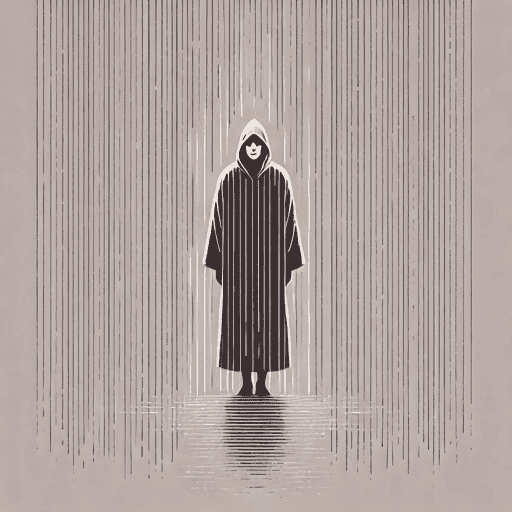
Glass Houses
62 pages • 2-hour read
Louise PennyGlass Houses
A modern alternative to SparkNotes and CliffsNotes, SuperSummary offers high-quality Study Guides with detailed chapter summaries and analysis of major themes, characters, and more.
Chapters 22-28Chapter Summaries & Analyses
Content Warning: This section of the guide includes discussion of death, substance use, pregnancy termination, child abuse, addiction, and death by suicide.
Chapter 22 Summary
In a hot courtroom, Gamache and Zalmanowitz exchange a brief look after Gamache’s testimony. Both understand the stakes. Gamache testifies that the motive for Katie Evans’s murder was wrath evolving into revenge. Judge Corriveau notices the understanding between the two men but continues. Gamache recalls a discovery in the church basement and knows someone in the courtroom is reporting his every word.
Meanwhile, at Sûreté headquarters, Inspector Jean-Guy Beauvoir interrupts Superintendent Toussaint’s meeting. She dismisses her agents, who address Jean-Guy as “patron,” intensifying his guilt. Toussaint reports that a shipment of 80 kilos of fentanyl crossed into the United States, with at least 10 kilos left behind in Québec for local distribution—untracked by design to make the cartel believe the Sûreté is incompetent. She describes mounting dissent after a year without major arrests. Jean-Guy reminds her they all agreed to Gamache’s plan and mentions a notebook in Gamache’s desk outlining the severe consequences of failure; their apparent weakness is meant to make organized crime reckless.
Maintaining plausible deniability, Toussaint avoids asking if Gamache committed perjury. She shows Jean-Guy information from Inspector François Gaugin about a new shipment—chlorocodide, or krokodil—hidden in nesting dolls at Mirabel airport. Gaugin seeks permission to arrest, but Jean-Guy orders inaction, realizing the cartel is waiting to see the trial’s outcome. He also confirms that Gamache perjured himself. He recalls Toussaint’s lunch phrase—"burn our ships”—signaling their irreversible commitment. Beauvoir leaves, feeling followed by a “dark thing.” Toussaint remains, and feels watched in return.
Back in court, Gamache testifies that the defendant came to his home to confess. When Zalmanowitz mentions a higher court, Gamache explains that it is a Gandhi line about the court of conscience. Judge Corriveau realizes the men are operating in a different court than hers. Gamache quietly pleads with her to let it pass.
Chapter 23 Summary
The narrative flashes back to Jean-Guy’s trip to Montréal to inform Katie’s sister, Beth, of her death. He questions Beth and her husband, Yvon, about the cobrador and whether Katie could sew; both say no. He asks about compromising secrets. Yvon expresses dislike for Patrick, calling him manipulative and describing the relationship as the “tyranny of the weak.” (221).
Jean-Guy accompanies Beth to Katie and Patrick’s home. In the car, Beth reveals that Katie terminated a pregnancy in high school after a brief relationship with Yvon, who does not know about the pregnancy or its termination. Katie kept it secret and attended Carnegie Mellon in Pittsburgh for a fresh start. They search the organized, cheerful home and find nothing suspicious. Jean-Guy takes a university-era photo of the five friends as evidence before accompanying Beth to inform her parents.
Chapter 24 Summary
At the Three Pines bed-and-breakfast, Patrick rocks on the sofa, hazy from medication, repeating that he does not understand. Matheo Bissonette resents the maternal attention Lea Roux gives Patrick and recalls their first-year university dynamic. Gabri brings tea and alcohol, trying and failing to comfort Patrick. While preparing shepherd’s pie in the kitchen, Gabri reflects that the friends’ bond seems colder during this visit, imagining them as Stonehenge rocks whose contact causes mutual destruction.
Matheo worries to Lea that he will be framed for the murder. Lea realizes that whoever speaks to police first can control the narrative. They acknowledge lying to investigators by claiming to know nothing. Matheo accuses Lea of giving Patrick more than one pill and threatens her. Lea reflects on her ruthless nature, recognizing that in a crisis, she would save herself first. She decides to speak with Gamache, but Matheo stops her, insisting they stay together. He knows Lea is ruthless and recognizes that he is equally so.
Chapter 25 Summary
Gamache makes notes inspired by the napkin bearing the phrase “burn our ships.” He considers a radical idea: Stop the futile struggle against drugs at the street level and allow the flow to expose and trap the source. He writes furiously in a notebook documenting the plan. Seeing Reine‑Marie staring ahead, thinking of the “dark thing” (the cobrador) in the root cellar, he comforts her. They decide to accept Myrna’s invitation for drinks. In his study, Gamache locks the napkin and notebook in a drawer, tapping the notebook as if waking something dangerous.
In the incident room, Jean-Guy shows Chief Inspector Isabelle Lacoste the photo of the five university friends. They discuss the dynamic among Katie, Patrick, and Edouard Valcourt. An agent reports that the Knowlton restaurant cannot confirm Patrick and Katie’s presence and that there is no credit card receipt. Jean-Guy vacillates between rational doubt and intuition, increasingly suspecting Reine‑Marie would have noticed the bat if it had been there. Lacoste suggests that the cobrador may have targeted someone other than Katie, allowing a third party to commit murder. She mentions newcomers Anton Lebrun, a dishwasher, and Jacqueline Marcoux, a baker, and their reluctance to discuss former employers Antonio and Maria Celeste Ruiz, who returned to Spain. Jean-Guy grows still, connecting Spain to the cobrador’s origin, and decides to contact the Spanish Guardia Civil about Ruiz.
At Myrna’s loft, the Gamaches join Myrna and Clara for drinks. Gamache says the murder does not appear random and the cobrador looks responsible. They discuss the nonviolent nature of traditional cobradors and wonder if Katie deserved her fate. Myrna argues one can kill conscientiously to prevent greater evil, leading to discussion of the Holocaust and how brutality becomes normalized under authority.
Chapter 26 Summary
In the incident room, Jean-Guy shows Lacoste a photograph he found during research. Taken 18 months earlier in Pittsburgh, it shows Colleen Simpson, who owned daycare centers, on a busy street just noticing a cobrador at the edge of the frame. Jean-Guy explains that Colleen was acquitted on a technicality for child abuse charges. He theorizes that Katie may have met Colleen while at Carnegie Mellon and that the cobrador came to Three Pines for Katie after dealing with Colleen. Lacoste tells him to investigate the connection and then reviews Ruth’s interview transcript.
At Myrna’s loft, Myrna describes the Milgram experiment, in which subjects administered seemingly fatal electric shocks simply because an authority figure ordered them to, demonstrating how ordinary people commit atrocities under authority. The conversation turns to Pinocchio, who lacked a conscience. Myrna explains that people with no conscience are “psychopaths,” who are often clever manipulators rather than overtly disturbed. Gamache begins to think a third person, a “psychopath,” manipulated both the cobrador and Katie.
Chapter 27 Summary
Back in the present, Judge Corriveau adjourns court and summons Gamache and Zalmanowitz to her chambers. Zalmanowitz apologizes for his slip in court. Gamache sees Jean-Guy, who has returned and gives a tentative wave. Zalmanowitz remarks that Jean-Guy was not there for Gamache, but Gamache defends him. A court clerk repeatedly summons them, but Gamache delays to speak with Jean-Guy.
Jean-Guy reports that the fentanyl shipment crossed and that at least 10 kilos were left behind in Québec, now untracked. Gamache is shaken, calculating the deaths his non-interdiction has sanctioned. Jean-Guy gives him a note about the new krokodil shipment sitting at Mirabel. Gamache realizes the cartel has waited two days, connects it to the trial, and understands they have a chance to spring their trap. He tells Jean-Guy to convene a meeting with everyone.
In chambers, Judge Corriveau demands to know what is happening. Gamache explains his year-long secret operation: gutting the Sûreté of resources for all crimes except drug trafficking to find and destroy the main cartel. He admits allowing the drug trade to grow and shipments to pass to make the cartel believe the Sûreté was incompetent so it would become reckless. He acknowledges thousands of deaths can be attributed to his actions. The judge is horrified, saying she should arrest him for murder. Gamache argues that arresting him will destroy their one chance to dismantle the cartel, which was growing uncontrollably anyway. Zalmanowitz adds that success could change the drug war’s terms. The judge sees the immense sacrifice both men have made. Gamache lies again, claiming the defendant did murder Katie. Knowing she is being lied to and that perjury has occurred, Corriveau gives them until 8:00 am the next day before deciding, effectively giving them a window to act.
Outside, Gamache and Zalmanowitz acknowledge that the judge will charge them but has given them time. Zalmanowitz confirms the operation is tonight and wishes Gamache luck. Alone, Judge Corriveau wrestles with her conscience, having bent the law to allow Gamache to proceed.
Chapter 28 Summary
In a flashback, Jean-Guy and Lacoste arrive at Myrna’s loft. Jean-Guy goes to the bistro to collect a casserole. Lacoste questions the group about Ruth’s comment that the church was used by rumrunners during Prohibition. Myrna confirms the story, learned from Ruth after asking about an unpublished poem concerning the guilt of an old inheritance. Myrna reveals that she cleans Ruth’s house and that Ruth learned the history from an old warden. Reine‑Marie notes that Prohibition led to the mob’s rise, and Gamache silently connects this to the modern drug trade and the church basement.
At the bistro, Jean-Guy learns Anton Lebrun is making the casserole and orders hot chocolate. Anton and Jean-Guy carry dinner to the Gamache home. Anton uses the phrase “progress not perfection” (281), and the two men recognize each other as Alcoholics Anonymous members. Anton shares his history—drug addiction, dealing, and recovery—leading to his passion for cooking. He got his job with the Ruiz family by working for cash and keeping his past quiet. Asked about the cobrador, Anton admits he recognized the figure and fears their former employer, Antonio Ruiz. In Gamache’s study, Anton shows Jean-Guy a Spanish news report about Ruiz being exonerated in a money laundering case and pauses the video to reveal a cobrador on the courthouse steps behind Ruiz. Anton admits he thought Ruiz sent the cobrador to Three Pines to threaten him and Jacqueline.
At Myrna’s, Lacoste asks about the friends. Myrna says they initially blamed Katie for Edouard Valcourt’s death by suicide after she left him for Patrick. The dealer who sold to Edouard disappeared after his death. Reine‑Marie suggests Edouard might have been pushed, something Gamache has also considered. Lacoste decides to contact the Valcourts. Gamache abruptly ends the evening, asking Lacoste to join him and telling Reine‑Marie to have Jean-Guy meet them at the incident room. Clara tells Myrna she is starting a new painting, insisting she knows when something is finished.
At the bed-and-breakfast, Lacoste interrupts the friends’ dinner, requesting the Valcourts’ contact information. Lea says she can provide it in the morning. Patrick claims to have deleted it. Lacoste leaves, certain Lea is in charge, and recalls the Mossad advice to “kill the women first” (290). Gamache examines the area behind the church, finding no tracks in fresh snow. He checks the wall and woods, puzzled when lights suddenly illuminate the area. He then goes into the church, meets Jean-Guy, and says he was looking for rumrunners before leading him to the incident room.
Chapters 22-28 Analysis
These chapters highlight the theme of The Moral Failures of the Law through Gamache’s secret operation and his perjury. The narrative pivots from a murder investigation to a moral crisis as Gamache subverts the legal system he is sworn to uphold. His justification for this drastic action is articulated when he quotes Gandhi, asserting that “[t]here is a higher court than courts of justice and that is the court of conscience. It supersedes all other courts” (217). By feigning incompetence for a year, Gamache acts according to this “higher court,” weighing the immediate cost in human lives against the potential to eradicate the source of the drug trade. By contrast, Judge Corriveau serves as the embodiment of the established legal order, forced to confront the limitations of her own court when faced with a problem of such magnitude. Her ultimate decision to grant Gamache a 15-hour window is a tacit acknowledgment that the law may be insufficient. The novel thus questions whether institutional justice is capable of addressing a systemic threat, or whether “burning their ships” becomes the only visible path.
The narrative structure, which interweaves the present-day trial with flashbacks to the November investigation, builds suspense. The narrative shows the consequences of Gamache’s actions—his perjury, Inspector Beauvoir’s pained flight from the courtroom, the Sûreté’s apparent decay—before fully revealing the elaborate strategy behind them. This temporal dislocation creates confusion and doubt, nudging readers to question Gamache’s judgment. His full plan only emerges in his confession to Judge Corriveau, a structural choice that mirrors the operation itself: a long-term deception designed for a single moment of clarity.
This interplay of withholding and revealing facilitates the theme of The Deceptive Nature of Appearances, as does the ongoing examination of the dark undercurrents beneath both communal and personal relationships. The facade of friendship among the university cohort unravels at the bed-and-breakfast as their shared grief gives way to mutual suspicion and self-preservation. Matheo and Lea, bound by secrets, begin to see each other as threats, with Lea acknowledging her own ruthlessness in a moment of self-awareness. Gabri’s perception of them as Stonehenge rocks whose proximity ensures mutual destruction serves as a metaphor for their toxic bond and contrasts sharply with the apparent solidarity they once projected, illustrating how long-held guilt and secrets can corrode even the strongest-seeming relationships from within.
Conversations in Myrna’s loft function as a recurring forum to explore the novel’s intellectual and ethical framework and its relationship to the characters’ actions. Myrna’s retelling of the Milgram experiment addresses the ease with which ordinary people commit atrocities when sanctioned by an authority figure, a concept that resonates with the actions of the cartel and the complicity required for Gamache’s own morally ambiguous plan. Furthermore, her description of “psychopaths” as master manipulators hiding in plain sight sharpens the investigation. She explains that psychopaths are often “clever […and] know how to mimic human behavior […] It’s a kind of magic” (248-49). This allows Gamache to theorize the existence of a third party who might be controlling events. These conversations invite consideration of the nature of conscience, or the lack thereof.
The hidden door in the church takes on greater thematic weight in this section, evolving from a historical curiosity into a metaphor for the novel’s layered secrets. The church’s use by Prohibition-era rumrunners connects past and present criminality, suggesting that illicit enterprises have long found cover in familiar institutions. This history mirrors Gamache’s secret war against the modern-day drug cartels. His perjury, concealing key facts from the court, becomes a symbolic act. He is not merely hiding a physical entrance but protecting the secret passage through which he hopes to deliver a form of unsanctioned justice. This act embodies Unresolved Guilt and Seelf-Justified Justice, as Gamache sacrifices his legal integrity by lying under oath to preserve his covert operation. The hidden door suggests the morally complex, extralegal paths the novel argues may be necessary when institutions fail.

Unlock all 62 pages of this Study Guide
Get in-depth, chapter-by-chapter summaries and analysis from our literary experts.
- Grasp challenging concepts with clear, comprehensive explanations
- Revisit key plot points and ideas without rereading the book
- Share impressive insights in classes and book clubs