Gone Before Goodbye
60 pages • 2-hour read
Harlan Coben, Reese WitherspoonGone Before Goodbye
A modern alternative to SparkNotes and CliffsNotes, SuperSummary offers high-quality Study Guides with detailed chapter summaries and analysis of major themes, characters, and more.
Symbols & Motifs
Content Warning: This section of the guide includes discussion of graphic violence and death.
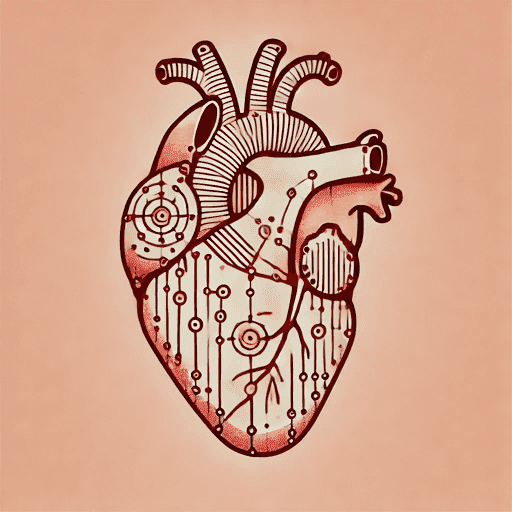
The THUMPR7 Artificial Heart
The THUMPR7, a total artificial heart, is a symbol that supports the novel’s exploration of The Corruption of Idealism. Initially representing the pinnacle of humanitarian ambition, it embodies the dream shared by Maggie, Marc, and Trace to revolutionize medicine and save lives on a massive scale. It is their joint creation, a testament to their shared hope and brilliance. The narrative establishes it as a groundbreaking device that, despite being a “distant pipe dream” (37), is born from a desire to push scientific boundaries for the greater good. This initial portrayal casts the THUMPR7 as a symbol of pure, albeit reckless, innovation and the altruistic core of WorldCures.
However, as the novel unfolds, the THUMPR7 becomes inextricably linked to the moral decay at the heart of the organization. Trace’s theft of the prototype and Porkchop’s use of it as a bargaining chip with Oleg Ragoravich transform it from a tool of healing into a commodity entangled in a web of crime and coercion. Its ultimate use is a moment of grim irony: It is implanted into Oleg using the literal heart of its corrupt co-creator, Trace. In this final act, the symbol’s meaning fully resolves. The THUMPR7, once a beacon of hope, becomes an instrument of dark, poetic justice, literally powered by the corrupted heart of one of its makers and serving as the engine for another’s desperate, criminal ambition.
The Serpents and Saints Tattoo
The Serpents and Saints tattoo is a symbol that charts the journey from perceived innocence to horrific truth, supporting the narrative’s development of the theme of corrupted idealism. When introduced, the tattoo is a personal, almost trivial detail—a goofy relic of Marc’s youth that Maggie views as a cringe-worthy but endearing part of his history. It symbolizes a past built on love and authenticity and speaks to Marc’s character, developing him as somewhat reckless but fun-loving. This perception is violently shattered when Maggie discovers an identical tattoo on Nadia’s leg, which Nadia explains as branding her as a survivor of the organ trafficking ring. In this pivotal moment of discovery, Maggie realizes, “Maggie has seen only one tattoo like this before. On Marc’s leg” (127). The symbol is instantly and irrevocably transformed, and this shift becomes a metaphor for Maggie’s shifting understanding of Marc as the truth about him and WorldCures is revealed.
What was once a mark of intimacy becomes a brand of unthinkable cruelty and betrayal, forcing Maggie to confront the probability that her understanding of Marc, and their entire life together, was built on a lie. The name itself, Serpents and Saints, is the name of Porkchop’s motorcycle gang, but it also perfectly captures Marc’s newly revealed duality, representing the coexistence of good and evil, and the ease with which one can masquerade as the other. On a narrative level, the tattoo functions as the primary key to the novel’s mystery, unlocking the connection between Marc’s secrets, Trace’s crimes, and the dark reality underpinning WorldCures, developing the novel’s examination of the intersection between Technology and the Elusive Nature of Truth.
Surgical Alteration and Disguise
The recurring motif of surgical alteration and disguise contributes to the theme of technology and the elusive nature of truth in a technologically advanced world. Throughout the novel, surgery is consistently perverted from a tool of healing into an instrument of deception, allowing characters to manipulate their physical identities to escape their pasts and perpetrate crimes. This motif is embodied by Oleg Ragoravich, who commissions Maggie to perform complex facial reconstruction on his body double and then uses the man to fake his own death. The procedures are described as a “rather unique open rhinoplasty” using a custom “artificial nose scaffold” (97, 98). The highly technical and bespoke nature of this surgery highlights a world where identity is not just masked but fundamentally reconstructed, making truth nearly impossible to verify.
This pattern of deception extends beyond a single character, becoming a defining feature of the novel’s criminal underworld. Dr. Barlow’s entire high-end practice is built on providing discreet, transformative alterations, and the criminals he serves rely on this technology to operate with impunity. The constant manipulation of appearances creates an atmosphere of deep uncertainty, forcing Maggie to question the authenticity of every face she encounters. The motif of surgical alteration serves as a literal manifestation of the novel’s core argument: In a world where reality itself can be skillfully forged, truth becomes the most vulnerable casualty.

Unlock the meaning behind every key symbol & motif
See how recurring imagery, objects, and ideas shape the narrative.
- Explore how the author builds meaning through symbolism
- Understand what symbols & motifs represent in the text
- Connect recurring ideas to themes, characters, and events