32 pages • 1-hour read
Grief is the Thing with Feathers
A modern alternative to SparkNotes and CliffsNotes, SuperSummary offers high-quality Study Guides with detailed chapter summaries and analysis of major themes, characters, and more.
Part 1Chapter Summaries & Analyses
Content Warning: This section of the guide includes discussion of animal death and death.
Part 1: “A Lick of Night”
Part 1, Pages 1-9 Summary
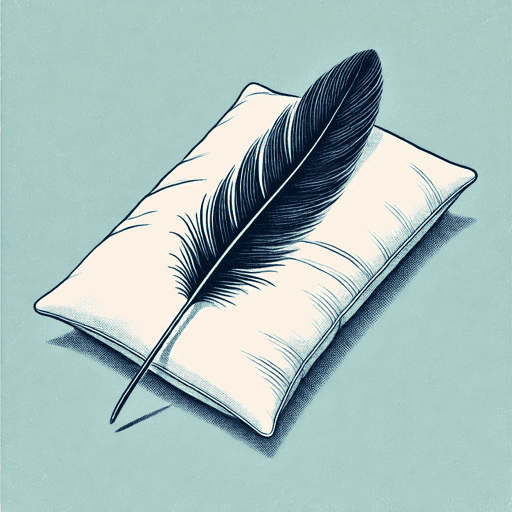
The boys notice black feathers on each of their pillows at night. They decide to sleep on the floor. Dad grows tired of all the well-wishers who have come one by one to the grieving family’s home to try to help take care of them in the wake of Mum’s death. When the doorbell rings yet again, he is greeted by a giant crow who picks him up and tells him, “I won’t leave until you don’t need me anymore” (6). He reluctantly greets the crow, who then disappears.
Crow describes the family’s home, noting how Mum still seems like she is everywhere, even though she has recently died. Crow describes watching Dad as he sleeps, going so far as to kiss him and put his claw around Dad’s eyeball. He leaves a feather on Dad’s forehead.
Part 1, Pages 10-17 Summary
Dad struggles to work on his book about Ted Hughes. Invariably, he becomes distracted and doodles instead, drawing images of his wife’s funeral, in which every guest has the head of a crow, or of his wife’s corpse being picked apart by birds. The boys are not explicitly told that their mother will not return, but they gradually begin to understand that she will not, and that life is going to be very different. Crow sets about implementing what he calls the “therapeutic method,” living with the family and accompanying them throughout their grief.
Part 1, Pages 18-25 Summary
The boys find a guppy in a tidepool and kill it with rocks. Dad is absorbed by thoughts of his dead wife and does not seem interested in his sons’ increasingly violent tendencies. On their own, the boys try to make sense of why they killed the fish. Crow attempts to soothe Dad by distracting him with dramatic performances of “unbound crow stuff” (23).
Part 1 Analysis
In Part 1, the narrative introduces the family’s tragic circumstances, establishing their status quo before breaking it with the arrival of the mysterious, unexpected Crow into their lives. Crow’s ominous arrival is foreshadowed by the black feathers on the boys’ pillows, evoking the sense, within the first couple of lines, that all is not well in the house. “There’s a feather on my pillow,” one brother tells the other, “It’s a big black feather” (3). Eerie and ominous, the black feathers are unsettling and invoke an understanding that something bad has happened, but it isn’t until Dad makes it clear in his first speaking section that Mum has died that this undefined wrong is given specific form. The Emotional Turmoil of Grief is established in these chapters through Porter’s method of gradually revealing information. This deemphasizes plot, favoring character development as the book’s source of momentum instead.
Compared to the reserved voices of Dad and the boys, Crow’s arrival as a speaker in the book gives his passages an explosive, maximalist quality. His exuberant use of onomatopoeia— “KONK. KONK. KONK. (16)”— has a vibrancy that contrasts with the melancholic tone of the grieving family. Crow is joyful to have found a grieving family to care for. He tells the reader, “Motherless children are pure crow. For a sentimental bird it is ripe, rich and delicious to raid such a nest” (16). This metaphor of a bird raiding a nest frames grief as a violent process, and it is seemingly at odds with Crow’s self-image as a caretaker for the family. This self-image is evident when the bird makes firm pronouncements like “I believe in the therapeutic method” (11). In these earliest stages of the book, Crow’s reliability is ambiguous: Is the bird really a therapeutic caregiver, or do the hints of his violence indicate that Crow will ultimately do more harm to the family? This uncertainty is part of Crow’s allegorical significance, since grief is a destabilizing force in people’s lives. From the moment his feathers appear on the boys’ pillows, he forces the family to confront his presence, and therefore the presence of their grief.
Porter further supports this notion of Crow as potentially unreliable and possibly antagonistic through Dad and the boys’ reaction; they are apprehensive about what Crow’s presence in their lives means. Upon discovering the feathers on their pillows, the boys decide it’s best to avoid their beds, rather than facing the problem head-on: “Let’s leave the feathers where they are and sleep on the floor,” they say (3), intent on avoiding what confronts them in the same way they avoid confronting Mum’s death. When Crow first arrives on his doorstep and scoops Dad up, Dad initially demands that Crow put him down, until eventually accepting the bird, saying, “Hello Crow […] Good to finally meet you” (7). As the story progresses, Dad gradually warms to Crow, eventually concluding that he has much to learn from the bird. The boys, however, do not acknowledge Crow’s presence until the very end of Part 1, when they eavesdrop on a conversation between Crow and Dad. They only see Crow in relation to their father, indicating that, at least at first, rather than representing the entire family’s grief, Crow very specifically embodies Dad’s grief.
While Dad copes by growing fixated on Crow, the boys turn to violence as an outlet for their grief. This dynamic is first apparent in the guppy episode, during which the boys have a violent impulse, which is sudden and inexplicable, toward the vulnerable fish. Even more abrupt is their reaction to their own violence: “All the fun was sucked across the wide empty beach. I felt sick and my brother swore” (19). This quick shift, and the disconnect it illustrates between the boys’ natures and their actions, highlights the emotional turmoil of grief.
The punchline of the episode, however, is Dad’s blasé response to the boys’ violent behavior. Porter writes, “Dad didn’t look up from his book but said ‘you’ve done something bad I can tell’”(18). This exchange is emblematic of Dad’s absorption in his Love of Art as Escape From Pain, and the parental void that occurs as a result of that absorption; Dad is more concerned with his book than he is with offering his sons guidance. Crow is the only figure who seems interested in stepping into that caregiving role, and yet ironically, Crow, as an extension of Dad himself, cannot adequately perform the duties of caretaker. This dynamic establishes the theme of Caretaking During Bereavement, which will become a main focus of the book, especially in regard to the parental needs of the children.

Unlock all 32 pages of this Study Guide
Get in-depth, chapter-by-chapter summaries and analysis from our literary experts.
- Grasp challenging concepts with clear, comprehensive explanations
- Revisit key plot points and ideas without rereading the book
- Share impressive insights in classes and book clubs