Heart of a Dog
44 pages • 1-hour read
Mikhail BulgakovHeart of a Dog
A modern alternative to SparkNotes and CliffsNotes, SuperSummary offers high-quality Study Guides with detailed chapter summaries and analysis of major themes, characters, and more.
Chapters 1-3Chapter Summaries & Analyses
Content Warning: This section of the guide includes discussion of death, animal cruelty, and child sexual abuse.
Chapter 1 Summary
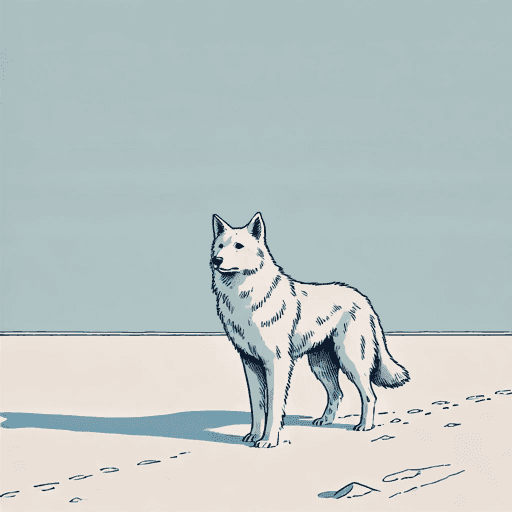
The Heart of a Dog opens with the internal monologue of a stray dog living in Moscow. The dog is in pain because a cook from the canteen at the National Economic Council poured boiling water on him while he was scavenging in the trash. It is winter, and the dog is convinced he will die from his injuries. He wishes it were summer so he could go to the park to find food and roll in the grass “that does you good” (4), even though, annoyingly, there is often an “old groaner” singing “O celeste Aïda” in the park. The dog reflects that not all cooks are bad; he thinks fondly of Tolstoy’s cook, who was friendly to dogs. While the dog sits in a doorway feeling sorry for himself, a woman notices him and calls him Sharik before going out into the snowstorm.
The narrative perspective shifts to free indirect discourse, flipping between the dog’s first-person perspective and third-person limited perspective. The dog resents being called Sharik, as it is a name for “a dog with pedigree,” and he is a “filthy, stray mongrel” (7). Then, a “gentleman,” Philip Philipovich, leaves the building across the street. The man approaches the dog and offers him a “Special Cracower” sausage. The man leads the dog to his apartment building on Obukhov Street with his sausage. The doorman, Fyodor, is skeptical of the dog, but he lets them in. As they enter, the doorman tells Philipovich that four new tenants have moved into one apartment in the building, which is being subdivided to fit them. The doorman reports that the new House Committee is working to move new tenants into all the apartments.
Chapter 2 Summary
In free indirect discourse, Sharik describes how stray dogs in Moscow learn to read basic letters and messages to survive, such as learning that butcher shops are labeled “MSFS.” Sharik tries to read the name on Philipovich’s door, but he does not get farther than “Pro—.” He wonders if it says “proletarian,” but quickly rules it out because the man seems too refined; it actually says Professor. In the apartment, Zina, Philipovich’s maid, greets Philipovich and Sharik. Zina shuts Sharik into an examination room. When Sharik notes the medical smell, he panics, thinking he is at the vet. He bites a man in an attempt to escape. Philipovich sedates Sharik.
When Sharik wakes up, his burns have been treated. Philipovich is standing over Sharik, singing to himself. He sees the man he bit, Doctor Bormenthal, nearby. Sharik overhears Philipovich telling Zina that he lured the dog there with sausage, as kindness works better than pain or threats. The doorbell rings, and Sharik follows Philipovich into his study. Sharik is discomfited by a giant stuffed owl on the wall. A man comes into the study to see Professor Philipovich for a follow-up on his “rejuvenation” treatments. He has had some kind of surgery on his abdomen that has made him more virile. In keeping with his pursuit of youth, the patient has also tried to dye his hair to hide his gray hair, but he was sold a faulty product and accidentally dyed his hair green. Philipovich warns the man not to overdo it. The man pays Philipovich a large sum and leaves.
Philipovich sees his next patient, a 51-year-old woman who is pursuing a younger man and seeks rejuvenation. The Professor agrees to “implant some monkey’s ovaries” (27) into her the following week. The Professor’s next patient is a “well-known” man in Moscow who is seeking the Professor’s advice. He has become involved with a 14-year-old girl even though he is married. Witnessing this, Sharik decides that “this place is indecent […] but I like it!” (28)
That evening, four young people arrive at the apartment. They are the new House Management Committee. They are led by a young man named Shvonder. They inform the professor that he is required to give up at least one of the rooms in his seven-room apartment. The professor objects, explaining he needs the extra rooms for his work. In response, Philipovich calls Pyotr Alexandrovich, a leader in the local party, and tells Pyotr that he will take his practice to Sochi unless he is allowed to keep his apartment. Pyotr tells Shvonder to allow him to keep his apartment. As they leave, a member of the committee accuses Philipovich of “hat[ing] the proletariat” (36). Philipovich agrees. After they leave, Sharik stands on his hind legs and “perform[s] obeisance” to the professor.
Chapter 3 Summary
That evening, Philipovich shares a lavish meal with Doctor Bormenthal. Periodically, Philipovich feeds Sharik scraps from the table. Philipovich tells Bormenthal that his patients’ health improves when they don’t read the newspapers, and it declines when they read Pravda. Toward the end of the meal, Philipovich complains he can hear a general meeting next door. He tells Bormenthal that his rubbers (rainboots) were never stolen from the hall stand until March 1917. Then, all of the rubbers were stolen, and the hall stand was removed, so now people walk on the staircase in their dirty rubbers. Bormenthal points out that “the proletarians don’t have any rubbers” (42). Philipovich retorts that the proletarians stole his rubbers. When Bornmenthal replies that “the place is going to ruin” (43), Philipovich says that ruin is “something that starts in people’s heads” (44). He goes on a rant about the state of the country. The doctor tells the professor he “sound[s] like a counterrevolutionary” (45).
After dinner, Philipovich tells Bormenthal he is going to the Bolshoi Theatre to see Aïda. He tells Bornmenthal to keep an eye on a dying patient because he wants the corpse as fresh as possible. When he doesn’t go to the Bolshoi or a meeting of the All-Russian Surgical Society, Philipovich spends many evenings in his study with Sharik amongst jars of human brains.
Over the next two weeks, Sharik continues to heal. He is incredibly grateful to the professor for saving him. As his health improves, he starts to take on more dog-like behavior, such as attacking the stuffed owl in the professor’s study. Zina and Philipovich discipline him for the destruction. Philipovich puts a collar on Sharik, and Sharik basks in the admiration this garners him from others. One evening, he sees a man sneak into the cook Darya Petrovna’s room.
One day, Sharik wakes with a sense of foreboding. Philipovich gets a phone call and quickly begins to make preparations. The doctor arrives with “an evil-smelling trunk” (54). Sharik is locked in the bathroom. Sulkily, Sharik plots his revenge for being locked away. Then, Zina drags him by the collar into the consulting room. Bormenthal sedates Sharik. Philipovich and Bormenthal perform an operation, replacing Sharik’s pituitary gland and testicles with the gland and testicles of a recently deceased man. When they are finished, Philipovich is not sure if Sharik will survive the operation.
Chapters 1-3 Analysis
The Heart of a Dog is a structurally complex novella that uses shifting perspectives and literary genres to convey irony, uncertainty, and humor in its satirical critique and analysis of Soviet Russian society in the early years following the Russian Civil War. Three dominant narrative structures shape the work. First, it is a satirical parable—a story with a moral message. The message of The Heart of a Dog is to warn about the dangers and unintended consequences of scientific experimentation, introducing the novella’s thematic engagement with Transforming Bodies to Transform Society. As a medical doctor, author Bulgakov was aware of real-life surgeons like Franco-Russian Serge Voronoff, who gained notoriety in the 1920s and 1930s for transplanting monkey testicles into the testicles of men as a form of revitalizing, anti-aging surgery—techniques echoed in the dubious surgeries undertaken by Professor Philipovich. Like many parables, The Heart of a Dog contains folkloric elements, chiefly seen here in the character of Sharik as a dog who gradually takes on human qualities.
In addition to its function as a parable, The Heart of a Dog is also a Faustian tale modeled after Mary Shelley’s Frankenstein; or, The Modern Prometheus. The literary figure Faust is a scholar who makes a deal with the Devil in exchange for knowledge, only to pay a tragic price for his decision. Shelley innovated on this stock character to create Dr. Frankenstein, a Faustian character who specifically seeks medical knowledge or the secret to life and uses it to create his Monster, only for his hubris to lead to his downfall. Bulgakov’s allusions to Faust and Frankenstein introduce an element of science fiction into the narrative. Like Dr. Frankenstein, Professor Philipovich is a Faustian figure in a science fiction setting who uses his damned knowledge to create new life, only to regret it when his new creature, the New Man-dog Sharik, escapes his control. However, Philipovich differs from Dr. Frankenstein in some important ways, which will be discussed in later analyses.
Like Frankenstein, The Heart of a Dog is a Bildungsroman that explores the moral development and maturation of a central figure. While Frankenstein explores the lifespan of both Dr. Frankenstein and his Monster, The Heart of a Dog focuses primarily on the transformation of the dog Sharik/Sharikov from his animal state governed by base desires to human young adulthood. These interlocking structures are used to explore the classic debate between nature versus nurture in human development. Bulgakov’s novel asks questions about the relationship between the human organism, nature, and society, and the consequences of attempting to change this relationship.
Early Anglophone analysis of The Heart of a Dog, written at the height of Cold War tensions between the United States and Russia, argued that the work is a roman à clef or clearly wrought critique of the Soviet Union, where elements match one-to-one with their real-life counterparts. This assessment of the work has been often repeated over time, as seen in the Introduction of Michael Glenny’s 1968 translation of The Heart of the Dog, where he writes:
The ‘dog’ of the story is the Russian people, brutalized and exploited for centuries […] The weird surgeon, a specialist in rejuvenation (for ‘rejuvenation’ read “revolution”), is the embodiment of the Community Party […] and the drastic transplant operation that he performs in order to transform the dog into the simulacrum of a human being is the revolution itself (viii).
However, Russian professor Diana L. Burgin and others have later argued that while Bulgakov’s novella satirizes The Destructive Consequences of Governmental Corruption, a close reading of the text does not support this “anti-revolutionary” interpretation of the work (i.e., “Bulgakov’s Early Tragedy of the Scientist-Creator: An Interpretation of The Heart of a Dog,” an essay by Diana L. Burgin). The analysis in this guide will instead focus on the multi-faceted structural meanings of the characters, language, and plot, as described in the preceding paragraphs, rather than treating it as a roman à clef, as described by the translator.
The first three chapters of The Heart of a Dog are written variously in the first-person perspective of the dog and in third-person limited perspective focused on the dog. The narrative shifts between the perspectives using free indirect discourse—a literary technique that integrates third-person narration with the character’s inner thoughts. This early focus on the dog’s perspective initially grounds the work in the realm of a parable, as it is more common in folklore to tell a story from the point of view of an animal, although Sharik is more realistically rendered than the common folkloric animal to facilitate Bulgakov’s thematic exploration of Class Conflict in Domestic Spaces. It also introduces the darkly humorous tone of the work, as when the dog reminisces about the quality of “Count Tolstoy’s” cook compared to the cooks who dish out “muck” at the Food Rationing Board (5). Bulgakov uses these perspective shifts to create an aspect of unreliable narration that is later developed through the focus on Doctor Bormenthal’s perspective. Like Bormenthal, Sharik adores Philipovich, describing him as a “gentleman” and a “dignified benefactor,” creating dissonance with Bulgakov’s indications that Philipovich is a dubious character who is driven by hubris, snobbery, and entitlement.

Unlock all 44 pages of this Study Guide
Get in-depth, chapter-by-chapter summaries and analysis from our literary experts.
- Grasp challenging concepts with clear, comprehensive explanations
- Revisit key plot points and ideas without rereading the book
- Share impressive insights in classes and book clubs