Heart of a Dog
44 pages • 1-hour read
Mikhail BulgakovHeart of a Dog
A modern alternative to SparkNotes and CliffsNotes, SuperSummary offers high-quality Study Guides with detailed chapter summaries and analysis of major themes, characters, and more.
Character Analysis
Content Warning: This section of the guide includes discussion of death, animal cruelty, and graphic violence.
Sharik/Poligraph Poligraphovich Sharikov
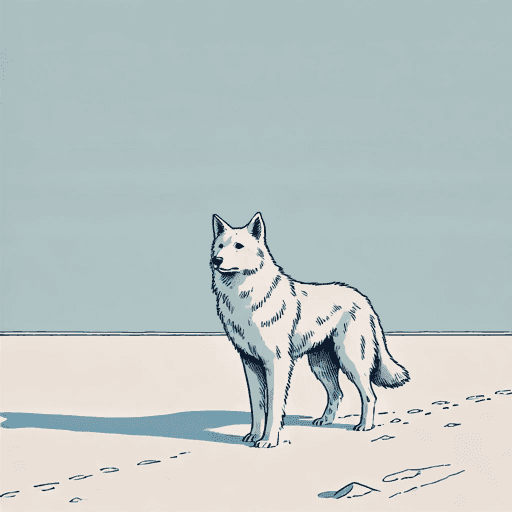
The Heart of a Dog traces the transformation of the stray dog Sharik into a human named Sharikov and his maturation as a human before ultimately returning to his original state. Sharik’s first-person point of view bookends the beginning and the end of the novel, giving insights into his thoughts and feelings when in dog form. Within Bulgakov’s satire, Sharik represents the Russian populace in general as it is transformed over the course of the Russian Revolution and the early days of the Soviet Republic.
At the beginning of the novella, Sharik is a miserable, injured stray dog living on the streets in Moscow. He is crying out in pain after being burned with boiling water by a cook who wanted to stop him from scavenging in the trash for food scraps. He believes he is “finished” and that he will die from his injuries. Initially, Sharik is characterized by his resentment of the proletariat and his anger over his mistreatment at their hands. He thinks, for example, that “garbage men are the lowest form of proletarian life” (5). He contrasts the brutish working class with the kindness of “a gentleman’s cook who worked for Count [Leo] Tolstoy’s family and not for your stinking Food Rationing Board” (5). Sharik’s hunger is reflective of the real hunger experienced by the Russian populace during and after World War I due to wartime food shortages. He is likewise resentful of being dubbed “Sharik”—a common name for dogs in Russia that literally means “little ball”—by a passing young woman. To him, it’s “the sort of name for a round, fat, stupid dog” (7), not a “stray mongrel” like himself.
At the start of his arc, the author presents Sharik as fully aligned with Philipovich’s worldview. When he first meets the professor on the street, he admires him as a “gentleman” who quickly wins over his trust with the promise of a sausage. After being lured to Philipovich’s and treated, Sharik’s admiration of Philipovich only grows. When he sees Philipovich stand up to the House Committee and proclaims that he doesn’t “like the proletariat,” Sharik “perform[s] obeisance to him” (36), illustrating that he has accepted Philipovich, who shares his dislike of the proletariat, as his master.
After his operation, Sharik transforms into a man and begins to diverge from the political views of his progenitor. He learns to walk on his hind legs, speak, and eventually names himself Sharikov, the surname form of Sharik. He ceases to obey Philipovich as his master as he progresses from “childhood” to “adolescence,” growing progressively more rebellious and difficult for Philipovich to control. He drinks, he steals, and he sheds his former disdain for the proletariat, eventually coming to self-identify as a “worker.” When he asserts his rights as a worker to “thirty-seven square feet” of Philipovich’s apartment, the conflict between the two comes to a head, and Sharikov attempts to shoot Bormenthal, underscoring his evolution to a Bolshevik revolutionary (139). Philipovich’s reversal of the operation, transforming Sharikov back into a dog, represents an attempt to reassert control over his experiment. Once returned to his dog form, Sharik is once again content to treat Philipovich as his “master.” He is sleepy, well-fed, and feels himself “very, very lucky” (146) to live in a gentleman’s home. He reflects that whatever Philipovich did to him is “none of my business, really” (146).
Sharik’s arc is representative of the limits of the Transforming Bodies to Transform Society, as he did not reach the ideal of the New Man to which Philipovich aspired. The transformation of Sharik from obedient dog into rebellious man and finally, back to obedient dog shows the lack of control Philipovich ultimately has over his own creation, leading him to “destroy” it by reversing the operation. As an autonomous being, Sharik’s continued growth and development were ultimately stifled by a controlling “master” who could not countenance his rebellious nature and increasingly human demands, reinforcing the elements of political satire in Bulgakov’s novella.
Professor Philip Philipovich Preobrazhensky
Professor Philipovich is a medical researcher who uses his knowledge and abilities to transform a dog, Sharik, into a man, Sharikov, whom he ultimately regrets and despises. Philipovich is a complex character who has been interpreted in a variety of ways by scholars. Philipovich can be understood in part as an autobiographical representation of Bulgakov himself. Like Bulgakov, Philipovich is a medical doctor from a bourgeois family who has a passion for theater. Philipovich also shares Bulgakov’s skepticism about reforms in Soviet society and is critical of the Soviet government, represented in the novella by the House Committee.
Philipovich can also be understood as a tragic hero in the Faustian model. Like the character Doctor Faust, he has an idealistic, egotistical, and aspirational view of how the application of knowledge can improve the world. However, in deploying this knowledge, he ends up creating chaos and destruction as his innovation, Sharikov, escapes his control. This chaos results in the erosion of his health and well-being as he becomes increasingly hunched and grayed over the course of the work. Bulgakov makes this Faustian connection explicit, describing Philipovich as “looking like a graying Faust” (112). Once Philipovich reverses Sharikov’s procedure, his own health returns.
Philipovich can also be understood as a mystical, quasi-religious figure, like a prophet or sorcerer. His surname, Preobrazhensky, literally translates to “transfiguration” with a spiritual connotation, pointing to the transfiguration of the dog into a man. Elsewhere, Philipovich is described as “thunder[ing] like an ancient prophet” while “his hair shone like a silver halo” (44). Similarly, Sharik sees him as “the wizard, the magician, the sorcerer” (47). This perspective expands Philipovich’s machinations from the realm of science and imbues them with a magical or supernatural aspect, in keeping with the folkloric quality of the work.
While the three above interpretations of Philipovich situate him as the protagonist of the novella, scholars—such as author and translator of Russian literature, Ellendea Proffer, A. Colin Wright, author of Mikhail Bulgakov: Life and Interpretations (1978), Diana L. Burgin, author of “Bulgakov’s Early Tragedy of the Scientist-Creator” (1978)—have argued that Philipovich is better understood as an antagonist who acts out of hubris to transform and then control life, society, and its expressions out of a reactionary sense of entitlement and ownership. While Philipovich has some humanist impulses, as seen in his repeated exhortations that “kindness [is] the only possible method when dealing with a living creature. You’ll get nowhere with an animal if you use terror” (20), he nevertheless operates on Sharikov without his consent, denying him his agency and humanity.
Bulgakov depicts the professor as a glutton who eats and drinks lavishly in his large apartment, even while others go hungry on rations and squeeze into subdivided spaces. He’s a snob who “hates” the proletariat and has few friends, suggesting a latent misanthropy. This snobbery directly impacts his relationship with Sharikov as he denies being Sharikov’s parent and resents the public accusation that Sharikov is his “illegitimate” son. He even adopts the censoriousness of which he is critical, as shown in his decision to burn Sharikov’s book. Collectively, these elements position Philipovich as a deeply flawed figure acting as much out of his own sense of self-importance as out of any greater desire to improve knowledge for the good of mankind.
Doctor Ivan Arnoldovich Bormenthal
Doctor Bormenthal, Philipovich’s assistant, serves two roles in the narrative, as Sharikov’s foil and Philipovich’s interlocutor. Like Sharik the dog at the beginning of The Heart of a Dog, Bormenthal admires Philipovich, his “master.” Philipovich took Bormenthal “under his wing” when he was “a half-starved student,” much like how Philipovich takes in Sharik and treats his injuries (118). In return, Bormenthal has “boundless” respect for Philipovich. When Sharikov becomes increasingly rebellious and challenges Philipovich’s authority, the tension between the loyal lackey, Bormenthal, and Sharikov steadily increases and becomes more violent. Bormenthal physically threatens Sharikov after Sharikov attempts to take advantage of the cook, Darya. He later advises Philipovich to kill his creation, even going so far as to offer to do the job himself. He is rebuffed by Philipovich, but his desire to harm Sharikov, his rival for Philipovich’s love and affection, and a disrespectful affront to his master’s dignity, is increasingly evident in the work.
Bormenthal also serves as Philipovich’s assistant and interlocutor. Like Philipovich, Bormenthal comes from an educated, bourgeois background and has medical training. This context provides a framework for Philipovich to explain his thinking and process to Bormenthal, giving insight into the character of Philipovich. At points, their relationship is one of co-parents sharing the duties of caring for Sharikov—such as when Bormenthal takes Sharikov to the circus, or they join together in urging Sharikov to tuck in his napkin at the dinner table. This parental aspect of Bormenthal’s relationship to Sharikov gives his request that Philipovich kill the “creature” a filicidal aspect.
Shvonder and the House Committee
The House Committee is representative of the Soviet government and its absurdity through Bulgakov's satirical lens. Shvonder, as the putative leader of the House Committee, is an antagonist to Philipovich and supports Sharikov in an attempt to undermine the professor. Bulgakov introduces the House Committee in opposition to Philipovich, who learns to his dismay that new tenants are being moved into his building and a neighboring apartment is being further subdivided to accommodate them at the behest of the new House Committee. This policy represents real-world initiatives in the early Soviet Republic to address housing shortages. In Chapter 2, the House Committee attempts to reappropriate some of Philipovich’s rooms to accommodate new tenants described as “all young people” (28) who track mud into Philipovich’s apartment and do not adhere to gender norms, illustrating their break from traditional, pre-revolutionary society. Philipovich invokes his privilege and connections to keep his property, and the House Committee reluctantly backs down.
Shvonder, as a government representative, acts as a rival mentor figure in Sharikov’s socialization, education, and evolution. He urges Sharikov to get identification papers and attempts to assist him in securing the housing rights due to him under the House Committee’s policies. He gives Sharikov a text of Marxist theory in an attempt to educate him. Despite Shvonder’s efforts to help him, Sharikov repays Shvonder by thwarting his governmental authority, refusing to register for the draft, and stealing seven rubles from the House Committee.
Shvonder's many attempts to get revenge on Philipovich for refusing to comply with regulations are repeatedly foiled, underscoring the novel’s thematic interest in Class Conflict in Domestic Spaces. He publicly denounces Philipovich as a Menshevik (an outlawed political party), but the professor emerges from the conflict unscathed when the accusation is disproved. In their final confrontation, Shvonder, “pale and gloating” (142), accuses Philipovich of murder, only to be thwarted by the professor once again when it is revealed that Sharikov is still alive.

Unlock analysis of every major character
Get a detailed breakdown of each character’s role, motivations, and development.
- Explore in-depth profiles for every important character
- Trace character arcs, turning points, and relationships
- Connect characters to key themes and plot points