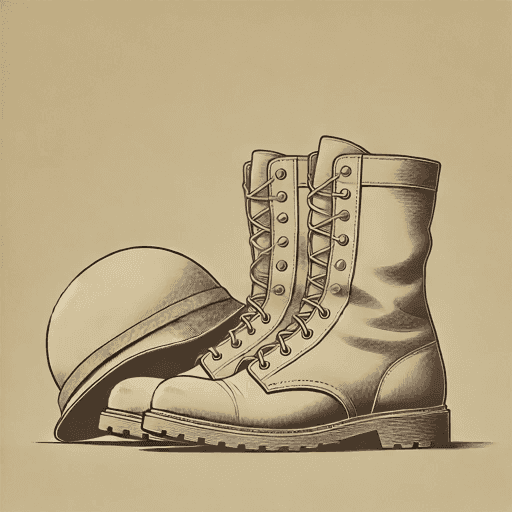
Helmet for My Pillow: From Parris Island to the Pacific
58 pages • 1-hour read
Robert LeckieHelmet for My Pillow: From Parris Island to the Pacific
A modern alternative to SparkNotes and CliffsNotes, SuperSummary offers high-quality Study Guides with detailed chapter summaries and analysis of major themes, characters, and more.
Chapters 5-6Chapter Summaries & Analyses
Chapter 5 Summary: “Brig-Rat”
Chapter 5 examines the culture of Marines who frequently find themselves in military prison, or “the brig,” exploring both the rebellious spirit that leads to their confinement and the harsh realities of brig life. Leckie argues that some of the most effective soldiers are those with independent minds who inevitably clash with rigid military discipline.
On George Washington’s birthday in 1943, Leckie and his friend Chuckler deliberately skipped the 1st Marine Division’s ceremonial parade through Melbourne, Australia, choosing instead to watch from a city club while drinking. They continued drinking heavily throughout the day. That evening, Chuckler was assigned guard duty at the camp canteen despite his intoxicated state. When he temporarily left his post, Leckie took over his duties and weapon. Lieutenant Ivy League—whom Leckie resented for previously stealing Leckie’s cigars—approached the guard post, and Leckie drew the pistol and threatened the officer with profane language. This act of threatening a superior with a firearm was one of the most serious military offenses possible.
After their arrest, Leckie faced court-martial before the battalion commander, nicknamed “Mr. Five-by-Five.” Despite the gravity of threatening an officer with a weapon, Leckie received a surprisingly lenient sentence: five days on bread and water with a reduction to private rank. The colonel noted Leckie’s previous good service record, delivering punishment far less severe than the potential decades of imprisonment such an offense could warrant.
Leckie provides detailed descriptions of the dehumanizing prison experience. After medical examinations and administrative processing, prisoners wore distinctive uniforms marked with large black circles (targets for the prison chaser to aim at in case the prisoners escaped) and surrendered all personal possessions. The bread-and-water cell was a converted shower room housing multiple prisoners in cramped conditions with perpetually wet floors, forcing inmates to stand constantly.
Their only sustenance consisted of bread and water served three times daily, which prisoners desperately fought over like wild animals. The psychological impact proved as challenging as the physical hardship; the men’s sense of time became distorted, and the daily ration of bread became the focal point of their existence. Despite harsh conditions, prisoners developed their own social structure, including electing a “mayor” based on frequency and length of incarceration.
After completing his sentence, Leckie experienced several dramatic confrontations with military police during shore leave. When MPs raided a restaurant where Marines were drinking and socializing with Australian women, Leckie escaped by climbing stairs to an upper floor, hiding in an Australian man’s bathroom, and eventually hanging from a roof ledge while MPs searched for him with flashlights.
During another incident, Leckie used deception to evade capture, claiming to be from a different company and slipping into a private dining room before escaping through a kitchen. These encounters escalated when an MP fired shots at fleeing Marines, wounding one soldier in the thigh. An Australian woman who witnessed the shooting aided Leckie by cleaning his wounds and hiding him from pursuing MPs, expressing anger at the military police’s aggressive tactics.
Later incidents involved Leckie, Chuckler, and another Marine called “Chicken” attempting to return to their ship after unauthorized shore leave. They encountered civilian guards who warned them that the officer of the day was arresting returning Marines, forcing them to climb fences and use small boats to reach their transport. A nervous recruit sentry with a loaded rifle detained them on the wharf until Lieutenant Racehorse—described as the most feared and capable leader in the battalion—arrived and arrested them.
Leckie and Chicken received another court-martial, resulting in ten days in a standard brig (no bread and water), while Chuckler lost his corporal stripes. However, Leckie discovered his punishment was improperly administered, as military law prohibited combining rank reduction, fines, and confinement in a single court-martial. Despite this legal error working in his favor, he was forced to sign a new court-martial that ignored his time already served, illustrating the arbitrary nature of military justice and the powerlessness of enlisted men against officers’ decisions.
The chapter concludes with the Marines’ departure from Melbourne in late September 1943, ending their nine-month respite from combat. As crowds of Australian women gathered dockside to bid farewell, departing Marines engaged in crude gestures, inflating and releasing condoms as balloons—a symbolic end to their period of recreation and relationships.
Chapter 6 Summary: “Veteran”
Chapter 6 recounts Leckie’s experiences aboard a Liberty ship transport and during jungle warfare operations on New Britain. The chapter covers the voyage north along the Australian coast, combat operations against Japanese forces, and Leckie’s eventual medical evacuation.
Leckie traveled aboard a poorly constructed Liberty ship with crowded conditions. During the voyage, Leckie met Father Straight, the battalion’s first chaplain, who provided spiritual guidance to the Marines. Upon landing, the Marines established a defensive perimeter on an island and began daily patrol operations. Leckie injured himself while swimming when he scraped against a coral reef. The author obtained food through unofficial means to help feed Father Straight during their difficult first days on the island.
Lieutenant “Big-Picture” assigned Leckie to work on a battalion newspaper rather than allowing him to learn essential combat skills like map reading. This assignment frustrated Leckie, who wanted practical military training for upcoming operations.
Leckie participated in reconnaissance patrols into the dense jungle. His first patrol under Lieutenant “Commando” involved an engagement with Japanese forces that used European-style retreat tactics unsuitable for jungle warfare. Fellow Marines criticized the lieutenant’s approach as ineffective for their environment.
A second patrol under Lieutenant Spearmint proved more successful. During this mission, Leckie encountered and killed several Japanese soldiers in close combat. The experience led him to reflect on the nature of death and human consciousness as he observed the enemy casualties.
An Australian soldier arrived with native police to reorganize local populations. Leckie struck up a conversation with a native named Kolo, who became his “batman” (personal servant) and helped with daily tasks like washing clothes. However, officers later took Kolo away to work in the officers’ mess.
Japanese forces launched a nighttime assault on the Marine perimeter with approximately 100 soldiers attacking the much larger American force. Leckie remained at the command post during the battle, guarding intelligence materials. The Marines successfully repelled the attack, killing most of the Japanese force while suffering relatively few casualties themselves. Leckie observed the aftermath and wondered about the motivations behind the seemingly hopeless Japanese assault.
The constant rain and jungle conditions created severe problems for equipment and personnel. Weapons rusted, clothing decomposed, and various tropical ailments affected the Marines. Leckie developed enuresis and other health problems from the prolonged exposure to harsh environmental conditions.
Leckie developed what appeared to be a hernia and received medical evacuation to New Guinea. At the hospital, he contracted severe malaria that nearly killed him. He spent days in fever and delirium before the illness broke, and he began recovering. After several weeks of treatment, he returned to Cape Gloucester only to find continued conflict with Lieutenant Big-Picture, who had stolen his Japanese equipment chest and assigned him to kitchen duty as punishment.
Chapters 5-6 Analysis
These chapters chronicle the narrator’s experiences from confinement in the brig through combat operations on New Britain, revealing the complex interplay between military discipline and individual identity. Leckie uses a distinctive narrative voice that oscillates between dark humor and philosophical reflection, transforming the memoir into a meditation on human nature under extreme circumstances. The author’s decision to structure these chapters around specific incidents of misconduct and their consequences illuminates the broader tensions inherent in military life.
The brig experience serves as a crucible that strips away pretense and civilian sensibilities, forcing the narrator to confront the harsh realities of military justice and institutional power, and underscoring the book’s theme of the Physical and Psychological Transformation Through Hardship. Leckie’s description of the bread-and-water cell reveals the deliberate dehumanization process: “You are shadow, and you are shade. The large black circles adorning front and back of your costume are almost endowed with weight, you feel them so poignantly; for you know that these are there for the prison chaser to aim at, should you break for freedom” (146). The physical deprivation of imprisonment becomes a metaphor for the broader process of military transformation, where individual identity dissolves into institutional requirements. This transformation continues throughout the combat sequences on New Britain, where the jungle environment becomes another agent of change, stripping away not just physical comfort but psychological certainties about survival and purpose.
Leckie’s thematic exploration of The Indomitable Nature of the Human Spirit emerges through his portrayal of Marines who maintain their humanity despite institutional pressures and environmental hostility. The narrator’s decision to help Father Straight establish shelter demonstrates how acts of compassion persist even within the dehumanizing context of military service. Soldiers like Oakstump, who creates salt sandwiches from prison rations and maintains his spirits through multiple incarcerations, embody the resilience that allows individuals to preserve their essential character despite systematic attempts to remake them. The Australian woman who aids the narrator’s escape from military police represents another manifestation of this theme, as civilian courage intersects with military rebellion. These examples illustrate how the human capacity for kindness, humor, and resistance operates as a counterforce to institutional control.
Leckie roots much of the narrative tension in these chapters in the inherent Conflict Between Individual Will and Military Hierarchy as he repeatedly challenges authority while remaining fundamentally committed to his role as a Marine. The confrontation with Lieutenant Ivy League over stolen cigars escalates into armed resistance, demonstrating how even minor grievances can explode into major conflicts when individual dignity collides with institutional indifference. The narrator’s complex relationship with various officers, from the cruel Lieutenant Racehorse to the more reasonable Lieutenant Spearmint, reveals how military effectiveness depends not just on obedience but on the quality of leadership. The recurring motif of Marines finding ways to circumvent regulations—whether through unauthorized liberty, food theft, or tactical disagreements—suggests that institutional survival requires a delicate balance between compliance and subversion.
Leckie’s narrative structure employs episodic organization that mirrors the fragmented nature of military experience, where significant events emerge from routine operations without warning or preparation. The transition from brig confinement to combat patrol occurs with little narrative fanfare, reflecting how military life compresses time and eliminates the gradual transitions that characterize civilian existence. Each episode builds upon previous experiences while introducing new challenges, creating a cumulative effect that demonstrates the author’s growing understanding of military culture and combat realities. The author’s decision to intersperse moments of dark humor with scenes of genuine terror creates a tonal complexity that captures the psychological disorientation of military service.
The memoir’s treatment of military justice reveals the arbitrary nature of institutional power and its effects on individual agency. As Leckie awaits judgment from Colonel Five-by-Five, he reiterates the peremptory nature of the decision: “I knew this, as every soldier knows in war: my future, my life even, was his to dispose of. It is a most unsettling thought” (145). The narrator’s encounter with the Colonel demonstrates how personal character and combat record can influence official decisions, while the subsequent legal manipulation of his punishment reveals the system’s capacity for bureaucratic dishonesty.
Leckie’s portrayal of combat operations emphasizes the psychological dimensions of warfare over the tactical details, focusing on fear, confusion, and the moral complexity of killing. The encounter with the Japanese patrol becomes a meditation on the nature of enemy contact and the split-second decisions that determine survival. The author’s description of the enemy dead transforms from tactical assessment into philosophical reflection: “I stood among the heaps of the dead and I knew—no, I felt that death is only a sound we make to signify the Thing we do not know” (194-195). The environmental descriptions of New Britain function as more than mere setting, becoming a character that actively opposes human presence and military objectives. Leckie’s portrayal of the jungle as “darkly and secretly evil” transforms the landscape into an antagonist that tests human endurance as thoroughly as enemy action (201). The constant rain, oppressive humidity, and threat of disease create conditions that reduce military operations to basic survival, stripping away the grand narratives of war to reveal the fundamental struggle between human will and hostile environment. The author’s decision to personify the jungle emphasizes how environmental factors can become as significant as enemy action in determining military outcomes.

Unlock all 58 pages of this Study Guide
Get in-depth, chapter-by-chapter summaries and analysis from our literary experts.
- Grasp challenging concepts with clear, comprehensive explanations
- Revisit key plot points and ideas without rereading the book
- Share impressive insights in classes and book clubs