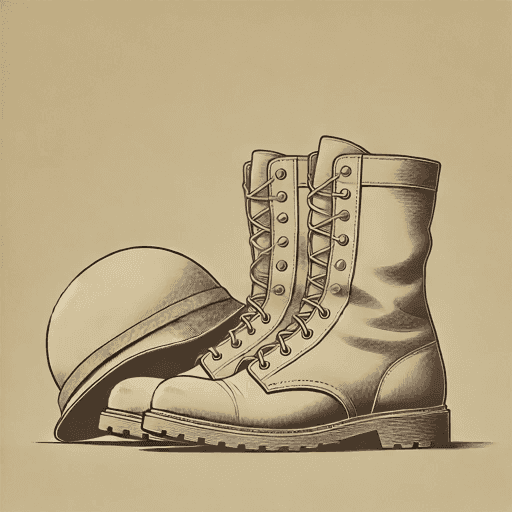
Helmet for My Pillow: From Parris Island to the Pacific
58 pages • 1-hour read
Robert LeckieHelmet for My Pillow: From Parris Island to the Pacific
A modern alternative to SparkNotes and CliffsNotes, SuperSummary offers high-quality Study Guides with detailed chapter summaries and analysis of major themes, characters, and more.
Index of Terms
Absent Without Leave (A.W.O.L.)
Absent without leave (A.W.O.L.) refers to a military offense in which a servicemember leaves their assigned post or duty station without proper authorization from their commanding officers. In Helmet for My Pillow, Leckie commits this offense when he secretly returns to Melbourne for several days while his unit is conducting training exercises at their camp in the Australian countryside. The term represents a serious breach of military discipline that can result in court-martial proceedings, confinement, or other punitive measures.
The Battle of Hell’s Point
“The Battle of Hell’s Point” was Leckie’s name for the first major combat engagement he experienced at Guadalcanal, which took place at the Tenaru River in August 1942. This battle marked the Marines’ first organized confrontation with Japanese forces on the island and represented a crucial turning point in both the campaign and Leckie’s understanding of warfare. During this nighttime engagement, Japanese forces launched repeated attacks against well-prepared American defensive positions, resulting in devastating casualties for the attackers while demonstrating their determination to fight to the death. For Leckie and his fellow Marines, the battle served as their introduction to the brutal realities of Pacific warfare, stripping away their initial romantic notions about combat and replacing them with a grim understanding of war’s true nature. The aftermath of the battle, including Leckie’s decision to swim across the river to collect souvenirs from dead Japanese soldiers, profoundly affected his psychological development and marked his transformation from naive recruit to hardened veteran.
Brig-Rat
A brig-rat refers to a Marine who frequently finds himself imprisoned in the military brig, though Leckie distinguishes between different types of these individuals. According to Leckie’s analysis, some brig-rats are habitual troublemakers and malingerers who consistently avoid their military duties and responsibilities, seeking to escape every consequence of wearing the uniform. However, Leckie argues that the most significant brig-rats are young soldiers with bold spirits and independent minds whose very nature brings them into inevitable conflict with harsh military discipline. These individuals possess the same qualities that make effective combat soldiers—courage, independence, and strong will—but these traits also make them likely to rebel against rigid military authority during peacetime or rest periods. Leckie positions himself and his companions like Chuckler and Chicken within this latter category, suggesting that being a brig-rat of this type reflects admirable character traits rather than moral failings.
Guadalcanal
Guadalcanal is the Solomon Islands site where Robert Leckie and the 1st Marine Division fought their first major campaign of World War II from August 1942 to February 1943. This strategic island became the site of a prolonged and brutal campaign that tested American resolve and military capability against determined Japanese resistance. For Leckie, Guadalcanal represented both a physical and psychological battlefield where he and his fellow Marines endured constant bombing, naval bombardments, disease, malnutrition, and the psychological strain of feeling abandoned by the outside world. The island’s harsh tropical environment became almost as much an enemy as the Japanese forces, with its oppressive heat, torrential rains, disease-carrying insects, and dense jungle creating additional challenges for the American troops. Leckie’s experiences on Guadalcanal fundamentally shaped his understanding of war, military hierarchy, and human nature, providing the central narrative focus for his memoir and serving as a crucible that transformed him from an idealistic young man into a battle-hardened veteran who understood the true costs of warfare.
Lotus-Eaters
Lotus-Eaters refers to Leckie’s metaphorical comparison of the Marines in Australia to the mythical people from Homer’s Odyssey who consumed lotus flowers and became so intoxicated by pleasure that they forgot their purpose and desire to return home. In the context of Helmet for My Pillow, the term describes how the combat veterans became consumed by the sensual pleasures and civilian comforts available in Melbourne after months of brutal warfare. The Marines, like the mythical Lotus-Eaters, risked losing their military discipline and focus as they indulged in drinking, romance, and the adulation of Australian civilians who viewed them as liberators. This metaphor captures the seductive danger of comfort and pleasure for soldiers who must eventually return to combat, suggesting that too much indulgence in civilian life could make them unfit for their military duties.
Military Police (MPs)
Military police (MPs) are specially designated soldiers responsible for maintaining discipline and enforcing military law among troops, particularly during periods when regular Marines are on liberty or shore leave. In Helmet for My Pillow, MPs function as antagonistic figures who represent the oppressive aspects of military authority, constantly pursuing Marines who violate regulations or engage in unauthorized activities. Leckie describes MPs as wearing distinctive black armbands with white “MP” lettering, which made them easily recognizable and widely resented by regular troops. During Leckie’s time in Melbourne, MPs conducted raids on establishments where Marines gathered to drink and socialize, leading to dramatic chase sequences and confrontations that sometimes escalated to violence, including instances where MPs fired weapons at fleeing soldiers. The MPs embodied the tension between individual freedom and institutional control, serving as the enforcement arm of a military hierarchy that sought to suppress the independent spirit that Leckie celebrates in effective Marines.
Quartermaster
The quartermaster represents the military supply system responsible for outfitting recruits with standardized uniforms and equipment at Parris Island. Leckie describes the quartermaster as a dehumanizing force that systematically strips away individual identity by replacing personal clothing with identical military gear. The quartermaster personnel operate with assembly-line efficiency, measuring recruits and distributing uniforms without regard for personal preferences or individual characteristics. In Leckie’s account, the quartermaster process serves as a crucial step in the military’s transformation of civilians into Marines, symbolizing the institution’s power to erase personal identity and impose conformity. The experience at the quartermaster represents the moment when recruits cease to be individuals and become interchangeable parts of the military machine, marked only by serial numbers rather than personal identity.
Washing Machine Charlie
Washing Machine Charlie was the nickname given by American forces to the Japanese aircraft that conducted regular nighttime bombing raids over Guadalcanal during the prolonged campaign. The aircraft earned this distinctive name from the peculiar sound of its engines, which reminded the Marines of the rhythmic noise made by washing machines. While these nocturnal raids rarely caused significant physical damage or casualties, Washing Machine Charlie served a crucial psychological warfare function by disrupting sleep and maintaining constant pressure on American morale. The aircraft’s regular appearances created an atmosphere of perpetual anxiety among the Marines, who never knew when the bombing might begin or end during the night. For Leckie, Washing Machine Charlie represented one of the many forms of psychological torture that characterized the Guadalcanal campaign, contributing to the gradual erosion of mental and physical strength that defined the Marines’ experience on the island.

Unlock all 58 pages of this Study Guide
Get in-depth, chapter-by-chapter summaries and analysis from our literary experts.
- Grasp challenging concepts with clear, comprehensive explanations
- Revisit key plot points and ideas without rereading the book
- Share impressive insights in classes and book clubs