58 pages • 1-hour read
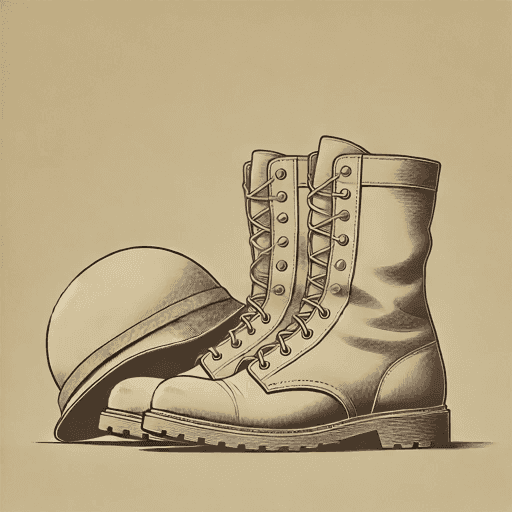
Helmet for My Pillow: From Parris Island to the Pacific
A modern alternative to SparkNotes and CliffsNotes, SuperSummary offers high-quality Study Guides with detailed chapter summaries and analysis of major themes, characters, and more.
Key Figures
Robert Leckie
Robert Leckie stands as one of America’s most accomplished military historians, distinguished by his unique combination of combat experience and professional writing expertise that shaped both his memoir Helmet for My Pillow and his subsequent prolific career. Born on December 18, 1920, in Philadelphia, Pennsylvania, to an Irish Catholic family of eight children, Leckie grew up in Rutherford, New Jersey, where he began his career as a writer in high school, working as a sports writer for The Bergen Evening Record in Hackensack, New Jersey. This early journalism experience proved foundational to his ability to transform personal combat experiences into historical narrative.
Following World War II, Leckie established himself in major metropolitan journalism before transitioning to book writing. According to his wife, Vera, in 1951, Leckie was inspired to write a memoir after seeing South Pacific on Broadway and walking out halfway through it, declaring he had to tell the story of the war as it was. This moment represents the genesis of what would become both his most famous work and the foundation of his career as a military historian. The publication of Helmet for My Pillow in 1957 marked several important milestones. The memoir received the USMC Combat Correspondents Association Award upon publication, providing professional recognition from within the Marine Corps community for its authentic portrayal of combat experience. The timing of its publication proved significant, appearing during the 1950s when American audiences were ready for honest accounts of World War II that moved beyond sanitized versions of warfare. Unlike later, more introspective war memoirs that would emerge in subsequent decades, Leckie’s work maintained a tone of humor and optimism despite describing scenes of tremendous carnage and violence, reflecting the era’s generally optimistic outlook on America’s role in the conflict.
The memoir’s dual perspective—written by someone who possessed both firsthand combat experience and professional journalistic skills—gave it particular authority and accessibility. Contemporary reviewers praised Leckie’s literary style, noting how he set his work apart from many other war narratives through his sophisticated approach to describing survival during battles at Guadalcanal, Cape Gloucester, and Peleliu.
Helmet for My Pillow became the launching point for Leckie’s extensive career as a military historian. Leckie wrote more than 40 books on American war history, spanning from the French and Indian War (1754—1763) to Desert Storm (1991), establishing him as one of the most prolific chroniclers of American military conflicts. His other works included Marines!, a collection of short stories, and Lord, What a Family!, a memoir, demonstrating his versatility across different literary forms. His military history works covered major conflicts including the Korean War, Civil War, and both World Wars, with titles such as Strong Men Armed: The United States Marines Against Japan, Challenge for the Pacific, and Delivered from Evil: The Saga of World War II.
The memoir’s cultural impact extended far beyond its initial publication. Leckie’s war memoir, Helmet for My Pillow, along with Eugene B. Sledge’s book With the Old Breed, formed the basis for the HBO series The Pacific (2010), the follow-up series to Band of Brothers. This adaptation introduced Leckie’s experiences to a new generation and solidified the memoir’s place as a foundational text for understanding the Pacific Theater of World War II. The miniseries featured Leckie as a central character portrayed by James Badge Dale, bringing his story to millions of viewers worldwide.
Chuckler, Hoosier, and Runner
Throughout his memoir, Leckie consistently references his friendships with his three companions—Chuckler, Hoosier, and Runner—whom he defines as his primary support network during his time in the US Marine Corps. Each of the specific details that Leckie provides about his friends—such as Hoosier’s initial surliness or the way that Runner earned his nickname—emphasizes their individuality and humanity, contributing to the text’s thematic engagement with the Conflict Between Individual Will and Military Hierarchy.
Leckie emphasizes the importance of these friendships as fundamental to their survival during the war, positioning their ability to form bonds of trust and camaraderie as a constant and necessary reminder of their humanity. Despite the hardships they endured in the Pacific Theater, their solidarity and support underscore The Indomitable Nature of the Human Spirit. Even as the environment systematically broke down both material possessions and the soldiers’ connection to their pre-war identities, their friendships allowed them to maintain a collective hold on their individuality.

Unlock analysis of every key figure
Get a detailed breakdown of each key figure’s role and motivations.
- Explore in-depth profiles for every key figure
- Trace key figures’ turning points and relationships
- Connect important figures to a book’s themes and key ideas