58 pages • 1-hour read
Here in the Real World
A modern alternative to SparkNotes and CliffsNotes, SuperSummary offers high-quality Study Guides with detailed chapter summaries and analysis of major themes, characters, and more.
Symbols & Motifs
The Church Lot
The church lot functions as the central motif in the story, representing the themes of Renewal and Rebirth, community, friendship, and Finding One's Purpose. The lot is initially an abandoned, broken-down space, but Ware quickly reimagines it as his castle—a place where he can live by the ideals of the knights he admires: “Castle designers incorporated sundials on south-facing walls like this, public timepieces for the villagers” (32-33). This observation demonstrates his tendency to apply a medieval framework to modern surroundings. The lot becomes more than just a playground; it's a blank slate for reinvention and a physical manifestation of Ware’s internal world.
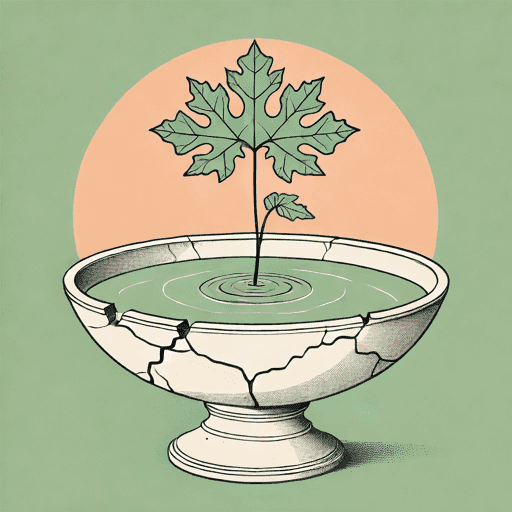
The moat he and Jolene build around the church deepens the symbolism of the lot. It eventually fills with “honest water” (273), a reflective surface that shows him as he is, not as he wishes to be. Though Ware tries to use the baptistry to be "reborn" into a better version of himself, nothing magically changes, teaching Ware that growth is gradual, not instantaneous. Still, the lot does transform him: Through filming, digging, and collaborating with others, Ware discovers his artistic identity. Even though the lot is eventually sold, Ware manages to preserve its memory and essence through his four-minute film that includes footage of the growing papayas, the life that found its way into the lot, and the art that emerged from Ware’s imagination.
Jolene’s Papaya Plants
Jolene’s papaya plants serve as a powerful symbol of survival, finding one's purpose, and agency in the real world. From the start, Jolene tends to them with intense care, devotion, and urgency: “She was dabbing her trowel over each plant down the row, like a fairy godmother bestowing blessings with her wand” (58). The plants represent her independence and her determination to take control of her circumstances. Unlike Ware, who initially retreats into his imagination, Jolene is grounded in harsh reality. She knows she needs the papayas to grow so she can sell them and cover rent, and this desperate need brings her to tears. The plants are her way of fighting back against an unfair life.
Ware becomes deeply moved by her commitment. He begins to see the papayas not only as plants but as a story, like a medieval tapestry, telling what came before. “The seventy-seven brand-new papayas were already poking up little green nubs, as if they wanted to know what all the celebrating was about” (109-110), he observes, recognizing them as symbols of new life. In trying to protect the garden, Ware finds his purpose.
By the end of the novel, the garden becomes a physical embodiment of Ware’s newfound beliefs: The “real world” can include fairness brought about by action. Jolene connects with others, like Ware’s parents, through her gardening, giving them an emotional as well as a practical purpose. The lot is gone, but the new space in which the papayas grow is born out of friendship, hardship, and healing.
Medieval Times
The medieval motif in the novel becomes a lens through which Ware interprets the world and eventually grows into his own identity. Ware often escapes into fantasies of knighthood and castles because they offer him the structure and clarity he lacks in the modern world: “If you were a knight, you knew where you stood” (14). For Ware, who never feels quite understood or accepted by the people around him, this predictability is comforting. Ware transforms the abandoned church lot into his own version of a castle, covering the walls with mud to make them appear stone-like. This physical transformation parallels Ware’s internal one; as he adds to the castle, he is also building up his confidence and identity.
The metaphor extends into his relationships. When he describes Jolene’s eyes, he compares them to “castle battlements… slotted with narrow openings called arrow slits… Ware got the impression that the girl’s blue eyes functioned pretty much the same way” (49-50). He sees people in the same terms he uses to describe buildings. Ware’s coat of arms, which includes a lizard and movie camera, and Jolene’s (a papaya plant and arms with tools), show how both characters translate their real-world traits into symbolic emblems, just as people did in the Middle Ages. In the end, Ware’s medieval dreams evolve from escapism into something more grounded. He doesn’t just play pretend anymore; instead, he actually takes on knightly ideals like protecting others and standing up for what’s right. When he confronts Ashley about the auction or takes care of Jolene’s garden, he’s upholding his code. The medieval motif thus becomes a symbol of finding one's purpose.
Birds
Birds appear throughout the novel as recurring symbols of freedom, renewal and rebirth, and hope, often mirroring Ware’s emotional state. In the novel’s beginning, a single bird signals the beginning of a journey: “An egret, as white and smooth as though carved from soap, glided through the purpling sky. In a movie, a single flying bird like that would let you know that the main character was starting out on a journey” (5). That early image sets the tone for Ware’s emotional and personal arc. He starts as someone grounded and unsure, but gradually discovers a sense of direction. Ware admires birds because they can do what he often feels he cannot: “Birds symbolized freedom. Which he would never have” (75). This pessimism leaves him as the story unfolds. Over time, the lot begins to attract ibises and all kinds of birds and other animals, demonstrating the return of life and balance to a once ruined space.
The most powerful bird symbolism comes at the story’s end. As the lot is about to be torn down, everyone gathers to watch the cranes fly overhead. Ware, holding Jolene’s hand, feels a sense of peace as the story comes full circle: “Ware squeezed back. He trained the camera on the last of the cranes. He knew how those birds felt” (308). Here, birds no longer symbolize something distant and unreachable; they now represent what Ware has achieved: emotional freedom, acceptance, and growth.
Art
Art in the novel takes many forms, including gardening, filmmaking, and even mud-castle construction. It acts as a symbol of identity, expression, and finding one’s purpose. For much of his life, Ware has been told that his way of seeing the world is strange or unproductive. When he begins documenting the lot with his camera, he finally finds a medium that validates his unique perspective. Ware’s filming style catches the attention of Uncle Cy, who notes that the palm trees Ware captured act like a Greek chorus, telling a visual story beyond what words can express.
Uncle Cy tells Ware that being an artist isn’t about audience or approval, it is also about answering one's personal calling. With this insight, Ware realizes that the value of his art doesn’t depend on others understanding it. Like Jolene’s gardening, his creativity has inherent worth, regardless of the end product. His film weaves together images of the papayas, the moat, the birds, and the transformation of the lot, becoming an artwork that tells their story and expresses his unique view of the world. By the end of the story, his mother tells him they are lucky to be raising an artist, a moment that signifies full-circle acceptance not just from others, but from Ware himself.

Unlock the meaning behind every key symbol & motif
See how recurring imagery, objects, and ideas shape the narrative.
- Explore how the author builds meaning through symbolism
- Understand what symbols & motifs represent in the text
- Connect recurring ideas to themes, characters, and events