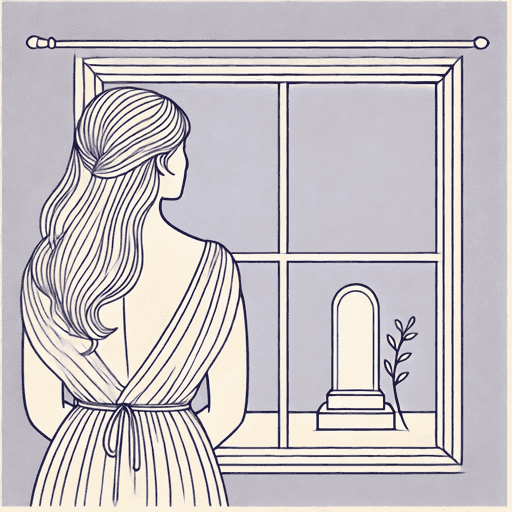
Home Burial
25 pages • 50-minute read
Robert FrostHome Burial
A modern alternative to SparkNotes and CliffsNotes, SuperSummary offers high-quality Study Guides with detailed chapter summaries and analysis of major themes, characters, and more.
Background
Literary Context: Victorian/Edwardian and Modernism
Many critics see Frost as bridging the gap between two centuries and styles: Victorian/Edwardian and Modernism. Frost blends self-reflection in nature—and other stylistic elements popular with previous poets, such as the Romantics and Transcendentalists—with innovative forms and bleaker philosophical messages common to the Modernist era. Frost’s poems, which were meditative but not esoteric, used common language and dialogue along with realistic characters from the New England region. Frost admired the fixed rhyme and meter of traditional poetry.
He also revered, however, those Victorian/Edwardian writers, like Thomas Hardy and William Butler Yeats, who used landscape to discuss the harsh reality of country life or the plight of mid-to-lower class workers. Frost’s decision to focus on the region of New England helped him gain the reputation as a uniquely American poet, familiar with the country’s idioms and dialect. He was particularly lauded for his ability to capture the voice of the people. Unlike his contemporaries, T. S. Eliot and Ezra Pound, he did not rely on personal symbolism. Instead, Frost’s reliance on realistic portrayals made him a unique poet, particularly during the years of 1913 and 1924, when he won his first Pulitzer Prize.
Authorial Context: The Death of a Child
In the late 19th and early 20th centuries in the United States, particularly in rural areas where doctors lived farther from their patients, rates of infant and child mortality were high. Amy and her husband’s difficulties weren’t uncommon as many families lost children to pregnancy loss, childbirth, and early childhood illness. This might account for the husband’s questioning of his wife: “What was it brought you up to think it the thing / To take your mother-loss of a first child / So inconsolably” (Lines 66-68). While the experience was far more common than today, it wasn’t less heartbreaking for many.
Frost might have pulled the emotional resonance of the poem from his own personal experience. He and his wife lost their three-year-old son Elliot to typhoid fever in 1900 and another daughter, Elinor Bettina, only lived one day in 1907. Elliot, their first born, was ill for many days and was misdiagnosed. By the time Frost called for a more experienced doctor, it was too late. According to biographer Jay Parini:
It was horrific for [Frost and Elinor], although Frost blamed himself for not calling a good doctor sooner: it was like murdering his own child, he said. Elinor slipped helplessly into a deep depression, saying if there were a God, he was malevolent. [Frost] preferred to think that heaven was simply indifferent to human suffering (Parini, Jay. Robert Frost: A Life. Henry Holt and Company, 2015).
These emotional losses played into the creation of the text, but Frost maintained that the source for the poem was “a recollection of the death of Elinor’s sister’s child” (Parini). According to Lea Newman, when “Elinor’s older sister Leona and her husband Nathaniel Harvey lost their first-born child in 1895 […] Leona left her husband [… but] later reconciled” (Newman, Lea. Robert Frost: The People, Places, and Stories Behind His New England Poetry. New England Press, 2000). The reader should be aware that while the characters and situation in “Home Burial” are borrowed from real life, they cannot be read as true autobiography.

Unlock all 25 pages of this Study Guide
Get in-depth, chapter-by-chapter summaries and analysis from our literary experts.
- Grasp challenging concepts with clear, comprehensive explanations
- Revisit key plot points and ideas without rereading the book
- Share impressive insights in classes and book clubs