Home Burial
A modern alternative to SparkNotes and CliffsNotes, SuperSummary offers high-quality Study Guides with detailed chapter summaries and analysis of major themes, characters, and more.
Themes
Same Loss, Different Grieving
The death of a child is heartbreaking in any era, but in 1914, when Amy and her spouse are going through their crisis, psychology was a burgeoning field and neither would have had access to the mental health information we have today. Additionally, where they live, north of Boston, would have been remote, a fact made clear by the necessity of a home burial. The two would have had to rely on each other for support, so their impasse is significant and potentially damaging to their future. Both grieve but neither can understand the other, which creates the dramatic tension in their altercation. The outside narration doesn’t choose a side, highlighting that the tragedy exists for both characters.
Amy’s grief is debilitating. She is having trouble processing and is alternately fearful and angry. When her husband tries to talk to her, her face “change[s] from terrified to dull” (Line 9). She actively avoids discussing the matter, even as he asks her to, and physically moves away to avoid his request, threatening to leave the home. Eventually, she reveals how she relives the moment she saw her husband dig their son’s grave. She cannot comprehend how he could do so efficiently while the body of the child lay still in the house. His ability to go back to “everyday concerns” (Line 90) is appalling to her and creates a divide from the person she thought she knew and loved. She feels betrayed by the comment she overhears him make about the damage to fences, which strikes her as unemotional.
By contrast, the husband’s way to handle grief is to remain stoic and do what needs to be done. The child must be buried, and the intimate action of digging the grave might allow the father some solace. Comparing the graveyard to a “bedroom” (Line 26) might show how he makes metaphors to cope, perhaps imagining tucking the child in for his final rest. His discussion about fences—“Three foggy mornings and one rainy day / Will rot the best birch fence a man can build” (Lines 96-97)—might also be a symbolic way to allude to the son’s passing. He is noting how quickly something treasured can be eroded by natural elements, like weather and death. He notes his resentment that he can’t speak of the loss “of his own child” (Lines 37, 74) and responds negatively to Amy’s implication he cannot understand what it is to grieve.
The dialogue doesn’t shy away from these resentments that divide the couple; at the same time, it makes clear that both characters are emotionally suffering. “Home Burial” serves as a testament to the intricacies of grief at a time when such responses were not openly discussed before psychotherapy.
Outside Escape and Inside Consistency
In “Home Burial,” Amy desires to escape her trauma by leaving the house, her husband, and possibly her marriage. The husband on the other hand wants her to expunge her grief so she can stay in the house and the marriage. The physical actions and statements of both characters enhance their different desires and add to the tension of the poem.
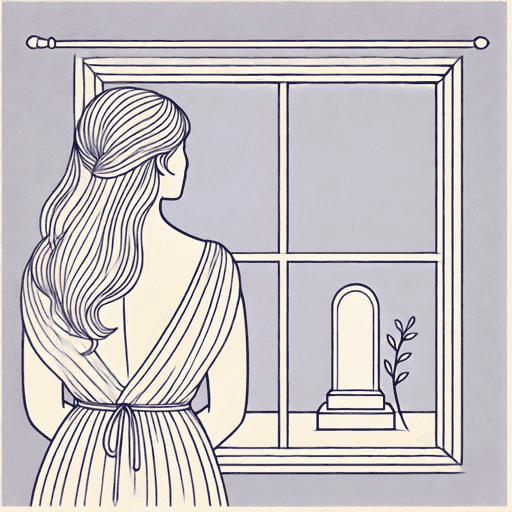
Amy wants to leave the location where the tragedy happened because she is constantly reminded of it due to the view of the cemetery through the window. Given the time period, it is likely that Amy’s child was born and died in the house itself. We know the small body rested in the “darkened parlor” (Line 100). The house is filled with triggers for grief, which Amy is desperate to escape. As her husband tries to talk about each of their reactions to the death, Amy ducks under his arm and descends the staircase. Throughout the poem, she fiddles with the door latch. That Amy has not been communicating well with her husband is clarified by his comment, made twice, that he doesn’t want her to go “to someone else this time” (Lines 41, 60).
Grieving his child, the husband is terrified he will lose his wife as well. Out of desperation, his actions are often intimidating. He “advanc[es] toward her” (Line 6) on the staircase, “[m]ounting” (Line 11) the steps. He takes the son’s death as a natural tragedy and doesn’t connect his loss with the home. He states, “I never noticed [the family cemetery] from here before. / I must be wonted to it” (Lines 22-23). His return to everyday life, which Amy can’t comprehend, is a comfort to him. He wants her to return there as well, saying, “Let me into your grief” (Line 62), to secure them as a couple.
In her confession that she can’t get over the grave-digging, Amy physically opens the front door, suggesting that she might step over the threshold. He listens to her, relieved she has spoken and is physically showing her grief with tears. He notes, “You won’t go now. […] Close the door” (Line 113), which shows his desire to keep her there and his faith that they can work it out. This uneasy truce is ruined by his panicked cry, “There’s someone coming down the road!” (Line 115). Amy takes this to mean he sees her grief as an embarrassment, but it could very well be that the husband sees this person visiting as a threat against the hope of reconnecting with his wife. Amy could go out to them and receive support and comfort from them, just like the “someone else” (Line 41, Line 60) she previously told her troubles to. This would carry her away from their house, burying their love as surely as their son.
The husband grows desperate to make her stay, and as she pushes the door further open, he claims he will “follow and bring [her] back by force” (Line 120). For him, the threat lurks in forces outside the house, including other, potentially more comforting people, while for Amy the threat is inside the house, where every space reminds her of grief.
A Mythic Ghostly Drama
There is a feeling of hauntedness in “Home Burial,” despite its lack of actual ghosts. Richard Poirier has discussed its “aura of suffocation” (Poirier, Richard. “On ‘Home Burial.’” Modern American Poetry): The isolation of the home combined with the nearby location of the family cemetery permeates the landscape with death. The son’s death haunts the couple even as his undisturbed body is tucked into the ground out back.
The wife begins the poem, “Looking back over her shoulder at some fear” (Line 3), and her face wears an expression that is “terrified” (Line 9). Her husband has become alien to her, a “[b]lind creature” (Line 16) who cannot understand her. Later, she sees him as the bearer of the dead, a Grim Reaper who uses an instrument to cut away life. In this case, she conflates the Reaper’s scythe to the husband’s “spade up against the wall” (Line 91). The soil of the graveyard is a “stain” (Line 88) not just on his shoes, Amy implies, but his soul. He is now in league with Death, and she cannot identify him as he used to be: “Who is that man? I didn’t know you” (Line 82).
For his part, the husband also feels that his spouse has been replaced by a doppelgänger. He cannot understand his wife, whom he believes handles her “mother-loss […] / So inconsolably” (Lines 67-68) and who wants to take her problems to “someone else” (Lines 41, 60). This is not how Amy was before their child’s death, he seems to reveal. He feels as if Amy is dealing with something otherworldly. He wants her to speak to him, but only “if it’s something human” (Line 61).
Poems in A Boy’s Will discuss ghosts, fairies, and Pan, so these subtle hints toward the mythic aren’t unusual for Frost. While there is no evidence that the body that lay in the “darkened parlor” (Line 100) has arisen in any afterlife form, the eerie atmosphere of a haunting pervades the text, exacerbating the couple’s alienation from each other.

Unlock every key theme and why it matters
Get in-depth breakdowns of the book’s main ideas and how they connect and evolve.
- Explore how themes develop throughout the text
- Connect themes to characters, events, and symbols
- Support essays and discussions with thematic evidence
Related Titles
By Robert Frost