Horror Movie
54 pages • 1-hour read
Paul TremblayHorror Movie
A modern alternative to SparkNotes and CliffsNotes, SuperSummary offers high-quality Study Guides with detailed chapter summaries and analysis of major themes, characters, and more.
Character Analysis
The Narrator/“The Thin Kid”
Content Warning: This section of the guide includes discussion of abuse, bullying, substance use, graphic violence, illness, suicidal ideation, and death.
The narrator of the novel is an unnamed protagonist, providing the central narrative arc that gives the story its shape. The narrative arc in question traces the narrator’s transformation into the character he plays in the original Horror Movie production, “The Thin Kid.” Given this transformation, it is important to distinguish the two character personas before exploring how and why the narrator chooses to inhabit the Thin Kid’s persona.
The narrator depicts himself as a one-time actor with minimal dramatic experience. After studying communications at the University of Massachusetts-Amherst, he rotates through a series of temporary employment roles like truck loading and data entry to pay off his burgeoning student debt. He is driven to take on the role of the Thin Kid because of the lack of direction he feels in his life, which makes it difficult for him to escape from the production once it starts putting his life at risk. This challenges the narrator to overcome his meekness and self-consciousness. Throughout the production of Horror Movie, he portrays himself as someone uncomfortable with vulnerability. This possibly stems from the implied abuse he experienced as a child, which he suggests when he reveals that he was bullied at school and that his mother used to force him to smoke cigarettes. The narrator starts to overcome this meekness by inhabiting the Thin Kid role, expanding on the details that are revealed about him in the Horror Movie screenplay.
In Cleo’s screenplay, the Thin Kid is depicted as an outsider, though he is loosely associated with the characters of Valentina, Cleo, and Karson. When the Thin Kid goes missing, his mother immediately calls of each of their parents to ask after him. Similarly, their peers at school offer them their condolences once he is considered missing. The Thin Kid’s motivations for participating in the three teens’ plan are never explicitly revealed, though when he tries to ask Valentina why he has been chosen to fulfill the role he has been given, Valentina tells him that there is no reason. Although the characters of Valentina, Cleo, and Karson are largely based on their real-life personas, it is never revealed whether the Thin Kid’s character is drawn from a similar person they knew growing up.
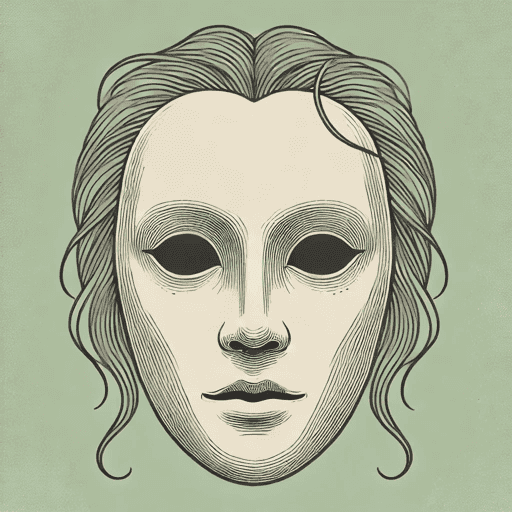
The narrator sees the Thin Kid as a version of himself that overcomes his personal flaws and weaknesses. Whenever he finds himself confronted with vulnerability, he reminds himself that the Thin Kid has already endured worse abuse in the screenplay. The more he inhabits the role of the Thin Kid, the more the narrator commits to Blurring the Line Between Art and Reality. Consequently, much of his life in the years following the original production is defined by his relationship to Horror Movie. This is signified in his choice to wear only white t-shirts and black jeans as uniform attire and his refusal to let go of the Thin Kid mask prop from the original Horror Movie production. The narrator’s uniform turns him into a blank canvas upon which he can impose the Thin Kid identity.
As the only surviving member of the production in the present storyline of the novel, the narrator holds the power and responsibility of cultivating the mythology surrounding the production. This turns him into an unreliable narrator, embellishing certain stories to challenge fans of the original film. On a metanarrative level, it also casts doubt over the story he is telling, which culminates in the final reveal that he has learned to change his physical form. His admission to killing his successor as the Thin Kid aims to challenge the perception of what really happened and what has been fictionalized in his retelling.
Cleo Picane
Cleo Picane is the screenwriter of the original Horror Movie film and a tragic figure in the narrative. Her death puts an end to the production of the original film, but also catalyzes the mythology that allows the film to take on a life of its own long after her death. This allows her character to represent The Ethics of Horror Movie Production and The Costs of Creating a Cultural Legacy as themes.
Cleo is introduced as Valentina’s childhood friend and collaborator. She has always aspired to become a writer as evidenced by her early habit of visiting the abandoned school that inspired Horror Movie to practice her writing. Cleo is the person who discovers the Thin Kid mask and is evasive about its mysterious origins. She engages the narrator’s skepticism, forcing him to consider what he is willing to believe for the sake of the production. One might even interpret that the mask’s origin story is the inception point for all the embellished tales that comprise the mythology surrounding Horror Movie.
Toward the end of the novel, Cleo clarifies that her character in the screenplay, also named Cleo, is a near-direct analogue of herself, drawing primarily from her experiences as a teenager. She distances herself from her screenplay avatar by stressing that she no longer feels the desire to die. That same distance enables her to elaborate on her motivations for making the film, which is to capture her real fears in art so precisely that it becomes wonderful. These statements prove crucial to the resolution of the novel, as it calls into question the prevailing theory that Cleo had died on the set of Horror Movie by suicide. Her intentions likewise become buried in Valentina’s quest to create a canonical film in the tradition of horror cinema.
Compared to Valentina, Cleo is a sympathetic figure. She advocates for the end of the production after the narrator loses his finger. She also continues to console him as he sinks further into his identification with the Thin Kid. Her sympathy is also reflected in her screenplay avatar, visiting the Thin Kid on her own to look after him following his abuse at the hands of the three teens. Although she battles the Thin Kid at the end, allowing her to assume the archetype of the “final girl” typical to slasher movies, she is killed by him, subverting the slasher movie trope and turning her into a sacrifice that results in the end of the movie.
Valentina Rojas
Valentina Rojas is the director of the original Horror Movie film. Although she is not a straightforward antagonist, she does possess antagonistic qualities that allow the novel’s horror elements to develop.
Valentina comes from a wealthy background, which allows her to attend Amherst College, where she meets the narrator. Against her parents’ expectations that she pursue a lucrative career in commercial endeavors, Valentina is driven to follow her passion for filmmaking. This passion is the basis of her early bond with the narrator, sharing her love for classic horror movies like the 1920 German silent horror film The Cabinet of Dr. Caligari. After Cleo’s death and the shutdown of production on Horror Movie, Valentina lives according to her parents’ expectations, at one point even working with her father in his car wash business. Her success in this area fills her with regret, realizing the irony that she could succeed at the things she didn’t want to do but not filmmaking, which she loved most. This emboldens her to carry out a plan that will cement Horror Movie’s legacy in the genre canon, which aligns with The Costs of Creating a Cultural Legacy as a theme.
The narrator suggests that Valentina is manipulative. Although he never confronts her for the behavior that leads him to declare this, he cites her tendency to express her frustration whenever the production doesn’t feel as “real” as she wants it to be. This pressures the narrator to placate her, worried about the consequences that might happen to him as someone who emotionally relies on his role in the movie. Incidentally, this recreates the dynamic between Valentina’s character in Horror Movie and the Thin Kid. Valentina and the other teens abuse the Thin Kid to turn him into the monster that kills others. In real life, Valentina puts the narrator in harm’s way until he can fully inhabit the Thin Kid role. Valentina capitalizes on this dynamic again years later when she sets her plan into motion, leveraging the mythology around the production to trigger a reboot of Horror Movie. She entices the narrator into her plan by exploiting his dependency on the Thin Kid persona to cope with the conditions of life. This is why the narrator does not resist Valentina’s plan to cut off his pinky, beginning the rumor that he had lost it on the set of Horror Movie. This allows her character to raise questions about The Ethics of Horror Movie Production.
Valentina’s willingness to do whatever it takes for the sake of the film drives a dynamic of conflict between her and Cleo. Cleo remains grounded in the reality of their production, often advocating for safety and the well-being of the cast and crew, while Valentina succumbs to the demands of the film, viewing people like the narrator as instruments to help her realize her vision. Although Cleo had originated the idea for Horror Movie, Valentina is more driven to see the film to its completion because of its stakes on her potential filmmaking career. Cleo can continue to pursue her ambitions as a writer if Horror Movie fails. The opposite is more likely for Valentina, as evidenced by the life she does end up living before she dies of pancreatic cancer. This pushes her to counter Dan and Cleo’s advocacy for on-set safety by seeking the narrator’s support, thereby balancing them out.

Unlock analysis of every major character
Get a detailed breakdown of each character’s role, motivations, and development.
- Explore in-depth profiles for every important character
- Trace character arcs, turning points, and relationships
- Connect characters to key themes and plot points