Hot Milk
53 pages • 1-hour read
Deborah LevyHot Milk
A modern alternative to SparkNotes and CliffsNotes, SuperSummary offers high-quality Study Guides with detailed chapter summaries and analysis of major themes, characters, and more.
Symbols & Motifs
Content Warning: This section of the guide includes discussion of illness, sexual content, emotional abuse, animal cruelty and death, mental illness, and ableism.
Medusa/Medusas
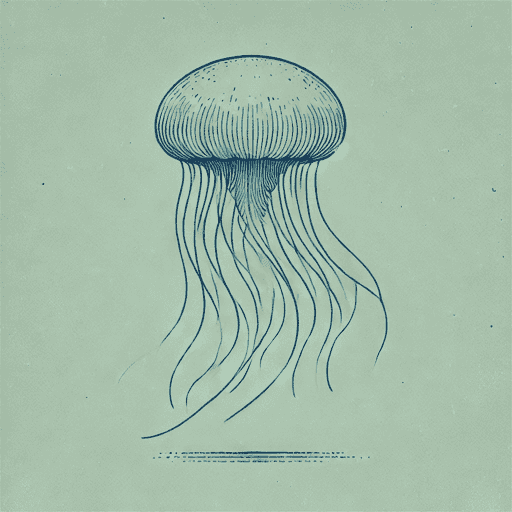
The interplay between the mythological Greek figure, Medusa, and the Spanish word for jellyfish, medusa, is an important symbol in the novel. The novel opens with a quote from Helene Cixous’s The Laugh of the Medusa, which is itself an argument for women to develop their own identities and modes of expression, while the Medusa Sofia envisions in the text is a feminine monster who expresses herself through rage and violence. As Ingrid calls Sofia a “monster,” Sofia grows to compare herself to the Medusa as a figure of independence and self-expression, interlocking with Sofia’s desire for personal growth and her sexual awakening.
At the same time, jellyfish, or medusas, play an integral role in instigating Sofia’s sexual and personal development, as she often compares medusa stings and her desire, saying she is “stung” with desire. Both Ingrid and Juan, Sofia’s eventual lovers, treat Sofia’s medusa stings, creating a cycle of getting stung, receiving treatment, and having sex. In the end, though, Sofia sustains the greatest number of stings while swimming to evade and investigate Rose walking on the beach, linking the stings to boldness in a more general sense and completing the link back to the Greek Medusa as a monster of self-expression.
The two forms of Medusa in the text unite to create a symbol of expression and self-interest, which guides Sofia’s development. Though swimming in the ocean when the Medusa flag is raised leads to pain, that pain is then connected to Sofia’s growth. Self-expression is not a complete freedom from suffering, but the medusas show how the suffering of self-expression brings its own reward of independence and fulfillment.
Sofia’s Laptop
Sofia’s laptop is a complex symbol in the text, as it represents Sofia’s life, her studies, and her difficult relationship with time and complacency. It also generates the motif of Sofia reflecting on the stars, which she looks at on her screensaver rather than in the night sky. The novel opens with Sofia saying that her laptop is broken, and “so am I” (1), but that it is not worth repairing because she would need to send it away. In this sense, Sofia is already on a trip to repair herself, even if the laptop will remain broken.
The laptop contains her unfinished thesis, which is a representation of her professional goals, which are put on hold to care for Rose. Sofia thus needs to repair herself to continue pursuing her own interests, and Rose is the obstacle standing in her way like the broken screen. Despite the damage to the screen, Sofia continues to use the laptop, as shown in her reading of Alexandra’s email, which layers this symbol with the imaginary, since the laptop is not truly broken beyond use.
The screensaver on the laptop serves as a separate symbol, though it is inevitably tied to the primary symbol of the laptop itself. The screensaver shows constellations, and Sofia mentions how thinking about or looking at these constellations often causes her to “slip” out of time. The constellations are a representation of her complacency in her life, in which she does not seek out real experiences, preferring to imagine them in her mind. The motif of Sofia comparing other sights and experiences to the constellations is a signal to the reader that Sofia is pausing her growth or returning to stagnation. For example, Sofia thinks about the constellations while having sex with Ingrid, marking how her relationship with Ingrid is not progress in and of itself. Instead, it is a steppingstone toward greater understanding.
Axes
There are two appearances of axes in the novel, with one being a physical axe and the other being ingrained in a simile for Rose and Sofia’s relationship. The physical axe is the axe Ingrid uses to kill the snake after having sex with Sofia. This action frightens Sofia and informs the relationship between Sofia and Medusa, whose hair is often depicted as being made of snakes. Ingrid beheads the snake, which symbolically threatens violence against Sofia. This relates to the connection between “Beloved,” the word Sofia thinks Ingrid embroidered in her shirt, and “Beheaded,” the word Ingrid actually embroidered. The axe is a symbol of the connection between these terms and the idea that love is intrinsically tied to suffering in the novel.
Sofia’s simile of her love for Rose and Rose’s love for her is: “My love for my mother is like an axe. It cuts very deep” (127), a phrase that Sofia repeats throughout the novel. In this simile, Sofia combines the strength and power of the axe with its usage as a weapon. Her love for Rose is strong, but it hurts her, just as Ingrid’s love for Sofia is embodied in a physical axe that kills the snake, a representation of Sofia. The axe, then, is a symbol of the double-sided nature of emotional attachment, in which one can enjoy the love of another person while also opening themselves up to the possibility of being hurt. Even though Ingrid loves Sofia, she hurts her to protect herself, just as she kills the snake. Likewise, Rose loves Sofia, but she hurts her to keep her from leaving. In each case, though the love is real, so too is the pain it causes.

Unlock the meaning behind every key symbol & motif
See how recurring imagery, objects, and ideas shape the narrative.
- Explore how the author builds meaning through symbolism
- Understand what symbols & motifs represent in the text
- Connect recurring ideas to themes, characters, and events