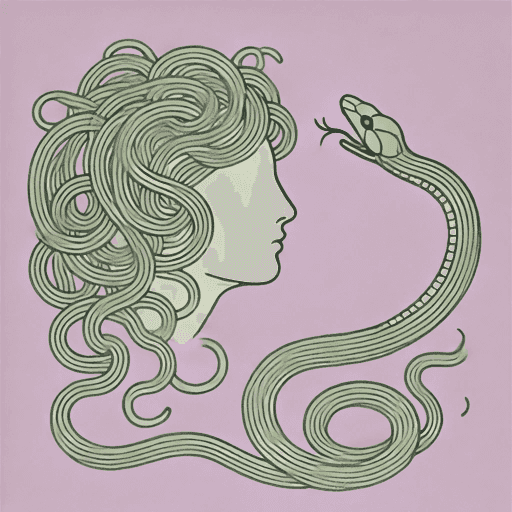
I, Medusa
66 pages • 2-hour read
Ayana GrayI, Medusa
A modern alternative to SparkNotes and CliffsNotes, SuperSummary offers high-quality Study Guides with detailed chapter summaries and analysis of major themes, characters, and more.
Background
Mythological Context: Medusa and Interpretations Across History
The oldest known written reference to Medusa is from Hesiod’s early ancient Greek poem Theogony (circa 700 BCE). In the poem, Medusa is one of the Gorgons, the three sisters whose terrifying gaze turns onlookers to stone. Since Medusa is the only mortal Gorgon, the hero Perseus is able to kill her. Most early versions of the Medusa story suggest Perseus was tasked by King Polydectes of Seriphus to fetch Medusa’s head. Perseus received help from the gods for his quest, with Athena gifting him a mirrored shield and Hades, his helmet of invisibility. The shield enabled Perseus to spot Medusa without looking her in the eye so he could decapitate her with the sword of Hephaestus. Medusa’s head was mounted on the shield of Athena, petrifying Athena’s enemies with her gaze.
Centuries later, the Roman poet Ovid gave Medusa a backstory in the Metamorphoses (circa 8 CE). Ovid describes how the beautiful Medusa became a monster: She was cursed by Minerva (the Roman version of Athena) after Neptune (Poseidon) raped her in Minerva’s temple. Ovid’s tale seems to show few qualms about depicting Medusa’s rape as her crime, yet the very fact that Perseus, in all accounts, kills Medusa while she sleeps, a less-than-heroic action, suggests the germ of an alternative narrative. Subsequent representations of Medusa see her as an apotropaic symbol—a symbol that can ward off evil. The smiling or screaming head of Medusa was often featured on vases, sculpture, art, and graves.
By the renaissance, Medusa’s backstory as a rape survivor was all but obscured. In art, she transitioned from an apotropaic symbol to the symbol of Perseus’s triumph. While in the classical tradition, the Gorgonian head was usually portrayed by itself, depictions during the Renaissance began to focus on Perseus, standing tall, holding aloft the decapitated head, as in Benvenuto Cellini’s sculpture, Perseus with the Head of Medusa. Cellini meant the sculpture as an allegory for Duke Francesco Medici “cutting off the head” of the republic, yet the representation clearly shows the need for male control of growing female power. The anarchical republic was displayed as a feminized entity that had to be tamed by male order. Over the next few centuries, Medusa began to represent unnatural or monstrous female power.
It was only in the second half of the 20th century that interest grew in Medusa’s backstory, with feminist scholars leading a deeper interrogation into the myth of Medusa. Medusa was increasingly seen as a symbol of female rage, her decapitation a means to silence a survivor of sexual violence. Folklorists like Maria Tatar return to the germs of the alternative narrative already present in the classical story. In “Double Trouble: Medusa and Embodied Paradoxes,” Tatar argues that Medusa’s very transformation into a monster is a vengeful response to the predatory male gaze. Able to turn men into stone, Medusa has the last laugh. Medusa is now seen as a powerful symbol of female rage and resistance. In I, Medusa, Gray gives Medusa narrative agency and explores how sexual violence operates as a tool of dominance, and how women continue to fight this attempt at disempowerment through asserting their agency and identity.
Literary Context: Feminist Retellings of Myths
I, Medusa joins the ranks of books like Margaret Atwood’s Penelopiad (2005) and Madeline Miller’s Circe (2018) in retelling the story of women from classical Greek myths. In the myths, these women are often marginal figures in male-centered narratives, playing out archetypes such as the monster or the patient lover. The retellings attempt to place them at the helm of their own lives, imagining the three-dimensional beings behind the archetypes.
In Circe, Miller reimagines the seductive sorceress of myth as a daughter exiled on an island when her burgeoning magical powers begin to threaten the gods. While in traditional versions, including Homer’s Odyssey, Circe’s brief episode ends when the hero Odysseus leaves her island, in Miller’s book, Circe’s life features many other experiences. Circe’s narrative in the novel ends with her reunion with her son Theogonus, an element Miller draws from the lost epic The Telegony.
As the example of Circe shows, feminist retellings often draw on alternative or forgotten sources which the mainstream tends to ignore. The retellings also focus on the underlying fear of female power that drives many popular myths. For instance, I, Medusa, shows how Poseidon “tames” Medusa’s growing female power by forcing her into sex. Feminist retellings further aim to wrest narrative agency from patriarchal myths. This reclamation is informed by second-wave feminism’s interest in reexamining the roles of women in myths, folklore, and fairy tales. In her famous essay “The Laugh of the Medusa,” French philosopher Helene Cixous argues for women telling the stories of female characters: “Woman must put herself into the text—as into the world and into history—by her own movement” (Cixous, Hélène, et al. “The Laugh of the Medusa.” Signs, vol. 1, no. 4, , pp. 875-93, 1976).
Thus, in I, Medusa, Gray gives a first-person voice to the woman patriarchy tries to disembody as a decapitated head, while in The Penelopiad, Atwood tells the story of the Odyssey from the point of view of Penelope, the wife of Odysseus. The novel also gives voice to the 12 of Penelope’s maids whom Odysseus killed upon his return home, examining why the maidens needed to be killed in the first place.

Unlock all 66 pages of this Study Guide
Get in-depth, chapter-by-chapter summaries and analysis from our literary experts.
- Grasp challenging concepts with clear, comprehensive explanations
- Revisit key plot points and ideas without rereading the book
- Share impressive insights in classes and book clubs