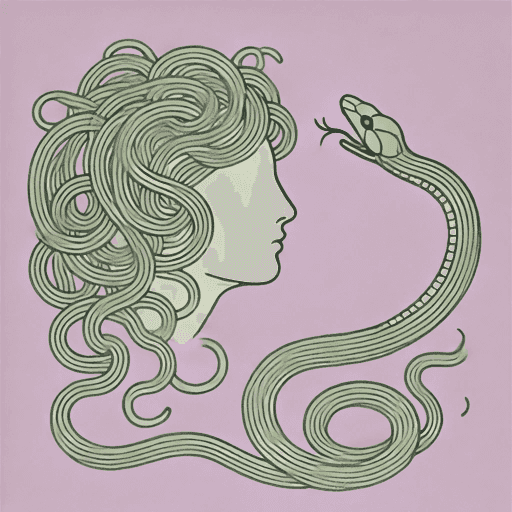
I, Medusa
66 pages • 2-hour read
Ayana GrayI, Medusa
A modern alternative to SparkNotes and CliffsNotes, SuperSummary offers high-quality Study Guides with detailed chapter summaries and analysis of major themes, characters, and more.
Important Quotes
Content Warning: This section contains direct textual quotes mentioning sexual assault, rape, violence against women, and child sexual abuse.
“‘Prince Maheer is a man with power, and men with power are always the first to be believed.’
I shake my head. ‘Stheno, what kind of man could do something like that?’
‘A cruel one,’ she says simply. ‘Then again, I’ve learned that most men are cruel. Some are just better at hiding it.’”
(Part 1, Chapter 3, Page 54)
These lines illustrate Stheno’s plain-spoken, canny estimation of the power dynamics of her society, introducing the theme of The Construction of Monstrosity to Silence Survivors. Stheno argues that Maheer hasn’t trained his lion with love, but subdued the captive animal through torture and by feeding it the meat of his enslaved men. Meddy only found it easier to accept Maheer’s version because society conditions people to unquestioningly believe powerful men. Stheno’s assertion about most men being “cruel” illustrates how violence against women is ubiquitous in Medusa’s world.
“‘How old are you, Medusa?’ His eyes are still trained on my loc.
‘Seventeen.’
I inch back just slightly, but he mirrors the movement.
[…] ‘So, you’re a woman,’ he murmurs. ‘Though I see your body isn’t fully developed yet.’
I take another step back.
‘You misunderstand.’ A smile touches his lips as he mirrors the move a second time. ‘It isn’t a bad thing. In fact, I prefer a woman’s body before it changes.’”
(Part 1, Chapter 5, Pages 72-73)
Maheer’s statements to Meddy show how some men prey on younger women and girls precisely because of their youth. Maheer attacks Meddy because he thinks he can get away with it, the extreme power imbalance between them reassuring him that Meddy will be too traumatized or afraid to speak up against him. His reasoning here reflects The Insidious Role of Manipulation in Power Dynamics, as he seeks to frame his attraction to Meddy as not a “bad thing,” as though his predatory behavior is normal.
“‘That’s the curious thing about monsters,’ she whispers. ‘The worst ones don’t bother hiding in the dark.’”
(Part 1, Chapter 8, Page 117)
Ceto’s statement to Medusa highlights the text’s preoccupation with The Construction of Monstrosity to Silence Survivors. She urges Medusa to consider that the most horrifying monsters derive their power from living in the mainstream, wearing the mask of propriety. Ceto’s allusion is to the Olympian gods, whose beauty hides their cruel nature.
“‘We were wondering…’ She gestures to the other acolytes as though she speaks for all of them. ‘Is your hair real, or is it a wig?’
I pause, confused. I’ve never been asked a question like that before. It seems so ludicrous that at first I wonder if she’s asked it in jest. I self-consciously roll one of my locs between my forefinger and thumb. ‘It’s mine,’ I say quietly. ‘It’s my hair.’ I make a point of tugging on the loc just slightly, so that she can see it’s attached to my scalp.”
(Part 2, Chapter 10, Page 140)
Kallisto turns her Eurocentric gaze upon Meddy’s locs, exoticizing and othering Meddy’s natural hair. Kallisto’s question is impolite and dehumanizing, an allusion to the real-world scrutiny of Black hairstyles. Kallisto deems Meddy’s hair a “wig” just because it is different from hers, exposing her own narrow-minded understanding of the world.
“A white owl is nestled within its dark green leaves […] Glaukopis. His round eyes wink in the night like golden coins, but what holds my attention is what is clutched in one of his talons. A garter snake hangs limp from it, dead.
‘Why?’ The word escapes me before I can stop it, and in my dream I do not question that I am speaking to an owl as though it can understand me. ‘Why did you kill it?’ […] Without warning, he opens his beak. A woman’s voice, low and sonorous, fills the air. It’s Athena’s voice.
You are my greatest disappointment.”
(Part 2, Chapter 13, Page 190)
An example of the use of foreshadowing, this passage is also replete with the text’s symbolism around owls. Owls in the text represent Athena and her wisdom, as well as the more problematic aspects of the Goddess. Here, in a dream sequence, Glaukopis, Athena’s owl, blames Medusa for the death of the garter snake. Medusa did not kill the snake, as the snake was seized and destroyed by a high priestess. Thus, Glaukopis’s warning foreshadows Athena’s propensity to blame the wrong person for a crime, just as she will do after Poseidon rapes Medusa. Athena’s claim in the dream that Medusa is her “greatest disappointment” also invokes The Insidious Role of Manipulation in Power Dynamics, as she uses emotional manipulation to keep Medusa hungry for her approval.
“Something in me snaps. I see a brief fear touch the boy’s face as I close the space between us and slap him as hard as I can. The force of the blow sends him reeling back, and my palm smarts in the place where it connected with his cheek. Beneath that pain, I feel the prickle of something else. It takes a beat for it to register that I feel satisfied, vindicated.”
(Part 2, Chapter 15, Page 210)
This passage highlights Meddy’s rage and her desire to seek retributive justice. When she spots an Athenian boy steal grain from a girl, Medusa punishes the boy by striking him. In Medusa’s mind, the boy becomes a representative of all male oppressors, making her keen to set him right. Meddy’s action suggests that she needs to learn to channelize her rage towards the true tyrants of her world, as here she is physically abusing someone smaller and weaker.
“I barely know this boy; a part of me realizes that the ease I feel around him is unwarranted. But when I look into his eyes, I see real concern in them, sincere interest. All I’ve held in breaks like a dam, and then I’m telling him everything.”
(Part 2, Chapter 15, Page 218)
Meddy’s growing trust in the Athenian young man shows The Insidious Role of Manipulation in Power Dynamics, as the young man is really Poseidon in disguise. The god uses his youthful disguise to build camaraderie with the teenage Meddy, posing before her as a kindred spirit. The boy’s youth and concern make Meddy invest him emotionally, sharing details with him she would never have with Poseidon in his grown-up sea-king form.
“Back home, the meals I was served were certainly grand, but in Athens, everything feels more vivid. My parents’ feasts were attended by immortal gods who dined and feasted as a pastime; the Athenians in these streets dance and sing and feast with an enthusiasm I’ve never seen before.
They live as though tomorrow isn’t promised, I realize.”
(Part 2, Chapter 17, Page 234)
Medusa’s affinity to Athens, Appolonia, and the wider world outside her island is linked with her mortality. In Athens, Medusa can finally find a counterpart for her own, ever-present sense of urgency, as other mortals have the same awareness of time. Though Medusa’s sisters love her, they cannot participate in her urgency because of their immortality.
“‘Mortals are like flowers,’ he murmurs […] ‘When a flower blooms, there is nothing more beautiful because it is real. We gods, we pretend to revel in our immortality, but the truth is most of us spend our eternities searching for just a glimpse of what a mortal feels: vitality, real and precious life. Never take that for granted, Medusa.’ I have no words to answer Poseidon’s. Never in my life has anyone—even Theo—made my mortality seem like something beautiful, something to be treasured and coveted.”
(Part 2, Chapter 18, Page 246)
Mortality is always on Medusa’s mind, particularly because it makes her different from the rest of her family. Poseidon, who is sharp at sensing a person’s insecurities, immediately guesses Medusa’s concerns around her mortality, and twists them to become her confidant. Poseidon’s praise of her mortality makes Meddy feel he is the sole person who truly treasures her, reflecting The Insidious Role of Manipulation in Power Dynamics.
“‘Apolonia has to accept a level of responsibility for what happened to her last night. She voluntarily confessed to Eupraxia that she’d been drinking heavily, that she was in the city alone at night at the time the soldiers found her […] She was all but asking for something to happen to her; she put herself in a compromising position. Does that make sense, Meddy?’
The truth is, it doesn’t make sense.”
(Part 3, Chapter 20, Page 271)
Appolonia’s rape is an example of how survivors are often blamed and shamed for sexual crimes, reflecting The Construction of Monstrosity to Silence Survivors. As Athena’s speech shows, part of the process of normalizing rape is blaming survivors for it. Athena frames the violent crime as a shared activity between Appolonia and the soldiers, and she decides that Appolonia was “asking” for violence by being out in the city. Meddy can see the logical inconsistencies in Athena’s argument, admitting to herself that the goddess’s interpretation of the crime is dangerous nonsense.
“‘But I don’t wish to speak about Apolonia anymore. Now, Medusa, I wish to speak about you […] I have been receiving reports from Eupraxia, updates on your progress here at the temple. I’m told you passed your second test rather memorably, and that you have shown a natural affinity for service to the people of the city.’
I smile, then feel guilty for it. A part of me isn’t ready to move on from Apolonia yet; I want to plead her case and try to convince Athena to reverse her decision. But there’s another, smaller part of me that relishes Athena’s praise, wants it to continue.”
(Part 3, Chapter 20, Page 272)
Like Poseidon, Athena also uses emotional manipulation to exploit Medusa, as evinced through this passage. Athena senses that Medusa does not buy her reasons for punishing Appolonia and quickly changes the subject to praising Medusa. Since Medusa “relishes Athena’s praise,” she becomes less likely to argue about Appolonia’s unjust treatment, reflecting The Insidious Role of Manipulation in Power Dynamics.
“‘There’s something I need to speak to you about.’ His gaze drops, and he looks abashed. “The other night, after I escorted you back to the Acropolis, we…’
‘I remember.’ My face warms.
‘I shouldn’t have kissed you […] But now there’s a more serious problem.’ Suddenly, he looks directly at me. ‘I haven’t been able to stop thinking about it […] The way I felt with you…’ He shakes his head and laughs, but it’s a humorless sound. ‘I don’t understand what you’ve done to me.’
Poseidon is the king of the sea; I am just the mortal daughter of two lowly sea gods. The idea that I might have any power or effect on someone like him thrills me, terrifies me, intrigues me.”
(Part 3, Chapter 22, Pages 299-300)
In this passage, Poseidon’s behavior illustrates The Insidious Role of Manipulation in Power Dynamics. Poseidon’s conversation with Medusa is a contrived performance, the god flitting through the roles of “abashed” suitor and helpless lover. He deliberately acts these parts to make Medusa believe he is as vulnerable as her, though the truth is that Poseidon is thousands of years old and one of three most powerful Olympian gods.
“‘Do you swear to be allegiant to me? Loyal, steadfast in your faith, and obedient?’
‘I do.’
‘And lastly.’ My candle’s light flickers in Athena’s silver eyes. ‘Do you swear to remain chaste, pure of mind, body, and spirit?’
Poseidon’s face crosses my mind, and I think briefly of the want I left in the halls of my palace just a few weeks ago. That want was real, powerful, but it paled in comparison to the want I have for this. When I speak, my voice is resolute. ‘I do. I swear it.’”
(Part 3, Chapter 23, Page 316)
While Medusa is infatuated with Poseidon—chiefly because of his constant manipulation of her—these lines show that her individual pursuit of becoming a priestess is more important for the young woman. Medusa clearly recognizes that her desire to be a priestess, forge a role away from her family, and do good by the people of Athens is too great to sacrifice for a passing fling. Medusa’s resolve makes Poseidon’s subsequent violation of her all the more terrible.
“‘You are a promising young woman, Medusa,’ she says warmly. ‘I have no doubt that you will do great things, but you must remember your place. It doesn’t do well for women to be too ambitious. Do you understand what I mean?’
I don’t. For the second time, Athena has said something I don’t understand at all, but I don’t admit that. I only bow my head. ‘Yes, Goddess.’”
(Part 3, Chapter 25, Page 336)
The text shows how Athena, like many other powerful people in the novel, is a master of doublespeak. She praises Medusa for her ambition and drive, yet also warns her against being “too ambitious.” In other words, Athena wants Medusa to be powerful, but only to the extent that suits the goddess. If Athena cannot use Medusa’s power, or if Medusa’s power threatens her own, it becomes a problem.
“‘You would dare,’ she says between her teeth, ‘you would dare touch one of my girls?’”
(Part 3, Chapter 27, Page 359)
Athena’s words after discovering Poseidon with Medusa are replete with selfishness. Athena does not blame Poseidon for hurting a young woman, but for “daring” to touch one of “her” girls. Thus, she sees Poseidon’s abuse of Medusa as a slight against her own authority. Medusa is no more than a possession or a weapon for the goddess.
“Poseidon does not grimace as he looks down at Athena. He does not even look angry. His expression is cool and indifferent; somehow, that is the most frightening thing. ‘You forget yourself, little niece,’ he says in a quiet voice. […] ‘You are a powerful goddess, perhaps the most powerful of them all. But you are no god; nor are you my equal. If you ever think to raise a hand to me again’—he yanks her to her feet so that their noses are mere inches apart—‘I will see to it that you are a virgin goddess no longer.’”
(Part 3, Chapter 27, Page 359)
Although Athena is not a sympathetic character in the novel, the text highlights that she, too, deals with male domination and violence. After Athena slaps Poseidon for raping Medusa, Poseidon twists the goddess’s arm and forces her to kneel, reminding her that she, a female, can never be his equal. He also threatens sexual violence against her, showing how his violent predatory behavior is a pattern.
“‘I don’t deny that I slept with the girl,’ he says lightly. ‘But as for ‘seduction,’ she was the one who courted me. I met her in Athens, and I knew she intended to become a priestess. My intention was only to do my duty in watching over her as a member of the Sea Court, but she grew increasingly interested in more carnal relations. Even when I cautioned her, she was…persistent.’ He smiles. ‘Tonight, I went for a stroll in the gardens, and she was there, drunk. She practically begged for me.’ I feel as though I’ve been plunged into cold water.”
(Part 3, Chapter 28, Page 365)
In these lines, Poseidon is emblematic of powerful male perpetrators who place the burden of sexual assault on their survivors, reflecting The Construction of Monstrosity to Silence Survivors. Poseidon lies smoothly because he is aware that people are only too eager to believe an influential male god like him. He reframes his assault of Medusa as her “seduction” of him. Just as Athena said about Appolonia, Poseidon claims Medusa was “asking” or “begging” for the crime. His words mirror real-world accounts and offer a sharp commentary on contemporary social norms that continue to normalize violence against women.
“I realize Euryale is right. Everything Poseidon did was deliberate. He methodically earned my trust, made me feel as though I was truly special to him. He lured me farther and farther away from the shore and into his depths until my toes couldn’t touch the bottom. And then he let me drown.”
(Part 4, Chapter 29, Page 379)
Medusa uses a marine analogy to describe Poseidon’s deception; the shore here stands for the truth, while Poseidon represents the treacherous sea. After Poseidon confuses Medusa’s perception of the truth by making her believe he can be trusted, he betrays her. Medusa “drowns” in his deceit. However, in narrative terms, Medusa’s “drowning” is a moment of rebirth, as it enables her to see that she was never to blame for Poseidon’s deception, now recognizing The Insidious Role of Manipulation in Power Dynamics.
“‘Your voice and your truth will never hold weight unless you also learn to hold power,’ says Euryale.
‘But I don’t know how to be powerful,’ I say in a small voice.
Stheno juts her chin, looking down her nose at me, and in that moment, she looks like a queen. ‘I’ll tell you this: Power is not given. It is taken.’”
(Part 4, Chapter 29, Page 382)
Sisterhood and female solidarity function as acts of resistance in the text, helping women to embrace Survival and Identity Forged Through Resistance. Medusa’s sister Stheno reminds her that women have to actively fight to change the world order. Those in power are loathe to give it away; therefore Meddy must claim power for herself.
“‘I don’t think this is good for you, Meddy,’ she says. ‘Every time you kill, a little less of you comes back. One day, it’s going to destroy you altogether.’
The words cut. I sit up and hug my knees to my chest. ‘This island is my home, Apolonia,’ I murmur. ‘It’s all my sisters and I have left. I have to help protect it.’
Apolonia’s eyes flash. ‘Is that what you want or what your sisters want?’
I find I can’t answer that question.”
(Part 4, Chapter 32, Page 417)
Appolonia and Medusa’s conversation investigates the limits of righteous rage. While the rage of the oppressed is rooted in injustice and seeks to dismantle unequal power structures, Appolonia wonders if anger can be self-destructive at the individual level. Medusa, and the novel, do not offer a convenient answer, encouraging readers to consider the power and limits of retributive justice.
“At last, I meet the great and powerful Ceto. White barnacles trace a line down her neck like a grotesque necklace; she doesn’t wear clothes. And her hair—the hair she so painstakingly cared for while she was on the island—now frames her face in a dark, wild mane that glitters with droplets of salt water […] [T]wo great finned beasts rise at her summons and charge at me. They are gray-skinned, muscular, and when one of them turns, I see a mouthful of dagger-sharp teeth. I feel them underneath my boat, and then it’s moving faster. It takes me a moment to understand. They are not attacking me: They are carrying me.”
(Part 4, Chapter 35, Page 439)
This passage highlights the text’s use of marine imagery to bring Medusa’s world to life. Drifting in the ocean, Medusa thinks she is hallucinating when she glimpses her mother Ceto in her primordial form. Ceto is unclothed and wild-haired, signifying primal female power, and one with the sea, garlanded by barnacles. She represents the benevolent aspect of the life-giving ocean, as opposed to Poseidon. Significantly, it is Ceto’s “monsters” who come to Meddy’s aid, once again establishing the dichotomy between perceived and actual monsters and speaking to Survival and Identity Forged Through Resistance.
“‘You wouldn’t serve me as a priestess,’ Athena continues. ‘But you would be something greater. The sick, the vile, the horrible people of this world, the ones who deserve violence. You and I could find them, punish them. You could leave this island again, see the world, and fight for a just cause.’
I cannot deny the appeal this idea holds. I hate Athena, but she knows me. She knows exactly what I’ve always wanted. Would it really be so hard, I wonder, to fall to my knees before the goddess of wisdom one last time?
But you would still serve, Stheno’s imaginary voice in my head says, and you would still be a tool.
My answer is instant. ‘No.’ I meet Athena’s gaze and hold it. ‘I want nothing else from you.’”
(Part 4, Chapter 35, Page 445)
The final conversation between Medusa and Athena marks the great evolution of Medusa’s character, invoking Survival and Identity Forged Through Resistance. Even though the goddess offers Medusa glory and purpose, Medusa rejects the offer, refusing to be a tool for Athena, and by extension, the dominant power structures of their world.
“‘You are not a monster,’ I murmur. I don’t know if the words are for the lion or for me. ‘You are only what they made you.’”
(Part 4, Chapter 35, Page 445)
Maheer’s lion is a key symbol in the text, representing Medusa and all other “monsters” of the text. Finally able to see the truth of the lion, Medusa meets the great beast as an equal, as a mirror-image. Her words here speak to The Construction of Monstrosity to Silence Survivors, as she recognizes how the “monstrous” nature of the lion has been cast upon it by those who abused it.
“I’m grateful now to know the truth, that the only person who can give me purpose is myself. As the world fades, I find myself wondering if perhaps purpose is not a single thing one finds, but rather a thing one finds over and over again.”
(Part 4, Chapter 35, Page 448)
As these lines show, the novel is also a coming-of-age tale, with Medusa reaching a crucial epiphany. She realizes that she alone can determine her purpose, rather than her sisters, Appolonia, or Athena. Medusa’s realization that the self is a complex being whose purpose and meaning are ever-evolving shows she has come a long way from the young woman of the first few chapters, speaking to Survival and Identity Forged Through Resistance.
“Men forget the terrors of the infamous Gorgons, and they are reduced to mere myth. Euryale and Stheno do not mind this. These days, they spend much of their immortality sitting on the island’s shoreline, basking in the sun. They always take care to save a place between them for their baby sister, the one men called Medusa, the one they simply called Meddy. They watch in silence as her true story is lost, as poets pen newer, more inventive ones. They listen as men give her new names—maiden, mistress, monster, legend. Stheno and Euryale understand that their sister is a myth now, and nothing at all like the girl they once knew. They do not mind. They remember her for who she truly was, and that is enough.”
(Epilogue, Page 453)
The novel’s concluding lines highlight how women can reclaim narrative agency from patriarchal myths, recognizing The Construction of Monstrosity to Silence Survivors. Stheno and Euryale preserve Medusa’s truth through their memory, a metaphor for the memory of all women who have been abused and silenced. By remembering women’s stories, and finding the stories buried in popular, male-centered myths, women can dismantle unequal realities, as I, Medusa is attempting to do.

Unlock every key quote and its meaning
Get 25 quotes with page numbers and clear analysis to help you reference, write, and discuss with confidence.
- Cite quotes accurately with exact page numbers
- Understand what each quote really means
- Strengthen your analysis in essays or discussions