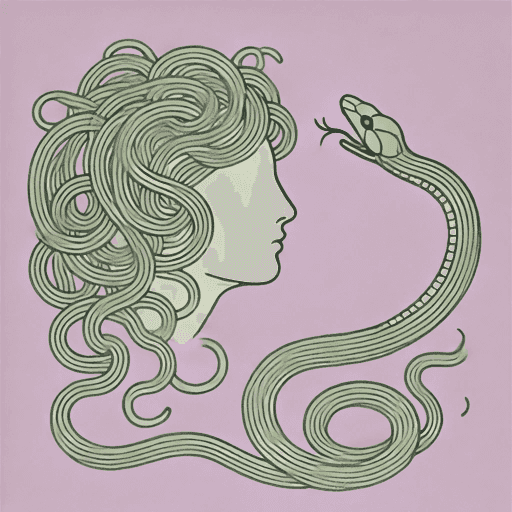
I, Medusa
66 pages • 2-hour read
Ayana GrayI, Medusa
A modern alternative to SparkNotes and CliffsNotes, SuperSummary offers high-quality Study Guides with detailed chapter summaries and analysis of major themes, characters, and more.
Character Analysis
Content Warning: This section contains discussion of rape and sexual harassment, domestic violence, emotional and physical abuse, child sexual abuse, racism, enslavement, gender discrimination, and pregnancy termination.
Medusa/Meddy
The protagonist and first-person narrator of the text, Medusa is 17 years old at the start of the main timeline. Medusa is affectionately called “Meddy” by her older sisters, Stheno and Euryale. Meddy is the daughter of the ancient sea-gods Phorcys and Ceto, but Medusa is the only one in her family who is a mortal. She has “wide-set brown eyes” (13), brown skin, and beautiful thick black locs. Although Meddy considers herself less beautiful than her sisters, it is clear she has a striking appearance. Meddy’s mortality bothers her, since it sets her apart from the rest of her family. She is keenly aware of the passage of time, which gives her actions a sense of urgency. Meddy’s humanity also makes her empathetic towards mortals, such as Theo, her best friend in her father’s palace.
Early in the novel, Meddy has a sheltered perspective, having limited knowledge of the world outside her island and knowing nothing about sex. However, she also possesses a clear-eyed sense of right and wrong. Meddy is quick to notice the injustices around her, which other adults accept as a given, such as her father describing her and her sisters to suitors as “a trio of nanny goats” (49). One of Meddy’s most defining characteristics is her righteous rage at the deeply patriarchal, misogynistic world she lives in. She attributes her enraged defense of the survivors of this world to her experience witnessing Phorcys’s domestic violence against Ceto.
Meddy is a dynamic character whose internal evolution keeps step with her dramatic physical transformation. Over the course of the narrative, the goddess Athena senses Meddy’s dynamism, intelligence, and female rage, which she terms “beautiful,” and invites her to train as a priestess at her temple. Although the young Meddy cannot see through Athena’s motives, it is clear the goddess plans to use Meddy as a weapon. Poseidon, the chief god of the sea, senses a spark in Meddy as well. His manipulation and seduction of Meddy symbolizes male power trying to drown female agency. After Poseidon rapes Meddy and Athena curses her, Meddy falls to the depths of despair. She must now forge a new sense of self, having realized the truth about Poseidon and Athena.
The transformation from mortal to so-called monster involves Meddy accepting her true nature and acting in accordance with it. She learns to control her gaze and the snakes that spring from her head. Although she is ambivalent about indiscriminate killing, she knows killing is necessary for her survival. When Appolonia asks Meddy not to punish the temple priest, a sorrowful Meddy accepts that she must defy her beloved Appolonia and act in accordance with her truest self. Unable to bear the priest’s exploitation of young women, Meddy unleashes her wrath against him.
At the end of her first-person narrative, Meddy is back with Stheno and Euryale, “excited to learn [her] next purpose” (448), ready to move on from the monster stage. The novel deliberately ends Meddy’s telling on this hopeful note so her character can reclaim narrative agency. The Epilogue commits Meddy’s real story to the immortal, endless memory of her sisters, ensuring the legend of Meddy lives on, growing larger than reductive labels.
Stheno
In Greek mythology, Stheno is the eldest of the three Gorgons, sisters who had snakes for hair and could turn people to stone with their gaze. After Perseus beheaded Medusa, Stheno and Euryale chased him in anger, but could not catch him as he was aided by the Olympian Gods. In the novel, as in most traditional accounts, the Gorgons are the daughters of Phorcys and Ceto. While traditional accounts of Stheno do not offer more backstory, the novel reimagines her as brave and plain-spoken, distinguished by her candor. Medusa describes Stheno as a beautiful 21-year-old young women, “tall, supple, and fine-featured”, sharing with her sisters “the same dark, sun-blazed skin” (13).
Stheno shows a keen understanding of the power dynamics in her world, using her knowledge as a tool for survival. When Medusa romanticizes Maheer’s control of the lion, Stheno encourages Medusa to ask how the lion survived on its long sea voyage. She nudges Medusa to see how the prince has been feeding his enslaved men to the lions. Stheno rightly predicts that Maheer’s cruelty to his servants is a precursor to his cruelty against Euryale. The flip side of her clear-eyed assessment of the world is that Stheno sometimes tends to be cynical. When Medusa protests that Euryale cannot be left to her fate, Stheno reminds her that Euryale “was our sister […] Now she is Maheer’s bride-to-be” (55).
At the same time, Stheno, along with Euryale, rebels against Athena after the goddess curses Medusa, receiving a similar punishment. Their defiance shows how love for Meddy awakens the sisters’ rage. In the novel’s final section, Stheno begins to combine her pragmatism with action, her physical transformation triggering the evolution of her character.
Euryale
Euryale, Medusa’s second-oldest sister, is also an immortal. Euryale is 19 years old at the start of the novel and longs to get away from their island. It is implied Euryale is often at the receiving end of her father and mother’s rage for intervening on behalf of her sisters. In an early sequence, Ceto hits Euryale on the mouth with a wine goblet for interrupting her, drawing golden blood (ichor) from Euryale. Euryale simmers in anger against the injustice, viewing an impending marriage as an escape from the oppressive environment at home.
More emotive than the reserved Stheno, Euryale is enraged at Meddy for stopping her arranged marriage with Maheer, but Euryale does not let the anger influence her affection for her younger sister, showing that Euryale’s love is unconditional. After Euryale discovers Meddy’s body in the Epilogue, she weeps so loudly that the walls crack, indicating the intensity of her feelings for Medusa. The shared love between the sisters is suggested in ancient accounts of the Medusa story, where Stheno and Euryale give chase to Perseus for beheading Medusa. Thus, Euryale, along with Stheno, symbolizes the redemptive power of sisterhood and female solidarity.
Athena
An antagonistic figure in the novel, Athena is a complex character who represents female rage. However, unlike Meddy, Athena often directs her rage against other women, thus becoming a tool for patriarchal systems.
Athena is fair-skinned and beautiful, though she does not affect extreme youth. Appearing as a woman in her forties or fifties, Athena has braided long red hair, an elegant demeanor, and gray eyes. Like Poseidon, Athena radiates power and authority. Initially appearing as the epitome of wisdom and justice, Athena soon reveals she has little empathy for mortals. She admires Meddy because she sees a potential weapon in her. When Meddy breaks Athena’s rules, Athena turns cold and angry, revealing how Athena can swiftly move from affection to rage without warning.
Although Athena is a powerful female god, the most problematic aspect of her behavior is her inconsistent support of women. Though she tells Meddy that the rage of women is a beautiful thing, she does not allow women like Meddy and Appolonia to show rage the way they desire. She victim-blames Appolonia and Meddy, upholding patriarchal double standards around sexual assault. Athena’s troubling attitude to mortal women is also rooted in her insistence on chastity to carve her place in a patriarchal pantheon. However, the text does not justify Athena’s actions, inviting the reader to reflect on how some women ally with unfair systems for personal gain.
Athena’s treatment of Meddy after she discovers her with Poseidon paints her in a particularly negative light. Athena does not even consider the possibility that Meddy may have been raped, even though Poseidon threatens Athena with rape as well. Instead, she drags her to the banquet hall by her hair and refers to her as a “whore” (364). She curses Medusa for Poseidon’s crime, transforming her into a “monster,” and later tries to coopt the same monster for her own benefit. Athena’s warning to Medusa for refusing her offer shows Athena is a static character who refuses to evolve over the course of the narrative.
Poseidon
The chief antagonist of the novel, Poseidon is an Olympian god, thousands of years old. Greco-Roman mythology describes Poseidon as one of the three most powerful Olympian gods, along with his brothers Zeus and Hades. He is often depicted as holding a trident. In the novel, Poseidon is tall and lean, with sun-bronzed skin, green-gold eyes, and thick black hair. It is clear that Poseidon weaponizes his beauty and charisma to lure women, with Meddy feeling her “bones hum” (27) the moment she studies Poseidon.
While Poseidon has natural allure and a striking presence, his physicality is a mask for his cruel nature. Theo warns Meddy that Poseidon sends floods and quakes to cities that defy him—an allusion to mythology in which Poseidon flooded Athens after the city chose Athena as their patron goddess. Further, Poseidon also chases women as prizes, losing interest in them after he has had sex with them, just as he did with his wife Amphitrite.
Central to the text’s theme of The Insidious Role of Manipulation in Power Dynamics, Poseidon uses his strength, magic, and maturity to make Medusa emotionally dependent on him. The fact that he first appears to Medusa as a boy her own age shows his shrewdness: Poseidon knows Medusa is unlikely to let her guard down before him in his sea-king form. Therefore, he appears to her as a mortal boy, someone on similar footing to Meddy. It is only after he has won Medusa’s confidence that Poseidon reveals himself. Poseidon also uses magic to manipulate Medusa, not only disguising his true appearance, but also creating “miracles” on Medusa’s behalf to impress her. Poseidon’s emotionally manipulative actions constitute a performance, with him playing the part of a helpless lover, a suffering husband, and a tragic king before her.
Apart from deceit, Poseidon also uses emotional blackmail to confuse Medusa. He abruptly withdraws his affection from Medusa after she resists his advances in Athens. The alienation ensures Meddy pines for Poseidon and blames herself for his departure. Poseidon’s return is equally calculated: He visits Meddy’s island when he knows she is drunk on heady Olympian wine and vulnerable. He rapes Medusa, then blames her for the attack, dropping his mask of friendship. Thus, Poseidon is a static character in the novel with few redeeming qualities, undergoing little change. He signifies brutal masculine power. The fact that he threatens Athena, his niece, with rape shows the extent of Poseidon’s will to rob women of agency. Like many other males in the novel, Poseidon uses sexual violence to suppress and silence women.
Appolonia
Appolonia is Medusa’s friend and later lover, representing the cathartic power of love and female solidarity. With dark hair and golden skin, Appolonia is graceful, reminding Meddy of Athena herself. From the very onset, Appolonia is marked by a quiet power and deep empathy, coming to Medusa’s aid when Medusa is being bullied by the other acolytes. Appolonia acts as a foil for Medusa, her gentleness contrasting with Meddy’s rage. While Appolonia recognizes the injustice in the world around her, she shuns violence. Meddy and Appolonia remain unreconciled on their stance on violence, since Meddy believes that righteous rage is sometimes necessary to purge a rotten system.
Appolonia is a rape survivor in the novel, with her experiences showing the grim reality of the universe she inhabits. The rape, her banishment from the temple and her family, and her sexual enslavement on Sobekemsaf’s ship leave her with trauma, as she has trouble sleeping when she arrives at the island. Despite her experiences, Appolonia’s continued insistence on non-violence is an act of resistance. She displays her power by asserting her strong, individual views. While Meddy and Appolonia are eventually forced to separate, their friendship and romance acts as a brief sanctuary for both characters, providing them with hope for the future.
Theo
Theo is Medusa’s best friend at her island, and is an enslaved worker at the palace. Brown-skinned with curly black hair, Theo looks “as though he’s stolen some piece of the sun and locked it deep in his chest” (19). Theo is often depicted working with the earth, thus associating him with nurture and truth. He smells of the garden, his physical presence comforting Medusa. Theo represents a connection to Meddy’s rawest, childlike self. Like Medusa, Theo dreams of leaving their island to see the larger world. He shares Medusa’s love of scrolls and maps, as well as her sensitivity to injustice.
Along with Appolonia, Theo functions as the voice of Meddy’s conscience in the novel. Even as Meddy briefly loses sight of the truth, Theo continues to function as a reminder of reality. He often makes Meddy face uncomfortable facts, such as when he describes Athena’s treatment of Appolonia as “cruel […] awful” (292). When he senses Meddy’s infatuation with Poseidon, Theo reminds her that the god’s “charm is all for show” (304). Not yet ready to face the truth, Meddy turns away from Theo. However, he continues to hold unconditional love for her, distinguishing him from men like Phorcys and Poseidon.
Theo and Medusa reconcile before their respective transformations, and Theo is the first person who offers Meddy help after Athena has cursed her. Theo’s transformation into a stone statue represents a sacrifice for the sake of friendship.
Phorcys
Phorcys is Meddy’s father. He dresses to project an aura of grandeur, often wearing rich purple robes and golden rings. However, Meddy notes that even though Phorcys owns a palace and maintains a court on their island, the primordial sea deity is no longer a king. Since his powers have been lost to Poseidon, Phorcys now curries favor with the Olympians, knowing he cannot afford to rebel against them. Phorcys behaves like a tyrant in the domestic sphere, abusing his wife and daughters.
Phorcys also considers his daughters as little else than possessions. He wants to marry them off to his advantage, and parades them before potential suitors as if they were cattle. When Maheer chooses Euryale as a bride, Phorcys does not even think of asking for Euryale’s consent. His attitude reflects the patriarchal sociocultural norms of his time. Meddy knows her father’s deep cruelty, yet also yearns for his affection. Her expectations are dashed when Phorcys excoriates her for not praising him to Athena. Despite Phorcys’s cruelty, he is not the worst father-figure in the novel: Meddy notes that despite her parents’ apathy, she can always return to her island, unlike Appolonia, who is cast out brutally by her father.
Ceto
Ceto is Meddy’s mother and a sea-goddess who predates the Olympians. Having lost her powers since the rise of the younger pantheon, Ceto is now a minor deity. In mythology, Ceto was the daughter of the earth mother Gaia and her son, Pontus. Married to her brother, Phorcys, Ceto gave birth to many “monstrous” children, including the Gorgons. In the novel, Ceto is “the goddess of all the ocean’s monsters and notorious for her collection of murderous sea pets” (30). The association with monsters paints Ceto as a character on the margins of society, who understands that monsters are created so others can be declared heroes. It is Ceto who warns Medusa against the Olympians, reminding her that the most frightening monsters live in the open.
Ceto is thousands of years old, though like most gods she assumes the appearance of youth. Ceto is abusive toward her daughters, often punishing them if they speak against her. The text suggests Ceto’s mercurial temperament is exacerbated by the loss of her oldest children, and the domestic violence she experiences. Unlike Phorcys, Ceto bristles at having to bow to the Olympians. Phorcys punishes her resistance by beating her up viciously in front of her children. Meddy recalls Phorcys’s violence against Ceto being a recurrent feature of her childhood.
Throughout the novel, Ceto continues to resist Phorcys in different ways, such as through her affinity for the sea’s monsters. Although the Olympian patriarchal order tries to suppress an older, matriarchal reality—represented by Ceto—the reality continues to assert itself in unexpected ways.

Unlock analysis of every major character
Get a detailed breakdown of each character’s role, motivations, and development.
- Explore in-depth profiles for every important character
- Trace character arcs, turning points, and relationships
- Connect characters to key themes and plot points