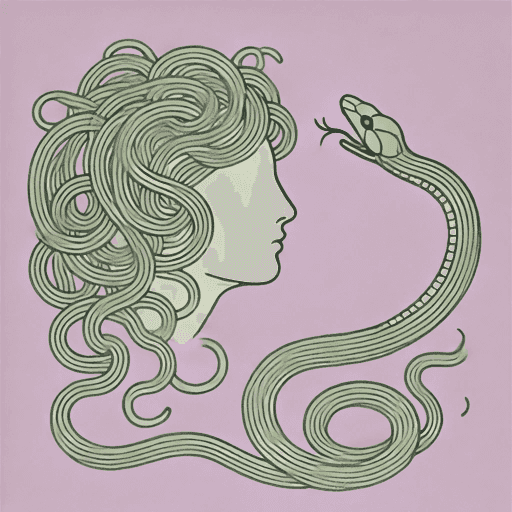
I, Medusa
66 pages • 2-hour read
Ayana GrayI, Medusa
A modern alternative to SparkNotes and CliffsNotes, SuperSummary offers high-quality Study Guides with detailed chapter summaries and analysis of major themes, characters, and more.
Part 2Chapter Summaries & Analyses
Content Warning: This section contains discussion of bullying, racism, sexual harassment and assault, sexual content and physical abuse.
Part 2: “Maiden”
Part 2, Chapter 10 Summary
As Meddy flies thousands of nautical miles to reach the bustling city of Athens, she is awestruck by the crowds milling below. Hermes deposits Meddy at the base of the hill leading up to the Acropolis, the grand group of marble structures in which the Temple of Athena is located. Meddy makes the long climb. Euphraxia, a high priestess in her sixties, scolds Meddy for being late. Euphraxia asks Meddy to go to the acolytes’ quarters and change, removing all adornments, including the golden cuffs Stheno and Euryale braided in her locs.
In the spare quarters, Meddy is accosted by a blonde, fair-skinned acolyte called Kallisto. Kallisto asks Meddy if her hair is “real,” touching Meddy’s hair without her permission. Meddy recoils at being treated like an oddity and tells Kallisto not to touch her. Kallisto turns hostile, telling Meddy she is a “metic”—a foreigner—who smells. Apolonia, another young acolyte, asks Kallisto to leave Meddy alone: Meddy has every right to be in the temple, as rumor says she was chosen by Athena herself. After Kallisto leaves in a huff, Apolonia tells Meddy that most of the acolytes belong to old families in Athens who offer their daughters to the service of the Goddess. Meddy is the rare acolyte visited by the Goddess.
The first test is held the next morning, with the acolytes administered Tacetaqua, a silencing potion crafted by Apollo. The antidote for the potion will be given after the hourglass-timed challenge ends. The challenge is to write down the solution to the riddle: “Men may give and take me, yet I consume them all. Who am I?” (154)
Part 2, Chapter 11 Summary
The purpose of the silencing potion is to eliminate cheating. Meddy watches in panic as Kallisto finishes her answer and deposits her chit with the high priestesses. Meddy’s mind ricochets between options such as love, knowledge, and death till she has the epiphany that the correct answer to the riddle is “time.” As she walks to submit her chit, she can see Appolonia in despair, unable to solve the riddle. Meddy knows that Apolonia will be sent home if she fails the text. Meddy pretends to knock over the hourglass so she can straighten it, conveying with a meaningful glance the right answer to a watching Appolonia.
The trick works. Appolonia and Meddy are amongst the six acolytes who will move onto the next round. Kallisto passes as well. After the antidote is administered, Appolonia thanks Meddy profusely.
Part 2, Chapter 12 Summary
A week passes before the next test. In the meanwhile, the acolytes are given a series of relentless chores around the temple, much to their chagrin. One day, Meddy and Appolonia are assigned to clean the barn housing the temple’s animals. Working alongside Meddy, Appolonia shares that she is from a wealthy family in Athens, with three older brothers slated to be senators. Appolonia fears that her father will not take her back if she fails to become a priestess.
Meddy feels a stab of pity since she knows she will always be allowed to return to her island. Her thoughts are interrupted when she notices an owl staring at her: Glaukopis, the emblem of Athena. Glaukopis takes to Meddy, perching on her arm. Just then, Kallisto arrives in the barn and taunts Meddy for talking to a bird. Kallisto tries to get Glaukopis to come to her, rattling the owl. Glaukopis flies out of the barn. A panicked Kallisto flees.
Meddy tells Appolonia they must find Glaukopis, now loose in Athens, before the priestesses discover the owl is missing. Appolonia is reluctant to exit the temple without permission but agrees. Meddy and Appolonia veil themselves and roam the streets of Athens, looking for Glaukopis. Meddy gets separated from Appolonia and runs into trouble when she knocks down a farmer’s produce, the farmer demanding Meddy pay her back.
A handsome young man around Meddy’s age appears on the scene and pays the farmer. Recognizing Meddy as an acolyte, the youth offers to help her, directing her to a grove where Glaukopis might be resting. To her relief, Meddy finds Glaukopis, but the young man has left. Meddy reunites with Appolonia and the young women return to the Acropolis. Just when Meddy is alone, she is confronted by Athena.
Part 2, Chapter 13 Summary
Barely resembling her warm self at the island, Athena coldly reprimands Meddy for breaking the rules of her temple and straying into the city. Meddy bows before the Goddess, promising never to repeat her mistake. Athena finally forgives Meddy and softens, asking the younger woman what she thought of Athens. Meddy replies that she loves Athens for its constant movement and changes. Athena is pleased at the answer. She compliments Meddy for her perceptiveness, telling her she sees herself in Meddy.
After Athena dismisses her, Meddy joins the acolytes. Led by the high priestesses, the group takes a walk along the periphery of the Acropolis, looking into the torch-illuminated city below. Enjoying the view, Meddy recalls the kind boy who helped her, wondering why she did not get his name. Just then, Kallisto sneakily throws a rock at Meddy. Meddy quells her anger, not wanting to cause a scene and risk displeasing Athena further.
Later, she finds a non-venomous garter snake and hides it in her chiton. At bedtime, Meddy slips the snake into Kallisto’s pallet. Kallisto gets up, screaming in fright. Euphraxia kills the creature with a rock and scolds Kallisto for creating a ruckus over a harmless snake. Meddy is seized with guilt, and has a dream where Athena calls Meddy her “greatest disappointment” (194).
Part 2, Chapter 14 Summary
For the second test, Euphraxia asks each acolyte to craft a handiwork in Athena’s honor. Meddy’s spirits plummet since she does not know how to sew, weave, or embroider. She confides her dilemma in Appolonia, who offers to weave a basket for Meddy. Meddy rejects the offer, as Appolonia may get caught for cheating. As she watches Appolonia craft her own basket, Meddy is reminded of her sisters braiding her locs. She is struck by an idea and gathers oil and beads. Meddy weaves her locs in an intricate hairdo.
After their assigned time is over, the priestesses come over to judge the craftwork of the acolytes. Appolonia’s basket and Kallisto’s embroidery receive favorable votes. When Meddy turns around and reveals her craftwork is her own hair, woven into the shape of an intricate basket, the priestesses are taken aback. Euphraxia praises Meddy’s unusual choice and passes her. Kallisto argues that hair-braiding is not a craft, but Euphraxia informs her that braiding is one of the oldest crafts in existence.
Part 2, Chapter 15 Summary
After the second test, the acolytes slip back into their routine of chores. One day, Euphraxia and the other priestesses take the acolytes to Athens to hand food to the needy. Euphraxia assures the acolytes that, as servants of the temple, they are well-respected in the city. Meddy does not tell Euphraxia that she has already been to Athens.
Once they are in the throng, the priestesses ask the people to form neat lines so they can receive fruit, bread, and grain. Meddy feels a sense of purpose as she passes sacks of food to impoverished-looking people, including a young girl. The acolytes head back to the Acropolis hours later, pleased with their work.
Appolonia tells Meddy the story of Athens. Legend says both Poseidon and Athena wanted to be patrons of the great city, when Zeus decided to settle the conflict with a test. Poseidon planted his trident in the soil of Athens and a fountain burst forth, meant to give succor to the people. However, its water was salty. Athena planted a seed from which grew a shady, fruit-bearing olive tree. She was declared the victor and the city became hers.
As Appolonia concludes her tale, Meddy notices the young girl to whom she gave a sack of food. An older boy has snatched the sack from the desperate child. Meddy is seized with anger and slaps the boy hard. Appolonia restrains Meddy as the children run off. Displeased by Meddy’s behavior, Appolonia tells her that acolytes are meant to serve the people, not to correct them. Meddy feels wounded by Appolonia’s words and turns back into the city. Soon, Meddy finds herself in an unfamiliar alley. Worrying about being late to the Acropolis, Meddy runs again into the young man who helped her earlier.
The young man offers to walk Meddy back to the Acropolis. He and Meddy fall into an easy conversation, Meddy revealing her fight with Appolonia. The young man tells Meddy she did nothing wrong; sometimes violence is necessary to achieve good ends. Meddy feels gratified. After she bids the boy goodbye, Meddy meets Appolonia. The two young women come to a truce.
Part 2, Chapter 16 Summary
Two weeks later, the acolytes head into Athens again to witness the celebrations of Panathenaia, the most important festival of the city, held in honor of Athena. Meddy is most excited about watching the chariot races at the Panathenaic Stadium. She and Appolonia sit on a grassy knoll, watching the bloody but exhilarating contests play out.
During a break, the young women go closer to the track to greet the next riders. One of the charioteers, whose name is Kallinikos, tells Meddy that he is not favored to win the race, and asks her to pray to Athena on his behalf. Meddy agrees and fervently prays to Athena during the race. Kallinikos nearly loses, till an owl flies out of nowhere and hits his opponent in the face, giving Kallinikos a final edge. A victorious Kallinikos credits his victory to Meddy’s blessings.
After the races, Appolonia suggests she and Meddy stay back in Athens for the night’s celebrations. Since revelry is permitted for everyone during Panathenaia, the acolytes will not be reprimanded. Meddy agrees.
Part 2, Chapter 17 Summary
Appolonia and Meddy join the street festivities in Athens, dancing among the crowds in the streets. Soon, they are joined by three young men who offer them strong wine. The young women drink, Meddy soon feeling woozy. She asks for directions to the public latrines to relieve herself, leaving Appolonia in the company of the young men, whom she feels she can trust.
Outside the latrines, Meddy is accosted by an older man who first pesters her for drachmas and then grabs her forcibly. As Meddy tries to fight loose, her friend, the boy, arrives in the alley, demanding that the older man release Meddy. When the man refuses, there is a flash of light. In place of the young man is none other than Poseidon. The man releases Meddy and runs away.
Poseidon comes close to Medusa and touches her gently, offering to take her back to the temple. When Medusa refers to him as “my king,” Poseidon asks her to call him by his name.
Part 2, Chapter 18 Summary
On their walk up to the Acropolis, Poseidon reveals that he assumed the form of the mortal boy to keep an eye on Medusa. Poseidon feels a responsibility towards Medusa, a member of the Sea Court. He calls Meddy’s performance in the acolyte tests “impressive,” making Meddy’s heart flutter. Meddy feels special to be appreciated by such a powerful being.
Outside the gates of the Acropolis, Poseidon kisses Meddy, flooding her with desire, then bids her goodbye. An ecstatic Meddy returns to the acolytes’ quarters. Imagining Poseidon touching her, Meddy brings herself to a climax.
Part 2 Analysis
As “Maiden,” the title of Part 2 suggests, each section of the book explores a single stereotype or label applied to Medusa, drawing attention to The Construction of Monstrosity to Silence Survivors through the parallel construction of sexual “purity.” The Maiden is an archetype of the pious, virginal young woman who derives her power from her sexual chastity. Athena herself is a maiden, as are the high priestesses of her temple. Though the position of Maiden initially seems liberating to Meddy, since it frees her from the expectations of an arranged marriage, it proves to be as much of a cage as the role of “mortal” which she played in Part 1.
The most problematic aspect of the Maiden archetype is its conflation of purity with chastity. The Maiden is expected to disown her sexuality, thus robbing her of sexual desire and agency. Worse, chastity becomes the woman’s responsibility, ignoring the threat of sexual violence and coercion that the young women face. Meddy feels the confusion between her human and Maiden selves when she considers her burgeoning relationship with Poseidon. As an acolyte, she is not supposed to have feelings for a man, but her sexual self asserts itself. The confusion between these two selves causes Meddy to hide her encounters with the youth even from Appolonia, the secrecy further heightening her isolation and pushing her towards Poseidon.
Meddy’s first-person telling inadvertently reveals how she is being manipulated by authority figures like Athena and Poseidon, reflecting The Insidious Role of Manipulation in Power Dynamics. When Poseidon reveals his true identity to Medusa, the text clearly establishes his deceit as problematic, but Meddy cannot fully understand the troubling aspects of Poseidon’s behavior at this point. A similar movement happens with Athena, with the goddess alternating between approval and harsh reprimands to confuse Medusa. Meddy is so keen to win back Athena’s affection that she does not register the calculated manner in which Athena wields her emotions. The novel does not judge Medusa’s character for her perceptions of Poseidon and Athena; rather, it shows how Medusa hopes to please both authority figures and is too young and inexperienced to spot troublesome patterns. Meanwhile, Poseidon uses his power to deceive Medusa, such as by transforming into a youth or pretending to hunt for Glaukopis with her while already knowing the owl’s whereabouts.
While Poseidon and Athena manipulate Medusa, she begins to assert her selfhood in other areas, illustrating the theme of Survival and Identity Forged Through Resistance. For example, she stands up to Kallisto after Kallisto touches her hair without permission, and displays greater confidence and curiosity in figuring out how to pass the acolyte tests. This section also develops the idea of female rage, establishing the creative and destructive aspects of Meddy’s anger. As Meddy explains to Appolonia, her rage is informed by her father’s abusive treatment of her mother, invoking rage against male oppression. Unlike male rage, which is recognized and even celebrated, female rage is an underground current, with women denied the vocabulary to articulate it. Robbed of the right vocabulary, women turn their rage against themselves or against other women, as in the case of Kallisto. Meddy’s rage, however, is clear and rightfully directed. However, as Appolonia points out, the rage alienates Meddy from her own humanity. Therefore, she must learn how to harness it.
Animal symbolism dominates these chapters, with Glaukopis the owl representing both the wisdom and cruelty of Athena’s gaze. In the barn, Glaukopis’s yellow eyes seem a beacon to Meddy. However, the eyes of wisdom can also turn pitiless and intrusive, as will happen in latter sections of the novel. The black garter snake that Meddy introduces in Kallisto’s bed symbolizes the uncontrolled nature of Meddy’s rage. Only when she begins to control her power will the rage turn fruitful. The snake also foreshadows Meddy’s transformation into a supposed “monster” with serpents for hair.

Unlock all 66 pages of this Study Guide
Get in-depth, chapter-by-chapter summaries and analysis from our literary experts.
- Grasp challenging concepts with clear, comprehensive explanations
- Revisit key plot points and ideas without rereading the book
- Share impressive insights in classes and book clubs